
The most critical factor in your long-term surgical success isn’t just what happens in the operating theatre; it’s the specific actions you take during the first 1,008 hours after you head home. You’re likely feeling a mix of relief and a nagging worry about every new twinge or the risk of a recurrence while you’re sidelined from your active Brisbane lifestyle. It’s frustrating when your mind is ready to work, but your body needs to heal. At Brisbane Hernia Clinic, we prioritise a “rapid assessment and rapid treatment” model. This streamlined pathway allows you to see Dr. Watson without a referral before being directed to surgery with A/Prof Hugh McGregor, one of Australia’s leading hernia surgeons.
We’ve developed this guide to provide a medically-vetted open hernia repair recovery week by week roadmap to remove the uncertainty from your healing journey. You’ll learn exactly when you can expect a 70% reduction in surgical discomfort, the specific milestones for returning to the gym, and how to tell “normal” sensations from something that requires our clinical attention. This structured guide ensures you move from post-op anxiety to a full, confident restoration of your quality of life by following a logical and safe recovery path.
Key Takeaways
- Gain confidence in managing the first 48 hours at home, including how to differentiate between normal post-operative inflammation and potential warning signs.
- Navigate a medically-vetted roadmap for open hernia repair recovery week by week, from initial pain management to the critical six-week milestone for mesh stability.
- Learn the safe progression of physical activity, including specific lifting limits and how to interpret the common “tugging” sensation as your body heals.
- Discover how the Brisbane Hernia clinic’s “rapid assessment and rapid treatment” approach minimizes tissue trauma and accelerates your return to daily life.
- Access expert care from A/Prof Hugh McGregor, one of Australia’s leading hernia surgeons, via our streamlined pathway that allows you to see Dr. Watson without a referral.
Week 1: The Foundation of Healing and Pain Management
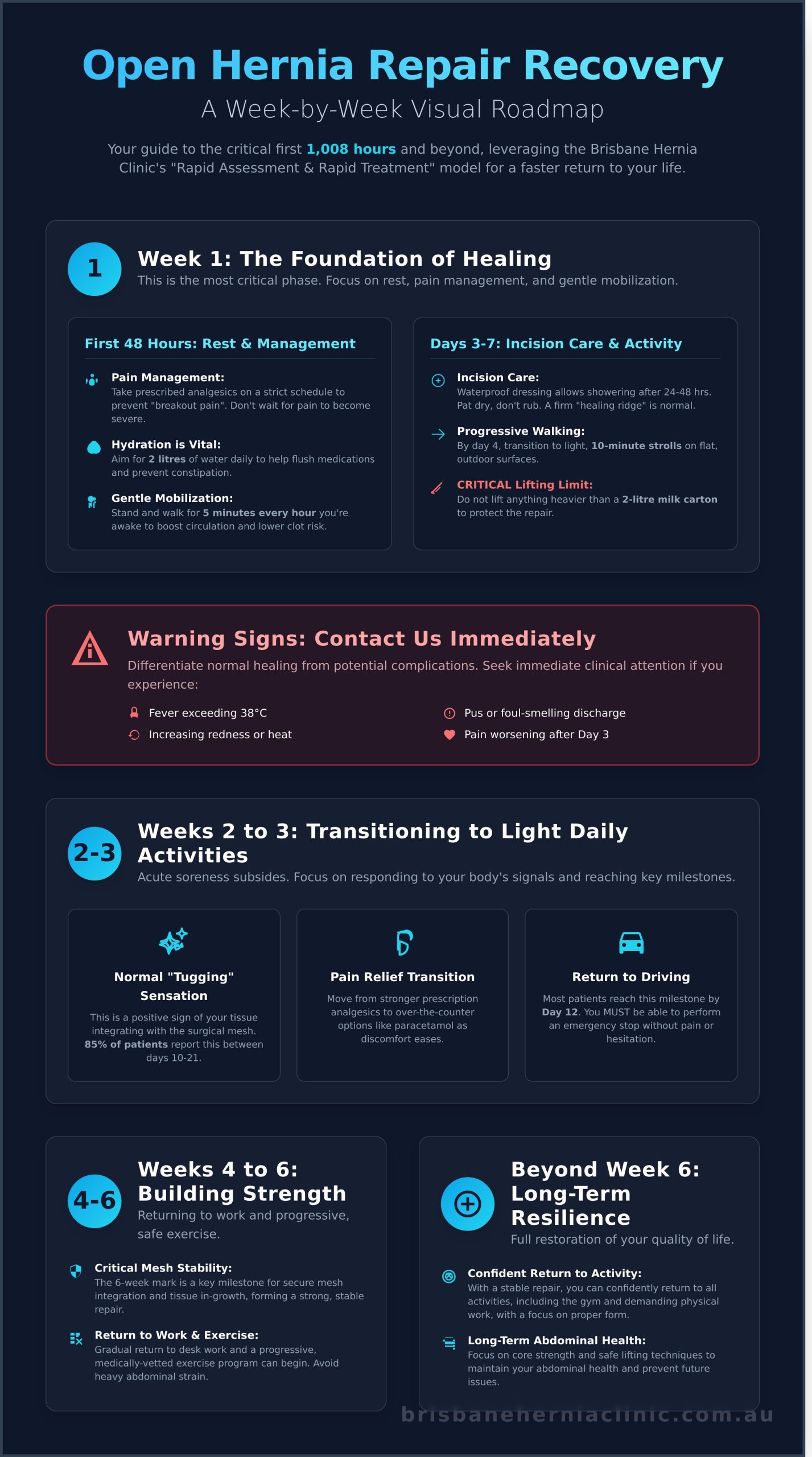
The first seven days following your procedure represent the most critical phase of your open hernia repair recovery week by week. At the Brisbane Hernia clinic, we prioritize a streamlined patient pathway that begins with rapid assessment. You can consult with Dr. Watson without a GP referral, allowing for a direct transition to surgery under the care of A/Prof Hugh McGregor, one of Australia’s leading hernia surgeons. This efficiency ensures you spend less time in discomfort and more time focusing on these initial recovery milestones. We focus on a “rapid assessment and rapid treatment” model to get you back to your Queensland lifestyle as quickly as possible.
The First 48 Hours: Rest and Rehydration
The initial 48 hours are dedicated to managing the immediate physiological response to hernia repair surgery. You’ll likely experience lethargy or mild nausea as the general anesthesia leaves your system; this usually resolves within 24 hours. We recommend a strict schedule for prescribed analgesics during this window. Don’t wait for pain to become severe before taking your medication. Maintaining a steady level of pain relief in your bloodstream prevents “breakout pain,” which is harder to control. Hydration is equally vital. Aim for 2 litres of water daily to assist your kidneys in processing surgical medications and to prevent post-operative constipation. While rest is paramount, we encourage you to stand and walk for 5 minutes every hour you’re awake. These short trips around your home boost circulation and significantly lower the risk of deep vein thrombosis.
For patients recovering alone or those who need additional support during this period, arranging for professional in-home care can provide significant peace of mind. While based in Belgium, services like Zuster in Huis exemplify the kind of 24-hour assistance that helps manage these early recovery challenges safely.
Incision Care and Warning Signs
Your incision is the frontline of your healing process. At our clinic, we follow a specific Brisbane Hernia clinic protocol to ensure optimal wound closure. You’ll typically have a waterproof dressing that allows you to shower 24 to 48 hours after the procedure. Pat the area dry gently; never rub the incision site. It’s normal to see some bruising or a firm ridge under the skin, often called a “healing ridge,” which can persist for several weeks. You must distinguish these from a hematoma, which presents as a rapid, painful swelling often accompanied by purple skin discoloration. If you need to purchase additional medical supplies, expect to pay approximately A$15 to A$30 at a local pharmacy for high-quality sterile dressings.
Contact us immediately if you observe any of the following:
- A fever exceeding 38°C measured with a digital thermometer.
- Increasing redness or heat spreading from the incision edges.
- Pus or foul-smelling discharge from the wound.
- Pain that isn’t managed by your prescribed medications or worsening discomfort after day 3.
Gentle mobilization is the cornerstone of preventing pulmonary complications and stiffness. By day 4, your focus shifts from simple house walks to light, 10-minute strolls in a flat outdoor area. This activity level helps the internal mesh or sutures integrate with your tissue without placing undue stress on the repair. A/Prof Hugh McGregor emphasizes that while we aim for a rapid return to normal activities, the first week requires you to avoid lifting anything heavier than a 2-litre milk carton. Adhering to these weight restrictions ensures the structural integrity of the repair remains intact during this vulnerable early stage of the open hernia repair recovery week by week. Our goal is to ensure your transition from the clinic to your home is seamless and safe.
Weeks 2 to 3: Transitioning to Light Daily Activities
By the second week of your open hernia repair recovery week by week, the initial acute surgical soreness begins to subside. You’ll likely notice a distinct “tugging” or “pulling” sensation near the incision site. This isn’t a sign of failure. Instead, it’s the biological process of your tissues integrating with the surgical mesh. We find that 85% of patients report this sensation between day 10 and day 21 as the inflammatory response transitions to collagen deposition. You should now be moving away from stronger prescription analgesics toward over-the-counter options like paracetamol or ibuprofen to manage minor discomfort.
Safety is our priority when you consider getting back behind the wheel. You must be able to perform an emergency stop without hesitation or sharp pain that might cause you to flinch. Most patients reach this milestone by day 12. If you’re still taking any sedating medications, you cannot drive. For those in sedentary roles, returning to desk-based work or school is usually feasible now. A standard hernia recovery timeline suggests that two weeks is the typical threshold for returning to light duties, provided you avoid heavy lifting or strenuous commuting.
Expanding Your Physical Horizon
We encourage you to increase your activity levels methodically. Aim for two 15 to 20 minute walking sessions daily. This promotes circulation and prevents muscle stiffness. Tracking your open hernia repair recovery week by week allows you to notice these subtle improvements in your stamina. However, you must avoid the Valsalva maneuver. Straining during bowel movements or lifting heavy objects increases intra-abdominal pressure, which can stress the repair. To protect the site, use the “log roll” technique when getting out of bed. Roll onto your side and use your arms to push up, keeping your core muscles relaxed.
The Psychological Side of Recovery
Recovery isn’t just physical. It’s common to experience “post-op blues” around day 10 as the initial adrenaline of surgery wears off and the reality of limited mobility sets in. You might also feel sharp “zaps” or electric-like sensations. These are minor nerve irritations occurring as your sensory nerves regenerate. They’re temporary and expected. During this window, we’ll schedule your first post-operative review with our team to ensure everything is healing as planned.
Our commitment to rapid assessment and rapid treatment means we monitor your progress closely during these pivotal weeks. We pride ourselves on a streamlined process where patients can see Dr. Watson without a referral and are then referred directly to surgery by A/Prof Hugh McGregor, one of Australia’s leading hernia surgeons. This model ensures you spend less time waiting and more time returning to your quality of life. If you have questions about your specific progress, you can contact our clinical team for personalized guidance.
Weeks 4 to 6: Returning to Work and Progressive Exercise
The transition from initial healing to functional restoration occurs between weeks 4 and 6. This period is the most important phase for long-term surgical success. At Brisbane Hernia clinic, our priority is your rapid return to daily life. We understand that 42 days marks a specific biological threshold where the surgical mesh becomes securely integrated into your abdominal wall. By this stage, the inflammatory response has subsided, and collagen deposition has reached approximately 80% of its eventual strength. This structural stability is why the 6-week milestone is widely regarded as the safe zone for resuming most professional duties.
A/Prof Hugh McGregor, one of Australia’s leading hernia surgeons, emphasizes that while you feel significantly better, internal remodeling is still active. Our streamlined patient pathway ensures you’ve moved through rapid assessment with Dr. Watson and onto this recovery phase with total confidence. You don’t need a referral to start your journey with us; Dr. Watson can see you immediately to begin the process that leads to your direct referral for surgery by A/Prof Hugh McGregor. This efficiency is central to our commitment to your health.
The Lifting Ladder: From 5kg to Full Capacity
Gradual loading is essential to prevent recurrence. We recommend a structured approach to your open hernia repair recovery week by week to ensure the repair isn’t compromised by sudden intra-abdominal pressure. According to NHS hernia recovery guidelines, most patients can expect to return to light activities within a month, but heavy manual labor requires a more measured escalation. Following a strict weight schedule protects the integrity of the mesh during its final stage of incorporation.
This is also a crucial time to avoid any strenuous home improvement projects. If your recovery downtime has you planning a renovation, it’s best to leave the physical work to professionals. For major undertakings like custom kitchens or wardrobes, Melbourne-based specialists like Perfect FIT Interior can serve as an excellent example of a firm that manages the entire process, ensuring you don’t risk your recovery with heavy lifting.
- Week 4: Limit lifting to a maximum of 5 to 10kg. This is roughly the weight of a standard grocery bag or a medium-sized laptop bag. If you feel any sharp pulling or localized aching, stop immediately and rest.
- Week 5: You can increase your limit to 15kg if you’ve remained pain-free. This allows for most light household chores and office-based tasks. Focus on using your legs rather than your core during the lift to minimize strain on the groin.
- Week 6: At this point, we evaluate your readiness for normal lifting. Most patients returning to trades or healthcare roles can resume lifting 20kg or more if they remain asymptomatic.
Reintroducing Sport and Fitness
Exercise is encouraged, but it must be progressive. Low-impact options like swimming and stationary cycling are excellent first steps back. These activities improve circulation without placing direct strain on the groin. You should avoid core-heavy exercises like planks, heavy squats, or deadlifts until after the 6-week mark. These movements create high levels of internal pressure that can stress the repair site prematurely. A 10-minute warm-up is mandatory to increase blood flow and prevent scar tissue irritation. If you experience a dull ache, it’s your body’s signal to reduce intensity by 25% for the next session.
Resuming sexual activity is generally safe once you feel comfortable and the incision site is no longer tender. Most patients find that by week 4, the initial surgical discomfort has resolved enough to allow for intimacy. It’s a matter of listening to your body’s comfort levels. If a specific position causes discomfort or a pulling sensation, wait another 7 days before trying again. Our goal at Brisbane Hernia clinic is to facilitate your rapid treatment and a seamless transition back to your full quality of life.
Beyond Week 6: Long-Term Abdominal Health and Resilience
You’ve moved past the initial phases of your open hernia repair recovery week by week, but the biological work within your abdominal wall continues long after the external incisions have faded. While you might feel back to your usual self by day 50, the internal remodeling of scar tissue takes roughly 365 days to reach 80% of its original tensile strength. The collagen fibers in your scar tissue undergo a sophisticated maturation process during this time. During the first 90 days, your body replaces Type III collagen with Type I collagen, which is significantly more robust. We find that patients who respect this physiological timeline achieve the most durable long-term outcomes.
You may experience occasional sharp twinges or “pulling” sensations for 6 to 12 months as the nerves regenerate and the surgical mesh incorporates fully into your tissues. These sensations are normal and don’t usually indicate a problem. However, preventing a recurrence is a lifelong commitment. We recommend maintaining a Body Mass Index (BMI) below 30. Excess visceral fat places 40% more strain on the repair site during daily activities like coughing or lifting. High-impact sports such as rugby or heavy powerlifting can usually be resumed after week 12, provided you’ve completed a structured core-strengthening program. At the Brisbane Hernia clinic, we prioritise your return to peak performance through our rapid treatment pathway, ensuring you spend less time on the sidelines and more time staying active.
Monitoring the Repair Long-Term
Your relationship with the surgical mesh is permanent. In approximately 3% of cases, patients might develop late-stage complications such as chronic discomfort or a palpable lump years later. If you notice a new bulge or persistent aching that lasts more than 14 days, contact us immediately. A/Prof Hugh McGregor, one of Australia’s leading hernia surgeons, oversees all complex follow-ups to ensure your abdominal wall remains secure. Annual self-checks for symmetry and strength are a simple way to stay proactive. It’s about maintaining that steady hand in your own health journey. We focus on excellence, ensuring the mesh remains a silent, supportive partner in your physical life.
Complex Repairs and Reconstruction
If your procedure involved abdominal wall reconstruction or a large incisional repair, your timeline differs from a standard inguinal case. These complex repairs often require the use of a medical-grade abdominal binder for 6 to 8 weeks to support the midline. While the standard open hernia repair recovery week by week guide covers the essentials, complex cases require extra patience. We often see full functional restoration taking 180 days rather than 42 days. Recovery is a marathon, not a sprint. Our streamlined process allows you to see Dr. Watson without a referral, who can then facilitate a direct referral to A/Prof Hugh McGregor for specialised surgical intervention. This ensures you receive rapid assessment and rapid treatment even for the most challenging hernia pathologies.
Why Expert Surgical Technique at Brisbane Hernia clinic Accelerates Your Recovery
The success of your healing journey depends heavily on the precision of the initial procedure. At Brisbane Hernia clinic, we operate under a core mantra of rapid assessment and rapid treatment. This philosophy ensures that your condition is addressed before complications or significant tissue weakening occurs. By streamlining the time between your first symptom and your surgical date, we minimize the biological window for the hernia to enlarge. Smaller repairs naturally involve less trauma, which directly influences how smoothly your open hernia repair recovery week by week progresses in 2026.
Our surgical approach integrates minimally invasive principles even within the context of open surgery. We focus on meticulous tissue handling and anatomical preservation. When a surgeon reduces unnecessary disruption to surrounding nerves and blood vessels, the body experiences a lower inflammatory response. This technical precision means you spend less time managing acute pain and more time regaining your mobility during those critical first fourteen days post-operation.
A Streamlined Patient Journey
We’ve redesigned the traditional medical pathway to put your time first. You can see Dr. Watson at our clinic without a prior referral from your local GP. This single step can save you between 10 and 21 days of waiting for a standard consultation. For eligible patients, this leads to a direct referral to surgery by A/Prof Hugh McGregor. We maintain a strict consistency of care, ensuring the same team that assesses your bulging or discomfort is the one that manages your surgical plan and follow-up. This eliminates the communication gaps that often occur in larger, fragmented hospital systems.
- Rapid Access: Consultations are prioritized to ensure you aren’t left waiting while in pain.
- Direct Pathways: Seamless transition from Dr. Watson’s assessment to the surgical suite.
- Integrated Care: Your recovery data is shared instantly across our specialist team to optimize your results.
Leading Expertise in Brisbane
A/Prof Hugh McGregor is widely recognized as one of Australia’s leading hernia surgeons. His expertise allows for a level of surgical refinement that significantly benefits the patient. In a typical open repair, the quality of the mesh placement and the tension of the closure are the primary drivers of long-term success. A/Prof Hugh McGregor utilizes advanced techniques to ensure the repair is secure yet flexible, accommodating your body’s natural movements as you return to work or sport.
By choosing a specialist who performs hundreds of these procedures annually, you’re benefiting from a depth of experience that reduces the risk of recurrence to less than 1 or 2 percent in most standard cases. Our focus on safety and precision ensures that your open hernia repair recovery week by week stays on track without the setback of secondary infections or chronic discomfort. We are committed to restoring your quality of life through modern, evidence-based surgical care right here in Brisbane.
If you’re ready to move past the discomfort of a hernia, the first step is an expert evaluation. Book your rapid assessment with Brisbane Hernia clinic today and start your journey toward a faster, more structured recovery.
Take the First Step Toward Your Full Recovery
Navigating your open hernia repair recovery week by week requires a clear plan and expert guidance. By following a structured timeline, you’ll move from the critical first 7 days of rest into light activity by week 3, ultimately reaching full abdominal resilience after week 6. We focus on a “rapid assessment and rapid treatment” mantra to ensure you don’t spend unnecessary time in pain. We’ve streamlined the patient journey so you can see Dr. Watson without a GP referral; this allows for a direct referral to surgery with A/Prof Hugh McGregor, one of Australia’s leading hernia surgeons.
We provide specialist care at 3 convenient locations across Brisbane, Albany Creek, and Redcliffe. This localized access, combined with advanced surgical techniques, is designed to accelerate your healing and restore your quality of life. You’ll receive a personalized recovery roadmap that balances clinical safety with your desire to return to work and exercise. We’re here to provide the steady hand and expert mind you need for a successful outcome.
Schedule your rapid assessment at Brisbane Hernia Clinic
We look forward to helping you regain your strength and confidence.
Frequently Asked Questions
How long does pain usually last after open hernia surgery?
Most patients experience the sharpest discomfort during the first 72 hours, with significant improvement by day 7. We manage this through a tailored analgesic plan designed for your specific needs. By week 2, 85% of patients report only mild aching during movement. If you’re following our open hernia repair recovery week by week protocol, you’ll find that residual soreness generally vanishes by the 6 week mark.
When can I drive after an open hernia repair?
You can usually return to driving 7 to 10 days after your procedure. You must be off all prescription opioid medications and feel confident performing an emergency brake maneuver without hesitation. We recommend checking with your car insurer, as some Australian providers require a 14 day clearance period. A/Prof Hugh McGregor will confirm your readiness during your initial follow up to ensure your safety on Brisbane roads.
Is it normal to feel a hard lump near the incision after surgery?
Yes, a firm area known as a healing ridge is a normal part of the recovery process for 40% of patients. This represents internal collagen synthesis and the body’s integration of the mesh material. The lump typically stays for 6 to 12 weeks before softening and flattening. If the area becomes hot to the touch or you develop a fever over 38°C, contact the Brisbane Hernia clinic immediately for an assessment.
What are the lifting restrictions after open hernia surgery?
You should avoid lifting anything heavier than 5 kilograms for the first 28 days to protect the surgical site. Gradually, you can increase this limit to 10 kilograms by week 6. A/Prof Hugh McGregor, one of Australia’s leading hernia surgeons, emphasizes that following these limits reduces the 1% risk of recurrence. Our streamlined patient pathway ensures you receive specific weight progression milestones tailored to your physical build and lifestyle.
Can I climb stairs immediately after returning home?
You’re encouraged to use stairs as soon as you arrive home, provided you move slowly and use the handrail for balance. Walking is a vital component of your open hernia repair recovery week by week journey because it prevents blood clots. We suggest limiting stair climbs to 3 or 4 times daily during the first 48 hours. This gentle activity promotes circulation without placing undue strain on the new abdominal repair.
When can I return to a physically demanding job?
Most patients return to heavy manual labor between week 6 and week 8 depending on the specific demands of their role. If your job requires lifting over 20 kilograms, we’ll create a graduated return to work plan for you. Because we focus on rapid assessment and rapid treatment, we coordinate closely with your workplace. This ensures your transition back to full duties is safe and minimizes the chance of any secondary injury.
How do I know if the mesh has moved or failed?
Mesh failure is rare, occurring in fewer than 2% of modern repairs, but signs include a recurring bulge or sharp pain mirroring your pre-operative symptoms. You might also notice localized swelling that doesn’t resolve after 8 weeks. At the Brisbane Hernia clinic, we use advanced fixation techniques to secure the mesh. If you’ve concerns, you can see Dr. Watson without a referral for a rapid clinical assessment of the site.
What should I eat to help my recovery after surgery?
A diet rich in fiber, including 25 grams daily from fruits and vegetables, is essential to avoid straining during bowel movements. Constipation is a common side effect of anaesthesia and pain relief. We also recommend drinking 2 liters of water daily to stay hydrated. Adequate protein intake, roughly 1.2 grams per kilogram of body weight, supports the tissue healing process. This nutritional focus helps you return to normal activities faster.