You may first notice a persistent, dull ache in your groin during physical activity or discover a visible bulge that unsettlingly disappears when you lie down. These sensations are often accompanied by a growing sense of anxiety about potential complications, such as strangulation. Identifying the specific inguinal hernia symptoms male patients commonly experience is the first step toward alleviating that uncertainty and reclaiming your physical confidence.
In this guide, we provide a clinical yet accessible overview of how to recognize a hernia and, more importantly, when to seek specialist intervention. You will gain clarity on the differences between a “wait and see” approach and the necessity of surgical repair to prevent emergency outcomes. At the Brisbane Hernia Clinic, our focus is on combining high-level surgical expertise with a patient-centered approach. By understanding your symptoms and the pathways to specialist care in Brisbane, you can move toward a structured recovery and a rapid return to your normal quality of life with total peace of mind.
Key Takeaways
- Understand the anatomical reasons why men are significantly more prone to developing protrusions within the inguinal canal.
- Learn to identify the primary inguinal hernia symptoms male patients typically experience, including the “disappearing lump” and sensations of heaviness or burning.
- Discover why hernias are mechanical gaps that cannot self-heal and how to recognize the critical signs of incarceration that require urgent surgical review.
- Navigate the diagnostic process in Australia, including the role of the physical “cough test” and when imaging like Ultrasound or CT is actually required.
- Explore modern, minimally invasive treatment options such as laparoscopic and robotic repairs designed for precision and a rapid return to your daily routine.
Understanding Inguinal Hernias in Men: Anatomy and Causes
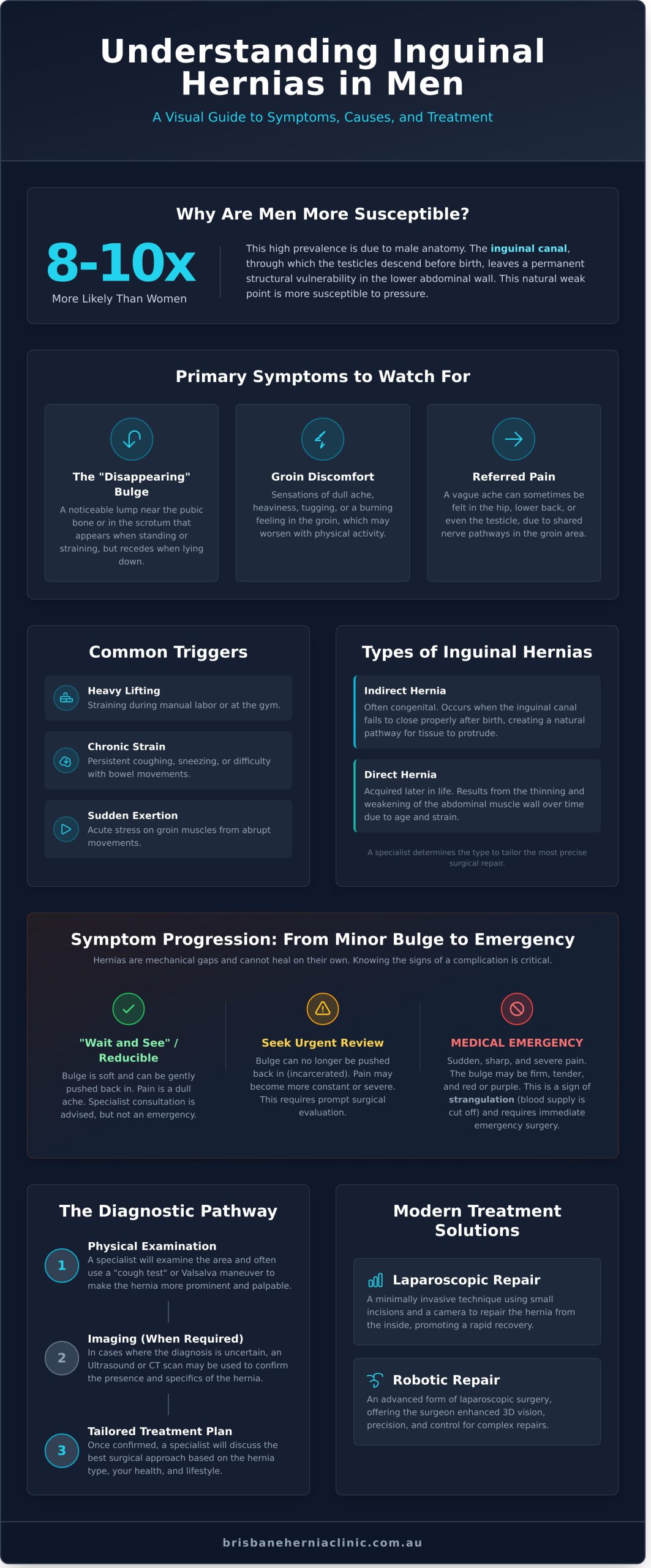
An inguinal hernia occurs when abdominal tissue-most commonly fatty tissue or a loop of the intestine-protrudes through a weakened point or tear in the lower abdominal wall. For many of our patients at the Brisbane Hernia Clinic, recognizing inguinal hernia symptoms male patients experience begins with an appreciation of the unique male anatomy. Statistically, men are eight to ten times more likely to develop these hernias than women, a disparity largely rooted in the developmental journey of the testicles before birth.
During fetal development, the testicles descend from the abdomen into the scrotum through the inguinal canal. While this passage usually closes or tightens significantly after birth, it remains a permanent structural vulnerability. For a comprehensive inguinal hernia overview, it is helpful to note that this canal houses the spermatic cord, making the male groin particularly susceptible to internal pressure.
The Inguinal Canal: A Male Vulnerability
The inguinal canal serves as the primary conduit for the spermatic cord and associated blood vessels. In a healthy state, the internal and external inguinal rings act as reinforced “shutters” to keep abdominal contents in place. However, these rings can fail over time due to persistent intra-abdominal pressure. Common triggers that may exacerbate this weakness include:
- Heavy lifting: Straining during manual labour or high-intensity gym sessions.
- Chronic strain: Persistent coughing, sneezing, or straining during bowel movements.
- Physical exertion: Sudden movements that put acute stress on the groin muscles.
Many trades are at a higher risk due to the physical nature of the work. For example, the daily tasks of a plumber can involve the exact kind of straining that leads to hernias. It’s a reminder that professionals in any physically demanding field, like the team at Viktor’s Plumbing Services, should prioritize safe lifting practices.
This pressure eventually forces tissue through the canal, leading to the characteristic bulging and discomfort associated with inguinal hernia symptoms male individuals frequently report to our specialists.
Direct vs. Indirect Inguinal Hernias
Surgical specialists distinguish between two primary types based on their anatomical origin. Indirect hernias are often congenital; they occur when the inguinal canal fails to close properly during infancy, leaving a “path of least resistance.” In contrast, direct hernias are typically acquired later in life. These result from the natural thinning of the muscle wall within Hesselbach’s triangle-a specific region in the groin prone to age-related wear.
Identifying whether a hernia is direct or indirect is a vital step in our diagnostic process. This distinction allows our team to tailor the surgical approach-often utilizing minimally invasive techniques-to ensure a precise repair and a rapid return to your normal Brisbane lifestyle.
Identifying the Signs: Primary Inguinal Hernia Symptoms in Males
Recognising inguinal hernia symptoms in the male patient requires an understanding of how internal pressure interacts with the abdominal wall. A hallmark sign of this condition is the “disappearing lump”-a protrusion near the pubic area that is visible when standing or straining but recedes when you lie flat. This occurs because the hernia contents often slide back into the abdominal cavity when gravity is removed and the muscles relax.
To confirm the presence of a hernia, specialists often utilise the “Valsalva Maneuver.” By asking you to cough or strain, intra-abdominal pressure is momentarily increased, forcing the hernia to become visible or palpable. Beyond the physical bulge, many men report sensations of heaviness, tugging, or a burning ache in the groin or scrotum. Furthermore, you may experience referred pain; because the nerves in the inguinal canal are interconnected, a hernia can sometimes manifest as a vague ache in the hip or lower back, occasionally leading patients to mistake the issue for a musculoskeletal strain.
Visual and Physical Indicators
In most cases, an inguinal hernia appears as a distinct bulge on either side of the pubic bone. For some men, this protrusion may descend further into the scrotum, resulting in noticeable swelling or a “full” sensation that causes significant discomfort. You may find that inguinal hernia symptoms in the male anatomy become more pronounced during physical exertion, such as lifting heavy equipment at work or during a gym session, as these activities place direct stress on the weakened abdominal wall.
The “Aching” vs. “Sharp” Pain Distinction
The nature of the pain provides critical clues regarding the hernia’s progression. A dull, persistent ache is common in the early stages or when the hernia is reducible. However, a sudden, sharp pain may indicate that the protruding tissue is being pinched. Understanding the causes and complications of inguinal hernias is vital, as acute pain can signal incarceration or strangulation, which requires immediate surgical intervention. Male patients typically describe the “dragging” sensation as a persistent, heavy feeling in the groin that intensifies toward the end of the day or after prolonged periods of standing.
The Progression of Symptoms: When Does a Minor Bulge Become an Emergency?
A common misconception we encounter at the Brisbane Hernia Clinic is the idea that an inguinal hernia will eventually resolve on its own. It is important to understand that a hernia is a mechanical defect-a physical gap in the abdominal wall musculature. Unlike a strain or a tear in the muscle fibres, this opening cannot “self-heal” through rest or exercise. Over time, the pressure of daily activity typically causes the gap to enlarge, making the management of inguinal hernia symptoms male patients experience a matter of “when,” not “if,” regarding surgical intervention.
The primary concern with a progressive hernia is the transition from a reducible bulge to a trapped one. We categorise this progression into two critical stages:
- Incarceration: This occurs when the protruding tissue (often fat or a loop of bowel) becomes trapped outside the abdominal wall and can no longer be pushed back inside.
- Strangulation: This is a surgical emergency. The trapped tissue becomes tightly constricted, cutting off its blood supply. Without immediate intervention, this can lead to tissue death (ischaemia) and life-threatening complications.
One of the most frequent objections we hear is, “If it doesn’t hurt, can I just ignore it?” While a painless bulge may feel benign, the underlying mechanical risk remains. Monitoring inguinal hernia symptoms is vital because a lack of pain today does not guarantee safety from strangulation tomorrow.
Warning Signs of a Medical Emergency
If you notice a sudden change in your condition, you must act quickly. Seek immediate care at your nearest Australian Emergency Department if you experience these “Red Flag” symptoms:
- Sudden, intensifying pain that radiates quickly.
- A hernia bulge that has become firm, hard, or tender to the touch.
- Discolouration of the skin over the bulge, appearing red, purple, or dark.
- Systemic signs of distress, including nausea, vomiting, or a high fever.
- An inability to pass gas or have a bowel movement.
The Risks of “Watchful Waiting”
In some clinical cases involving very small, asymptomatic hernias, a period of “watchful waiting” may be discussed. However, the current medical consensus suggests that for most active men, early intervention is preferable. As a hernia grows, the surrounding tissue weakens, which can increase the complexity of a future inguinal hernia symptoms male repair. At our specialist clinic, we advocate for elective surgery-ideally using minimally invasive techniques-as it offers significantly better long-term outcomes and a more predictable recovery than an emergency procedure performed under duress.
Diagnostic Pathways: How to Confirm an Inguinal Hernia in Australia
Identifying and confirming the inguinal hernia symptoms male patients often report requires a methodical clinical approach. In the Australian healthcare system, the diagnostic journey typically begins with your GP, but the definitive diagnosis is best made by a specialist surgeon like Dr. Hugh McGregor. While many patients assume an ultrasound is the first requirement, a physical examination remains the gold standard for diagnosis.
The cornerstone of this examination is the “cough test.” During this assessment, the surgeon palpates the groin while asking you to cough or strain. This action increases intra-abdominal pressure, forcing the hernia to protrude and allowing the specialist to feel the exact nature of the defect. In many cases, this clinical confirmation makes expensive imaging redundant, saving you time and unnecessary exposure to radiation.
What to Expect During Your Consultation
A specialist clinical evaluation is a structured process designed to provide clarity and reassurance. Your surgeon will conduct a differential diagnosis to ensure your discomfort isn’t caused by other conditions, such as:
- Sports hernias: Often involving muscle tears rather than a wall defect.
- Enlarged lymph nodes: Which can mimic the swelling of a hernia.
- Hydroceles: Fluid collection around the testicle.
It is important to note that ultrasound results can sometimes be misleading, particularly with small hernias. A “negative” scan does not always mean a hernia isn’t present; a specialist’s tactile assessment is often more sensitive than imaging for early-stage defects.
Brisbane’s Rapid Access Hernia Pathway
To simplify the patient journey, the Brisbane Hernia Clinic offers a unique Rapid Access service. This pathway is specifically designed for patients who have identified inguinal hernia symptoms male concerns and want to move quickly toward a resolution. By streamlining the transition from initial discovery to surgical planning, this service removes the administrative hurdles often found in the broader health system.
Early specialist involvement through this pathway ensures that you receive an accurate diagnosis promptly. This proactive approach not only provides peace of mind but also allows for the early scheduling of minimally invasive repair, facilitating a faster return to your professional and personal life in Brisbane.
Modern Treatment Solutions: From Diagnosis to Specialist Repair
Once you have identified the inguinal hernia symptoms male patients typically experience-such as a persistent bulge or localized aching-the focus shifts to a permanent surgical solution. Modern hernia repair has evolved significantly, moving toward “tension-free” techniques that utilize medical-grade mesh to reinforce the abdominal wall. This approach provides a durable internal scaffold, drastically reducing the likelihood of the hernia returning.
At a specialist clinic, treatment is tailored to your specific physiology and lifestyle. While open surgery is still utilized for very large or complex cases, most patients benefit from minimally invasive techniques, including:
- Laparoscopic (Keyhole) Repair: Performed through small incisions using a camera and specialized instruments.
- Robotic-Assisted Repair: The latest advancement in surgical precision.
- Specialist Revision: Expert care for recurrent hernias that require a more nuanced surgical plan.
Robotic-Assisted Hernia Repair
For many men, robotic hernia repair represents the pinnacle of modern surgical care. This technology allows your surgeon to operate with enhanced 3D high-definition visualization and “wristed” instruments that offer greater dexterity than the human hand. The primary benefits include smaller incisions, reduced post-operative pain, and meticulous precision. This method is particularly effective for bilateral hernias or for patients who have had previous abdominal surgeries.
Life After Hernia Surgery
The ultimate goal of treatment is to restore your quality of life and get you back to Brisbane’s active lifestyle. Recovery is often faster than patients anticipate:
- First 24 Hours: Most patients return home the same day, focusing on light mobilization.
- One Week: You can typically return to office-based work and light walking along the Riverwalk.
- Six Weeks: Most restrictions on heavy lifting and high-impact sports are lifted, allowing a full return to the gym or weekend activities.
Addressing inguinal hernia symptoms male patients face shouldn’t be a source of anxiety. By choosing a specialist environment like the Brisbane Hernia Clinic, you ensure that your recovery is managed with the highest level of clinical expertise and personal care.
Prioritising Your Health: Next Steps for Inguinal Hernia Care
Recognising the inguinal hernia symptoms male patients frequently experience-such as a visible bulge, localized aching, or pressure during physical activity-is the vital first step toward reclaiming your quality of life. While these signs may initially seem manageable, proactive specialist intervention is the most effective way to prevent progression and avoid emergency complications. By understanding your diagnostic options and the modern surgical pathways available in Australia, you can move forward with a clear and structured plan for recovery.
At the Brisbane Hernia Clinic, our lead specialists, Dr. Hugh McGregor and Dr. Lindsay Watson, provide authoritative care tailored to your specific needs. With expertise in robotic, laparoscopic, and open repairs, we offer precision-focused treatments across multiple convenient locations, including Albany Creek and Redcliffe. Our clinical approach is designed to demystify the surgical process, providing you with the reassurance of a steady hand and a path back to your normal daily activities.
Do not let physical discomfort hold you back from the life you enjoy. Book a Rapid Access Assessment at Brisbane Hernia Clinic today and partner with a team dedicated to your long-term health and well-being. We are here to provide the expert care and clinical excellence you deserve.
Frequently Asked Questions
Can an inguinal hernia go away with exercise or physiotherapy?
While exercise is vital for general health, it cannot repair an inguinal hernia. A hernia is a physical defect in the abdominal wall-a hole that allows tissue to protrude. Neither physiotherapy nor targeted core strengthening can close this gap. While specific exercises may temporarily manage discomfort, surgical intervention remains the only definitive way to repair the wall and prevent the condition from worsening over time.
Is it safe to exercise with an inguinal hernia if I have no pain?
If you are experiencing the inguinal hernia symptoms male patients often report, such as a mild bulge without acute pain, light exercise like walking or swimming is generally safe. However, you must avoid heavy lifting, straining, or high-intensity abdominal workouts. These activities increase intra-abdominal pressure, which can force more tissue through the defect, potentially leading to serious complications like incarceration or strangulation.
What is the difference between an inguinal hernia and a sports hernia?
An inguinal hernia involves a physical protrusion of fat or intestine through a weakness in the abdominal wall, usually visible as a palpable lump. In contrast, a “sports hernia” (athletic pubalgia) is not a true hernia but a strain or tear of soft tissues, such as tendons or muscles, in the groin area. While both cause groin pain, a sports hernia does not involve a hole in the abdominal wall.
How much does hernia surgery cost in Brisbane for private patients?
For private patients in Brisbane, the total cost of hernia surgery typically ranges from A$3,000 to A$6,000, depending on your level of private health insurance. This estimate covers the surgeon’s fee, anaesthetist, and hospital theatre costs. At Brisbane Hernia Clinic, we provide a detailed, transparent quote following your initial consultation, ensuring you understand any out-of-pocket “gap” payments before proceeding with your minimally invasive repair.
What happens if I leave an inguinal hernia untreated for too long?
Leaving an inguinal hernia untreated can lead to progressive enlargement and increased daily discomfort. The primary risk, however, is strangulation-where a loop of intestine becomes trapped and its blood supply is cut off. This is a surgical emergency. By addressing inguinal hernia symptoms male patients notice early, we can perform a planned, laparoscopic repair, which is significantly safer than undergoing emergency surgery for a strangulated hernia.
Does hernia mesh cause long-term pain or complications?
Modern lightweight mesh is the gold standard for hernia repair, significantly reducing the risk of recurrence. While some patients worry about long-term pain, chronic discomfort occurs in only a very small percentage of cases. Our specialists use advanced, minimally invasive techniques and high-quality materials designed to integrate seamlessly with your tissues. This approach ensures a durable repair while prioritising your long-term comfort and a rapid return to your quality of life.
How long do I need to take off work after a laparoscopic hernia repair?
Most patients undergoing laparoscopic hernia repair can return to light office work within 3 to 7 days. If your occupation involves heavy lifting or strenuous physical activity, we typically recommend waiting 4 to 6 weeks before returning to full duties. Because our Brisbane clinic focuses on minimally invasive surgery, your recovery is generally faster and involves less post-operative pain than traditional open surgery, allowing you to resume your routine sooner.
Do I need a GP referral to see a hernia specialist in Brisbane?
Yes, to see a specialist at the Brisbane Hernia Clinic and claim a Medicare rebate for your consultation and surgery, you will need a valid referral from your GP. A referral ensures that your medical history is properly communicated and that your specialist care is integrated with your general health management. Once you have your referral, our team can quickly schedule your assessment to discuss your diagnosis and treatment options.
While the referral process mentioned is specific to Australia, consulting with a general practitioner is a universal first step for any health concern. For those researching how to connect with a primary care physician, you can check out Sage Creek Medical Center for a helpful guide on the process.