
Why is it that obtaining a transparent quote for your health often feels more complex than the medical procedure itself? You likely want to avoid the 400 day wait lists currently affecting many Australian public hospitals, yet the ambiguity surrounding "the gap" and private facility fees creates a different kind of anxiety. It’s a common frustration for patients who are ready to resolve the persistent strain of a hernia but find themselves blocked by a lack of financial clarity.
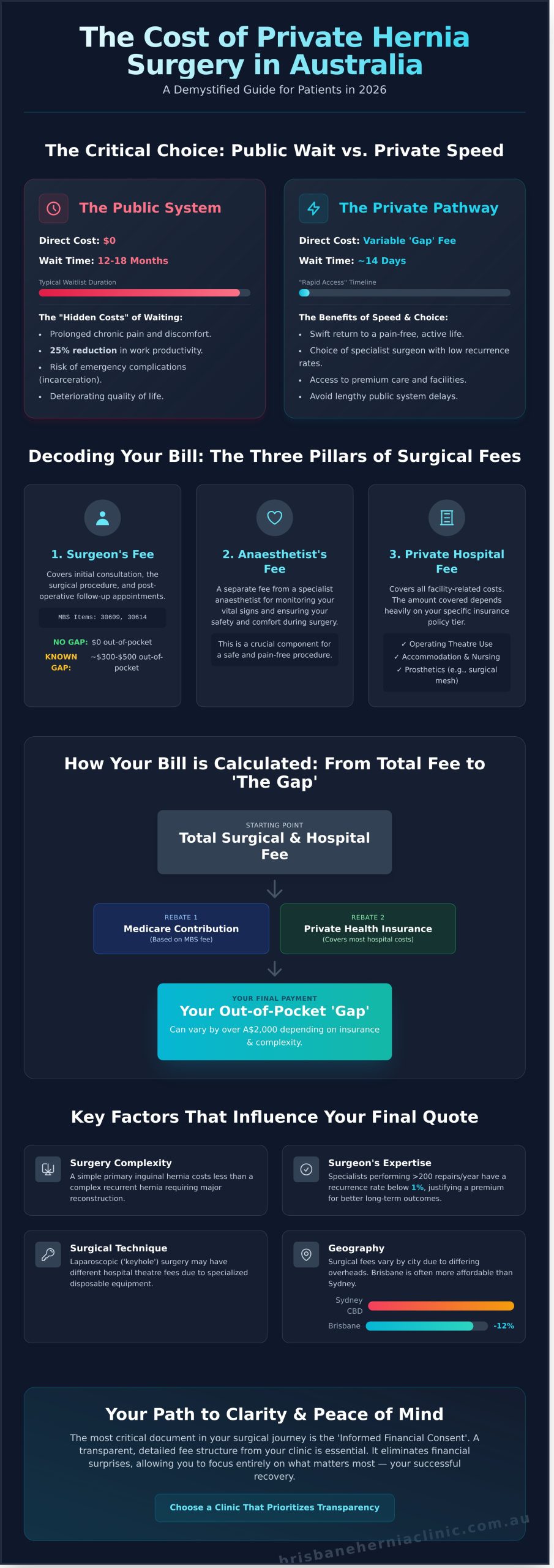
Understanding the cost of private hernia surgery australia requires looking at the three distinct pillars of surgical billing: the specialist surgeon’s fee, the anaesthetist’s contribution, and the private hospital stay. In 2026, out-of-pocket expenses can vary by over A$2,000 depending on your insurance tier and the complexity of the laparoscopic repair required. This specialist guide demystifies these figures by referencing current Medicare Benefits Schedule (MBS) rebates and typical private health sector benchmarks. We’ll provide a methodical breakdown of every potential charge, ensuring you can choose your specialist clinic with total confidence and focus entirely on your physical recovery.
Key Takeaways
-
Distinguish between total surgical fees and your "out-of-pocket" gap to gain a clear understanding of the financial landscape for your hernia repair.
-
Break down the three pillars of private billing-surgeon, anesthetist, and hospital-to ensure you are fully prepared for each component of your care.
-
Learn how to leverage Medicare and private health insurance rebates to minimize the cost of private hernia surgery australia while accessing premium specialist care.
-
Evaluate the benefits of self-funding your procedure to avoid lengthy public waitlists and accelerate your return to a pain-free, active lifestyle.
-
Understand the importance of "Informed Financial Consent" and how a transparent fee structure provides peace of mind throughout your surgical journey.
Table of Contents
-
Understanding the Cost of Private Hernia Surgery in Australia (2026)
-
Private Health Insurance and Medicare: Calculating Your ‘Gap’
Understanding the Cost of Private Hernia Surgery in Australia (2026)
If you’re experiencing the persistent ache or visible bulge of a hernia, your primary focus is likely a swift return to your daily activities. In 2026, the cost of private hernia surgery australia reflects a sophisticated medical landscape where technology and specialist expertise dictate pricing. Understanding the financial commitment requires a clear distinction between the total surgical fee and your out-of-pocket gap. The total cost represents the entire bill from the surgeon, anaesthetist, and hospital. Your out-of-pocket gap is the remaining amount you pay after Medicare and your private health fund contribute their respective rebates.
Before diving into the financials, it’s helpful to understand What is hernia repair surgery? at its core; it involves returning displaced tissue to its proper place and reinforcing the abdominal wall, often using advanced synthetic meshes. In the current 2026 fiscal year, medical inflation has stabilized at approximately 4.2 percent, yet the adoption of robotic-assisted platforms has introduced new variables into hospital billing. Choosing the private route isn’t just about comfort; it’s a strategic decision to avoid the deteriorating quality of life associated with prolonged wait times.
Several factors influence the final quote you receive. A simple primary inguinal hernia repair generally costs less than a complex recurrent incisional hernia that requires extensive abdominal wall reconstruction. We focus on providing a transparent breakdown so you can plan your recovery without financial surprises. Precision in the initial surgery is the most effective way to prevent the much higher costs associated with treating a recurrence later.
Why Prices Vary Between Surgeons and Clinics
Expertise carries a premium because it directly correlates with lower complication rates. A specialist hernia surgeon who performs over 200 repairs annually typically has a recurrence rate below 1 percent, whereas a generalist may have different outcomes. Geography also plays a role; surgical fees in Brisbane are often 12 percent lower than in Sydney’s CBD due to differing overheads. The cost of private hernia surgery australia also fluctuates based on the technique used, with laparoscopic (keyhole) surgery requiring specific disposable equipment that may influence the hospital theatre fee.
Public vs. Private: The Financial and Time Trade-off
The public system offers surgery at no direct cost, but the "hidden cost" of waiting is substantial. In 2026, elective surgery waitlists for non-urgent hernias in public hospitals can stretch between 12 and 18 months. During this time, many patients experience a 25 percent reduction in work productivity due to chronic pain or the risk of incarceration, which is a medical emergency. Private care utilizes "Rapid Access" pathways, often moving you from consultation to theatre within 14 days.
Medicare provides a foundational rebate based on the Medicare Benefits Schedule (MBS) fee, but this hasn’t kept pace with the actual costs of running a modern surgical practice. Private health insurance bridges much of the hospital and prosthetic gap, but your specific policy tier will determine if you have a "no-gap" or "known-gap" experience. We believe that providing you with a detailed Informed Financial Consent document early in the process is essential for your peace of mind while you focus on healing.
The Three Pillars of Private Surgical Fees
Understanding the cost of private hernia surgery australia requires looking at three distinct billing entities. It’s not a single invoice from one provider. Instead, it’s a coordinated effort between the surgeon, the anesthetist, and the hospital facility. This transparency ensures you understand exactly where your investment goes, from the precision of the surgical mesh to the specialist monitoring your vitals during the procedure. By breaking these down, you can move toward your recovery with financial clarity and confidence.
Breaking Down the Surgeon’s Quote
Your surgeon’s quote is the most visible component of your care. It covers the initial consultation, the technical repair of the abdominal wall, and your post-operative recovery appointments. Most specialists use specific Medicare Benefits Schedule (MBS) item numbers, such as 30648 for an open inguinal hernia or a laparoscopic repair, to calculate these fees. A ‘Known Gap’ usually results in a predictable payment, often capped between A$300 and A$500. For those seeking the latest advancements, robotic-assisted hernia repair may involve an additional fee due to the time and expertise involved. While this A$1,000 to A$3,000 investment isn’t always covered by private health funds, many patients find the increased precision and reduced recovery time justify the expense.
Anesthesia and Hospital Costs Explained
The anesthetist and the hospital facility issue their own accounts separate from the surgeon. Anesthetists are independent practitioners who bill based on the complexity of your case and the duration of the procedure. To get a clear picture of these variables, you can consult the Australian Government’s Medical Costs Finder to see typical regional pricing. Hospital fees are generally covered by your private health insurance, provided you’ve served your waiting periods and your policy includes the relevant clinical categories. You’ll still need to account for your agreed excess, which typically ranges from A$250 to A$750. Choosing a day surgery over an overnight stay can reduce the facility fee by A$800 or more, though your surgeon’s clinical recommendation for your safety always takes priority.
The final pillar involves the physical materials used during your procedure. High-quality synthetic or composite meshes are essential for reinforcing the weakened tissue and preventing recurrence. While the cost of the mesh itself is usually included in the hospital’s clinical package, specialized robotic instruments are single-use consumables that contribute to the overall surgical budget. These tools allow for 360-degree wrist movement within the abdomen, providing a level of dexterity that traditional laparoscopic tools cannot match. This investment in technology is a key factor in why the cost of private hernia surgery australia varies between clinics, as it reflects the level of specialized equipment utilized to restore your quality of life.
Private Health Insurance and Medicare: Calculating Your ‘Gap’
Determining the final cost of private hernia surgery australia involves a precise calculation of three separate figures. First, the Medicare Benefit Schedule (MBS) fee serves as the government’s baseline price for your procedure. Second, your private health insurer contributes to this fee. Finally, your surgeon’s specific fee accounts for their expertise and the complexity of your repair. When you choose the private system, Medicare pays 75% of the MBS fee for your in-hospital procedure, and your private health insurance (PHI) covers the remaining 25%. The "Gap" is the amount your surgeon charges above this combined 100% MBS total. This out-of-pocket expense is a direct reflection of the specialist’s experience and the high-quality materials, such as advanced prosthetic meshes, used during your operation.
Recent research on hernia repair costs highlights that these expenses can vary significantly based on the surgical technique chosen. For instance, a complex laparoscopic bilateral repair often requires more specialized equipment than a simple open primary repair. Beyond the surgeon’s gap, you must also account for your insurance excess. Most policies include an excess ranging from A$250 to A$750, which you pay directly to the hospital upon admission. Our team at the Brisbane Hernia Clinic prioritizes financial transparency. We provide a detailed "Informed Financial Consent" document before your surgery so you can see every dollar accounted for before you enter the theatre.
How to Check Your Level of Cover
You need to confirm your policy includes the "Digestive System" clinical category. Since the 2019 private health insurance reforms, hernia repairs are typically found in Bronze, Silver, or Gold hospital tiers. We recommend calling your provider with the specific MBS item numbers we provide during your consultation. Ask them directly: "Am I covered for an inpatient stay for this code at a private facility?" It’s also vital to ask if the Brisbane Hernia Clinic is a "Contracted Provider" with your fund. These agreements often result in lower out-of-pocket costs for you because the insurer agrees to pay a higher portion of the clinical fee.
Medicare Rebates for Hernia Surgery in 2026
Medicare provides essential support for your surgical journey. In 2026, the MBS item numbers remain the primary way the government tracks and rebates your care. Common codes include:
-
30648: Inguinal hernia repair (groin).
-
30621: Umbilical or small ventral hernia repair.
-
30655: Large incisional hernia repair requiring complex reconstruction.
The 75% rebate applies specifically to the "in-hospital" portion of your care. For your initial diagnostic consultations at our clinic, the rebate is 85% because these are "out-of-hospital" services. If you have reached the Medicare Safety Net threshold for 2026, which is approximately A$2,600 for most families, your out-of-pocket costs for subsequent specialist visits may be significantly reduced. This safety net is a critical financial buffer for patients requiring multiple diagnostic scans or follow-up appointments within a single calendar year.
You should be aware of two common pitfalls that can unexpectedly increase the cost of private hernia surgery australia. First, a 12-month waiting period applies to all pre-existing conditions. If you noticed your hernia bulge before joining or upgrading your cover, you must wait the full year to claim. Second, "Restricted" or "Excluded" cover on basic policies might only cover you as a private patient in a public hospital. This often leads to long wait times and significant facility fees that your insurer won’t cover. Always verify these details early to ensure your path to recovery is smooth and predictable.
Navigating these insurance details can be complex. For professional assistance in finding the right health cover and avoiding common pitfalls, you can visit AllCover Insurance Brokers.
Self-Funded Hernia Surgery: Costs for Uninsured Patients
For many Australians, the decision to self-fund surgery isn’t about luxury; it’s about time. In 2026, the average wait for elective hernia repair in the public system often exceeds 15 months. This delay can lead to increased pain, lifestyle restrictions, and the risk of hernia incarceration. Choosing to pay out-of-pocket allows you to bypass these queues and schedule your procedure within weeks, ensuring a faster return to your daily routine.
The total cost of private hernia surgery australia depends on the complexity of the repair and the specific hospital used. For a standard unilateral inguinal hernia repair, self-funded patients typically face an all-inclusive price range between A$3000 and A$5000. This figure bundles the surgeon’s fee, the anaesthetist’s fee, and the hospital’s theatre and accommodation charges. If you require a bilateral repair (both sides), expect the price to increase by approximately 35% to 50% due to the extended time in the operating room.
Self-funding carries inherent financial risks that you must consider. While most packages cover the standard stay, complications can arise. If your recovery requires an unplanned admission to the Intensive Care Unit (ICU) or additional nights in a ward, costs escalate quickly. A single night in a private hospital bed can cost between A$1,150 and A$1,600. We recommend asking for a "fixed-fee" quote that clearly outlines what happens if your stay exceeds the initial estimate.
To manage these expenses, medical financing has become a common tool in 2026. Providers like MediPay or TLC offer specialized loans for surgical procedures. These plans often feature interest rates between 11% and 16%, allowing you to spread the cost over one to five years. This approach makes the immediate financial burden of surgery more manageable while you focus on healing.
Estimating the Total Bill Without Insurance
Hospital facility fees are the most significant component of your bill, often accounting for 65% of the total expense. These "bed fees" cover the nursing staff, surgical consumables, and the high-tech equipment used in the theatre. Even without private insurance, you aren’t entirely on your own. Medicare still provides a rebate for the professional services portion of the bill. You’ll receive a refund for 75% of the Medicare Benefits Schedule (MBS) fee for both the surgeon and the anaesthetist.
The surgical technique also influences the price. Laparoscopic (keyhole) surgery is frequently preferred for its faster recovery times and reduced post-operative aching. However, it generally costs A$900 to A$1,400 more than open surgery. This is due to the specialized disposable instruments and the sophisticated video towers required for the procedure. When calculating the cost of private hernia surgery australia for your specific case, we’ll help you weigh these clinical benefits against the additional investment.
Tax Implications and Early Release of Superannuation
The Australian Taxation Office (ATO) allows for the "Compassionate Release of Superannuation" to pay for essential medical treatment. To qualify, you must demonstrate that you have a condition causing chronic pain or restricted physical function that cannot be treated in the public system within a reasonable timeframe. The application process requires two distinct medical reports: one from your GP and one from our specialist clinic. Approval typically takes 14 to 21 days once the documentation is submitted.
Be aware that withdrawing Super carries tax implications. The amount released is generally taxed as a lump sum at a rate of 22%, so you should apply for a higher amount than the surgical quote to cover this tax debt. While the Net Medical Expenses Tax Offset has been largely phased out, it’s worth discussing your situation with an accountant to see if any specific deductions apply to your healthcare spending. If you are ready to move forward, you can request a personalized cost estimate from our team today.
Transparent Pricing at Brisbane Hernia Clinic
We believe you deserve absolute clarity before entering the operating theatre. At Brisbane Hernia Clinic, we prioritize Informed Financial Consent for every patient we treat. This means you’ll receive a comprehensive breakdown of the cost of private hernia surgery australia before you commit to any procedure. A/Prof. McGregor and Dr. Watson have structured their fees to balance world-class surgical expertise with financial accessibility. We’re committed to ensuring you don’t face unexpected gap payments or hidden administrative charges after your recovery has begun.
Our commitment to transparency extends to the ‘Rapid Access’ pathway. This model is designed to reduce both diagnostic costs and the total time-to-surgery. By coordinating scans and specialist evaluations efficiently, we often shorten the clinical timeline by 14 to 21 days compared to traditional referral patterns. This streamlined approach minimizes the number of appointments you need to attend, which helps you save on travel time and initial consultation fees while addressing your physical discomfort sooner.
Our Process: From Consultation to Clear Quote
Your journey begins with a specialist evaluation at our North Lakes rooms. During this 30-minute consultation, our surgeons perform a physical examination and review any existing imaging to confirm your diagnosis. We don’t believe in guesswork; we provide a detailed written estimate that includes specific Medicare Item Numbers, such as 30648 for inguinal or femoral hernia repair. This document is essential for your financial planning.
Our administrative team provides dedicated support to help you navigate the complexities of Medicare and Private Health Insurance (PHI) claims. We’ll help you understand how your specific policy interacts with the cost of private hernia surgery australia, identifying potential out-of-pocket expenses early. This structured flow ensures that when you arrive on the day of your surgery, your focus remains entirely on your health rather than your finances.
The Value of Specialist Hernia Care
Choosing a specialist clinic provides long-term financial protection that general surgical units may not offer. General recurrence rates for hernia repairs can be as high as 10% to 15% in non-specialist settings. Our focus on precision techniques keeps our recurrence rates significantly lower, often below 2% for primary repairs. Avoiding the need for a second revision surgery saves you thousands of dollars in additional hospital fees and prevents further time away from your professional responsibilities.
We utilize the latest minimally invasive and robotic-assisted techniques to facilitate a faster return to work. Patients undergoing laparoscopic repair typically return to light duties within 7 to 10 days, whereas traditional open surgery often requires 4 to 6 weeks of recovery. This reduction in downtime is a critical factor in the overall value of your care. Precision surgery doesn’t just fix a bulge; it restores your quality of life with minimal disruption. Book a consultation with our specialists to receive a tailored estimate.
Take Control of Your Surgical Recovery
Navigating the financial landscape of medical care shouldn’t be a barrier to your physical recovery. As you plan for 2026, it’s vital to recognize that the cost of private hernia surgery australia depends on the three-pillar fee structure: your specialist surgeon, the anaesthetist, and the private hospital facility. While Medicare and private health insurance provide essential support, understanding your out-of-pocket "gap" ensures you can focus entirely on your health rather than your finances.
At Brisbane Hernia Clinic, we combine over 20 years of specialist surgical experience with a commitment to absolute price transparency. We provide a detailed Informed Financial Consent document to every patient before treatment begins; this eliminates any hidden surprises. Our Rapid Access Pathway streamlines the process, offering you a faster route to diagnosis and repair. You don’t have to endure persistent aching or strain while waiting for answers. Our team is ready to provide the clinical excellence and financial clarity you need to move forward.
Request a transparent cost estimate from our Brisbane specialists today.
We look forward to helping you restore your quality of life and return to your daily activities with renewed strength and confidence.
Frequently Asked Questions
What is the average out-of-pocket cost for private hernia surgery in Australia?
Your out-of-pocket cost for private hernia surgery in Australia typically ranges between A$500 and A$2,500 if you have private health insurance. This figure covers the gap between the surgeon’s fee and the Medicare Benefits Schedule rebate. At Brisbane Hernia Clinic, we provide a detailed quote during your initial consultation so you can plan your finances with certainty. Your specific policy and excess level will determine the final amount you pay to the hospital.
Does Medicare cover the full cost of a hernia operation?
Medicare does not cover the full cost of a hernia operation in the private system. It contributes 75% of the Medicare Benefits Schedule fee for your procedure; your private health fund typically covers the remaining 25%. However, Medicare doesn’t pay for private hospital theatre fees or accommodation. You’ll need to account for your insurance excess, which usually falls between A$250 and A$750 depending on your specific policy and level of cover.
Why is there a gap payment for private surgery?
A gap payment exists because the Medicare Benefits Schedule hasn’t kept pace with the rising costs of providing specialist surgical care in 2026. The rebate often covers less than 50% of the actual cost of operating a high-tech surgical facility, a financial pressure that affects medical professionals worldwide; in the UK, for example, many turn to specialists like Doctors Mortgages for their own financial needs. This gap ensures you receive treatment from a specialist surgeon using the latest minimally invasive techniques. It also allows for shorter waiting times, often reducing your delay from many months to just 2 or 3 weeks.
Is robotic hernia surgery more expensive than laparoscopic surgery?
Robotic hernia surgery generally incurs higher costs than traditional laparoscopic surgery, often adding A$1,000 to A$2,000 to the hospital bill. This increase reflects the specialized robotic instruments and maintenance required for the Da Vinci or Hugo systems. While the surgical technique is similar to a laparoscopic repair, the robotic platform offers 3D visualization and greater precision. Some private health funds include these costs in their premium covers, so it’s vital to check your policy details.
Can I get my hernia fixed in the private system if I don’t have health insurance?
You can choose to self-fund your procedure in the private system if you don’t have health insurance. The total cost of private hernia surgery in Australia for a self-funded patient usually ranges from A$3,000 to A$10,000. This comprehensive fee includes the surgeon’s fee, anaesthetist’s fee, and hospital costs like theatre time and mesh implants. While the upfront cost is higher, self-funding allows you to bypass public waiting lists and return to your normal activities much faster.
How much does the anaesthetist charge for a hernia repair?
Anaesthetist fees for a hernia repair typically involve a gap payment between A$400 and A$1,200. This fee is separate from the surgeon’s bill and depends on the complexity of your case and the duration of the surgery. Most anaesthetists use a unit system based on Australian Society of Anaesthetists guidelines. We’ll provide you with the contact details of your assigned anaesthetist before your surgery date so you can obtain a precise written estimate of their charges.
What happens if I have a complication-who pays for the extra costs?
If you have private health insurance, your policy generally covers the costs of treating complications, such as an unplanned overnight stay for observation. If you’re a self-funded patient, you are responsible for any additional hospital charges incurred due to unforeseen events. Current statistics for 2026 indicate that less than 2% of our laparoscopic hernia repairs are expected to require an unplanned hospital readmission. We prioritize safety and precision to minimize these risks and ensure your recovery remains on track.
Are there any hidden fees I should be aware of before surgery?
Potential additional costs include pathology fees, surgical assistant fees, and post-operative medications. If a hernia sac is sent for analysis, a pathology lab may bill you roughly A$150. Surgical assistants often charge a fee that is 20% of the surgeon’s fee, though many health funds cover this. You should also budget approximately A$50 for pharmacy items like pain relief or stool softeners to assist your recovery once you leave the hospital and return home.