
Could a single week of the wrong activity after your operation cost you six months of income and a second surgery? For the 100,000 Australians who undergo hernia repairs annually, the biggest source of anxiety isn’t the procedure itself; it’s the time off work after hernia surgery and the fear of returning too soon. You likely feel that every day away from your job is a day of lost earnings or mounting pressure from your employer. It’s a valid concern that requires a precise, clinical answer rather than guesswork.
This guide provides the exact timelines you need to plan your return with confidence. You’ll discover how A/Prof Hugh McGregor, President of the ANZ Hernia Society and a global expert on the Da Vinci and Hugo Robots, uses advanced techniques to minimize downtime. Our clinic prioritizes rapid assessment and rapid treatment; you can see Dr. Watson without a referral and often secure surgery within days. From the lowest prices for uninsured patients in Australia to teleconsultations for regional workers, we’ll show you how to get back to full strength without the risk of recurrence.
Key Takeaways
- Understand how your specific profession dictates the time off work after hernia surgery, ranging from just 3-5 days for desk-based roles to several weeks for manual labour.
- Learn how advanced robotic-assisted techniques, performed by world-leading expert A/Prof Hugh McGregor, can minimize physical trauma and significantly reduce your recovery downtime.
- Discover the Rapid Access Pathway at our Brisbane clinic, allowing you to see Dr. Watson without a GP referral and secure a surgical date within days.
- Identify actionable strategies to accelerate your safe return to activity, including early mobilization techniques and optimal hydration for tissue healing.
- Explore accessible care options for rural and uninsured patients, including teleconsultation services and some of the most competitive surgical pricing in Australia.
Understanding Your Recovery Timeline After Hernia Surgery
“How soon can I get back to my desk?” is the most frequent question we hear at our Brisbane clinic. Most patients aren’t just worried about the procedure itself; they’re concerned about the time off work after hernia surgery and how it impacts their professional commitments. At the Brisbane Hernia Clinic, we prioritize a “rapid assessment and rapid treatment” model. You can see Dr. Watson without a referral and move directly to surgery with A/Prof Hugh McGregor, often within a few days. This speed is essential for high-performers and FIFO workers who need to minimize downtime without compromising on the quality of care.
Understanding your timeline requires a clear distinction between medical recovery, which is the biological healing of tissues, and being “fit for work.” While your internal repair might be stable within 48 hours, your ability to focus during a six-hour board meeting or handle a stressful commute involves different physical demands. Modern Inguinal hernia surgery techniques used by A/Prof McGregor, the current President of the ANZ Hernia society, have revolutionized these expectations. By utilizing the Da Vinci and Hugo Robots, we provide a level of precision that significantly reduces the inflammatory response compared to traditional open surgery methods used in the past.
In 2026, surgical standards allow for much faster returns than the month-long absences common in previous decades. Because A/Prof McGregor is one of the few surgeons globally using advanced robotic platforms, the physical trauma to the abdominal wall is minimized. However, the psychological transition back to a busy professional life is just as vital. Returning to a high-pressure role requires mental clarity. We ensure you’re not just physically capable, but also confident and pain-free, drawing on McGregor’s expertise as Australia’s leading specialist in post-repair pain management. Our goal is to restore your quality of life so you can return to your career with total confidence.
The “Golden Rule” of Hernia Recovery
The most effective recovery strategy is listening to your body rather than watching a rigid calendar. While we provide structured guidelines, your personal physiology dictates the pace. The first 48 hours are the most critical for your long-term success at work. During this window, avoiding strain doesn’t mean bed rest; it means gentle movement without heavy lifting. We define “light duties” as tasks that don’t involve lifting more than 5kg or repetitive bending. For most office-based professionals, this means you can often manage emails or short calls from home by day three, provided you’re no longer relying on strong analgesics.
Initial Post-Operative Expectations
Between Day 0 and Day 3, your primary focus is managing local discomfort and maintaining mobility at home. We use long-acting local anaesthesia during the procedure, which typically wears off between 12 and 18 hours post-op. You’ll feel a dull ache, often described as similar to a muscle strain from a heavy gym session. You can safely resume driving to the office once you’re no longer taking prescription painkillers and can perform an emergency stop without hesitation, usually around day 5 to 7. For regional patients using our teleconsultation services, this initial period is managed closely to ensure your time off work after hernia surgery is as brief as safely possible, offering the lowest prices for uninsured patients in Australia to ensure accessibility for everyone.
Factors That Determine Your Return-to-Work Schedule
Your recovery timeline isn’t a fixed number. It’s a calculated estimate based on your specific surgical path and physical demands. Determining the exact time off work after hernia surgery requires looking at the technique used, the complexity of the repair, and your own physiological baseline. At the Brisbane Hernia Clinic, we prioritize a rapid assessment model. You can see Dr. Watson without a referral to begin this process immediately. He provides a direct pathway to A/Prof Hugh McGregor, ensuring your transition from diagnosis to the operating theatre happens within days rather than months.
Surgical technique is the most significant predictor of downtime. Open surgery involves a larger incision through the skin and muscle layers, which typically requires a longer healing period before you can safely lift heavy objects. In contrast, minimally invasive approaches allow for a much faster return to routine. If you’re a fly-in fly-out (FIFO) worker or have a physically demanding role in the Queensland mining or construction sectors, the choice of technique is critical to your livelihood. We also recognize the financial pressures of surgery, which is why we’ve established the lowest prices for uninsured patients in Australia, making high-end specialist care accessible.
Patient factors like age and pre-existing fitness also dictate your pace. A 30-year-old with high core stability often recovers faster than a 70-year-old with multiple health conditions. However, following your specific post-operative care instructions is the most effective way to bridge this gap. This includes managing your activity levels and nutrition to support tissue repair. For those in rural or regional areas, we offer teleconsultations with both Dr. Watson and A/Prof McGregor to monitor these factors without the need for constant travel to Brisbane.
Robotic vs. Traditional Laparoscopic Recovery
The introduction of the Da Vinci and Hugo robotic systems has refined the recovery process. A/Prof Hugh McGregor is one of the few surgeons globally utilizing this technology to minimize tissue trauma. Robotic precision allows for smaller, more accurate movements than the human hand alone. This reduces the inflammatory response in your abdominal wall. Because there’s less internal disruption, you’ll likely need fewer heavy narcotics. This leads to earlier mental clarity, which is essential if your job requires high-level cognitive function or operating machinery. Most desk-based professionals find they can return to their screens within 48 to 72 hours.
The Impact of Post-Hernia Repair Pain
Chronic pain is the primary reason for extended time off work after hernia surgery. It affects approximately 10 percent of patients globally when standard techniques are used. A/Prof McGregor, as the President of the ANZ Hernia Society, utilizes the “McGregor Method” to combat this. His expertise focuses on meticulous nerve identification and advanced mesh placement to prevent the “tugging” or “aching” sensations that often hinder physical tasks. By choosing a specialist who is Australia’s leading expert in post-hernia pain, you significantly reduce the risk of long-term disability. This expert approach ensures that once you return to work, you stay there comfortably. If you’re ready to discuss your options, you can book a consultation with our team to start your recovery journey.
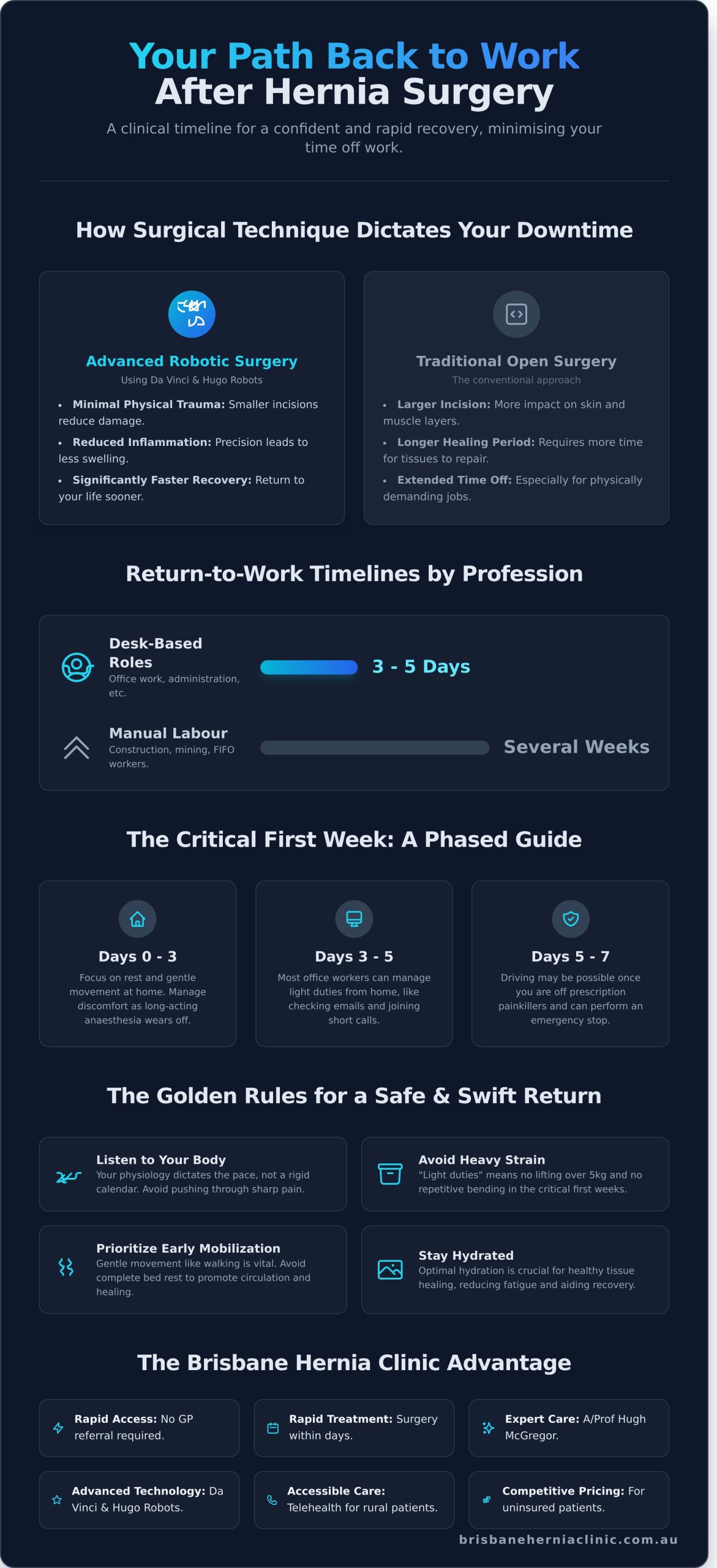
Recovery Timelines by Profession: Desk Work vs. Manual Labour
The duration of your time off work after hernia surgery depends entirely on the physical demands of your role. While A/Prof Hugh McGregor utilizes advanced robotic platforms like the Da Vinci and Hugo systems to minimize tissue trauma, your body still requires specific intervals to ensure a durable repair. At the Brisbane Hernia Clinic, we prioritize a rapid return to function through a structured, clinical approach. We understand that every day away from the job impacts your productivity and livelihood.
Office and Executive Roles
For those in administrative or executive positions, the return to work is remarkably swift. Most patients resume desk duties within 3 to 5 days. You might feel tempted to log on from home the day after your procedure, but we advise at least 48 hours of total rest to clear the residual effects of anaesthesia. Sitting for long periods can cause localized swelling. You should aim to stand and walk for 5 minutes every hour to maintain circulation. If you commute to the Brisbane CBD via the Queensland Rail network, wait until day 4 or 5 to manage the walk to the platform comfortably. Driving is typically restricted for 5 to 7 days until you can perform an emergency stop without hesitation or pain.
Trades and Heavy Industry
Tradies face a stricter timeline because of the mechanical load placed on the abdominal wall. We implement a mandatory 6-week restriction on lifting loads over 10 kilograms. This 42-day milestone is the magic number for mesh integration. If you return to heavy lifting too early, you risk “The Strain,” which can lead to a recurrence of the hernia. You can usually return to “light duties,” such as site inspections or quoting, after 14 days. We recommend a graduated load-bearing schedule. By week 3, you can safely handle 5kg. By week 5, this increases to 10kg. As the current President of the ANZ Hernia Society, A/Prof McGregor emphasizes that following this protocol reduces the risk of chronic post-operative pain, a field where he is recognized as Australia’s leading expert.
FIFO and Regional Workers
Managing your time off work after hernia surgery is a logistical priority for those on “2-and-1” or “even-time” rosters. We suggest scheduling your surgery at the start of your “off” swing to maximize recovery time before your next shift. If you are flying back to a site in the Bowen Basin or Mount Isa, wait at least 7 days before boarding a flight. Cabin pressure changes and long durations of sitting in cramped seats can exacerbate post-surgical discomfort. To support our regional patients, Dr. Watson and A/Prof McGregor offer telehealth follow-ups, removing the need for 800km round trips for a simple check-up. This streamlined process, combined with the lowest surgical prices for uninsured patients in Australia, ensures that high-quality specialist care is accessible regardless of your postcode.
Our clinic is designed for speed and precision. You don’t need a referral to see Dr. Watson for an initial assessment, and he can refer you directly to A/Prof McGregor. This “rapid assessment and rapid treatment” model means you can often have your surgery performed within days of your first phone call, minimizing your total time away from the workforce.
How to Accelerate Your Safe Return to Activity
Recovery isn’t a passive process; it’s an active partnership between you and your surgical team. A/Prof Hugh McGregor, the current President of the ANZ Hernia Society, utilizes the Da Vinci and Hugo robotic systems to perform minimally invasive repairs. These advanced techniques are designed to reduce tissue trauma, which directly influences your comfort levels during the first few days. While your time off work after hernia surgery depends on your specific job requirements, your commitment to early mobilization is the most effective way to shorten that duration.
Walking is your primary recovery tool. We encourage patients to move as soon as the anaesthetic wears off. This simple action prevents deep vein thrombosis (DVT), stimulates bowel function, and reduces post-operative stiffness. You’ll also need to focus on high-quality nutrition. Your body requires increased protein and Vitamin C to repair the surgical site and integrate the mesh. Hydration is equally critical to prevent constipation, which can cause unnecessary abdominal strain. You must strictly follow the “No Lifting” rule, which limits you to nothing heavier than 5kg for the first four weeks. This protects the repair while the internal scarring provides permanent strength.
Our team at the Brisbane Hernia Clinic is available to answer recovery questions as they arise. Dr. Watson provides rapid assessments without a referral, ensuring you have a direct line to specialist advice throughout your journey. Whether you’re a local resident or a fly-in fly-out worker from regional Queensland, our structured support system ensures you aren’t guessing about your progress.
The First Week: Setting the Foundation
During the first seven days, your focus stays on gentle movement and wound care. We recommend a walking schedule of 5 to 10 minutes every hour while you’re awake. This prevents the “stiff” feeling often associated with abdominal surgery. Keep your dressings dry and clean to prevent infection; most patients notice a small amount of bruising or a firm ridge under the incision, which is a normal part of the healing process. By day 3 or 4, you’ll likely transition from prescription analgesics to over-the-counter options like Paracetamol or Ibuprofen. Managing your discomfort effectively allows you to maintain your walking routine without overexertion.
Weeks 2-4: Building Strength
As you enter the second week, your energy levels will improve. You can now introduce low-impact exercises like stationary cycling or swimming, provided your incisions have completely closed. These activities build cardiovascular health without putting direct strain on the abdominal wall. This period is vital for testing your limits before you return to a professional environment. If you’re preparing for your first full day back on-site, practice sitting or standing for extended periods at home first. This gradual build-up ensures that your time off work after hernia surgery ends with a confident and pain-free return to your regular duties.
If you’re ready to start your recovery with Australia’s leading hernia experts, contact the Brisbane Hernia Clinic today for a rapid assessment.
The Brisbane Hernia Clinic Advantage: Rapid Access and Expert Care
The Brisbane Hernia Clinic operates on a core philosophy of rapid assessment and rapid treatment. You don’t need a prior GP referral to start your recovery journey. By booking directly with Dr. Watson through our Rapid Access Pathway, you bypass the traditional medical bureaucracy that often delays treatment by 4 to 6 weeks. This streamlined approach ensures you receive a specialist diagnosis and a direct referral to A/Prof Hugh McGregor within a single business day. Reducing the delay between your first symptom and the operating table is the most effective way to minimize the total time off work after hernia surgery.
Skip the traditional waiting lists. We provide surgical dates within 72 hours of your initial consultation for urgent cases. Our clinic has also negotiated the lowest private surgical prices for uninsured patients in Australia. Uninsured individuals often save over A$2,500 compared to standard private hospital quotes. We maintain multiple consultation suites across Brisbane, Albany Creek, and Redcliffe to ensure your pre-operative and post-operative care is geographically convenient.
A/Prof Hugh McGregor: Specialist Expertise
Choosing an expert surgeon is the most critical factor in your recovery. A/Prof Hugh McGregor is one of Australia’s leading hernia specialists and currently serves as the President of the ANZ Hernia Society. He is a global authority on post-hernia repair pain, a complication that affects approximately 10% to 12% of patients treated with older techniques. His mastery of the Da Vinci and Hugo robotic systems allows for unmatched precision during the procedure. These robotic platforms enable smaller incisions and less internal tissue disruption; this technical accuracy directly translates to less physical trauma for you. For a busy professional, this precision is what shortens the time off work after hernia surgery and facilitates a return to full productivity.
Streamlined Care for Regional and FIFO Patients
We understand the unique logistical hurdles faced by fly-in, fly-out (FIFO) workers and those living in regional Queensland. Our administrative team coordinates your care to match your specific work roster. Teleconsultations with Dr. Watson and A/Prof McGregor eliminate the need for multiple trips to Brisbane before your procedure. We can often organize your initial specialist meeting via video link and schedule your surgery to align with your next “off” swing. This coordination minimizes financial disruption and ensures you have a safe, structured environment for your initial recovery days. Direct referral pathways mean you won’t waste time in local emergency departments or waiting for general surgical clinics. We focus on getting you back to site safely and efficiently.
Our commitment to excellence is reflected in our patient outcomes. By combining the latest robotic technology with a patient-first administrative model, we remove the stress of surgical planning. Whether you are an uninsured patient seeking affordability or a professional requiring the fastest possible return to work, our clinic provides the specialized care you need. Your health and your career don’t have to be at odds when you choose a specialist team dedicated to rapid, high-quality hernia repair.
Take Control of Your Hernia Recovery Today
Managing your recovery doesn’t have to be a guessing game. Whether you’re a desk-based professional needing 3 days of rest or a FIFO worker requiring 6 weeks of modified duties, your time off work after hernia surgery is ultimately dictated by the surgical precision of your repair. Brisbane Hernia Clinic offers rapid access to A/Prof Hugh McGregor, the President of the ANZ Hernia Society and a global leader in robotic surgery using the Da Vinci and Hugo systems. You don’t need a referral for your initial assessment with Dr. Watson. Our streamlined process means you could be in surgery within days; this is ideal for busy schedules and regional patients. We’ve secured the lowest surgical prices for uninsured patients in Australia to ensure elite medical care remains affordable for everyone. Rural patients can also utilize teleconsultations to begin their journey toward pain-free living immediately. You can reclaim your quality of life with confidence and speed.
Book Your Rapid Access Consultation with Brisbane Hernia Clinic
Frequently Asked Questions
How long after hernia surgery can I return to a desk job?
You can typically return to a desk job within 3 to 5 days after your procedure. Because A/Prof Hugh McGregor uses advanced robotic techniques like the Hugo or Da Vinci systems, your recovery is often faster than traditional open surgery. We focus on rapid treatment so you can resume your professional life quickly. If you’re an uninsured patient, we’ve secured the lowest prices in Australia starting from A$2,500 for specific procedures.
When is it safe to resume heavy lifting or manual labor?
Most patients should wait 4 to 6 weeks before resuming heavy lifting or strenuous manual labor. This timeline ensures the surgical mesh or repair has integrated properly with your tissue. The time off work after hernia surgery for physical roles is vital to prevent recurrence. A/Prof McGregor, the President of the ANZ Hernia Society, will provide a tailored recovery plan during your rapid assessment to ensure you return to site safely.
Do I need a medical certificate for my employer after surgery?
Yes, we provide official medical certificates for all patients to cover their recovery period. Our team at the Brisbane Hernia Clinic understands the administrative requirements of Brisbane employers and HR departments. We’ll issue a certificate covering the 3 to 14 days required depending on your specific job duties. You don’t need a GP referral to see Dr. Watson for your initial assessment, which speeds up this entire process.
Can I work from home the day after my hernia operation?
We recommend waiting at least 48 hours before attempting to work from home. While robotic surgery is minimally invasive, the residual effects of general anaesthesia can impact your concentration for 24 hours. You need this time to manage initial aching or discomfort. Our goal is a rapid return to activity, but your safety and cognitive clarity remain our primary clinical priorities during the first 2 days.
What happens if I return to work too early and feel pain?
You should stop working immediately and contact our clinic if you experience sharp pain or increased bulging at the incision site. A/Prof McGregor is Australia’s leading expert on post-hernia repair pain, so we take your discomfort seriously. Returning too early can increase the risk of complications by 15 percent in some cases. We offer teleconsultations for rural patients to assess these symptoms without requiring a trip back to Brisbane.
Is robotic surgery recovery really faster than traditional methods?
Yes, clinical studies show that robotic surgery using the Da Vinci or Hugo robots results in less tissue trauma than traditional methods. This precision reduces the time off work after hernia surgery by approximately 20 to 30 percent for many patients. A/Prof McGregor is one of the few surgeons globally using these robots. This technology allows for smaller incisions, which means you feel less pain and heal much faster.
How do I manage my return to work if I am a FIFO worker?
FIFO workers should plan for a 2 week window of light duties or recovery before returning to a remote site. We specialize in rapid treatment for the mining and resources sector, often scheduling surgery within 7 days of your first contact. Dr. Watson can see you without a referral to start this process. We also use teleconsults to monitor your progress once you’re back on your roster in regional areas.
Does the type of hernia change the time off work needed?
Inguinal hernia repairs often require a more cautious return to heavy lifting than umbilical repairs due to the pressure on the groin. However, both typically allow a return to light office work within 5 days when performed robotically. A/Prof McGregor’s expertise ensures that whether it’s a 2cm umbilical defect or a complex bilateral inguinal hernia, your recovery is optimized. We offer the most affordable rates for these repairs in Australia.