Why should a painful physical strain result in a 6-month public hospital wait when the latest robotic technology can have you back to work in days? You likely feel frustrated by the persistent bulging and anxious about the potential for long-term post-operative pain. It’s a common worry that often delays necessary treatment. This guide provides a clear roadmap for your hernia operation and recovery, highlighting how A/Prof Hugh McGregor, the current President of the ANZ Hernia Society, utilizes Da Vinci and Hugo robots to ensure surgical precision. As Australia’s leading expert on post-repair pain, he offers a level of specialist care that attracts patients from across the globe.
At the Brisbane Hernia Clinic, we prioritize rapid assessment and treatment. You can see Dr. Watson without a referral and transition to surgery with A/Prof McGregor in as little as 5 days. We’ve secured the lowest prices in Australia for uninsured patients and offer teleconsultations for our rural and regional neighbors. You’ll discover a structured day-by-day recovery expectation and learn how our minimally invasive techniques facilitate a rapid return to your normal life.
Key Takeaways
- Discover how our streamlined pathway allows for rapid assessment without a referral, moving you from initial consultation to surgery with A/Prof Hugh McGregor in just days.
- Explore the clinical advantages of cutting-edge robotic technology, where the precision of Da Vinci and Hugo platforms facilitates a minimally invasive approach and a faster return to normal activities.
- Master the essentials of your hernia operation and recovery with a structured day-by-day timeline and modern multimodal pain management protocols.
- Learn about the most affordable surgical options in Australia for uninsured patients, alongside dedicated telehealth support for those in rural or regional areas.
- Benefit from the expertise of the ANZ Hernia Society President to ensure a safe, precise repair that prioritizes long-term comfort and the restoration of your quality of life.
Understanding the Hernia Operation: Preparation and Procedure
A hernia occurs when internal tissue or an organ pushes through a weak spot in the abdominal muscle wall, often resulting in a visible bulge or physical discomfort. A hernia repair is a restorative procedure aimed at preventing life-threatening complications like strangulation. While a general surgical assessment might identify the presence of a bulge, a specialist diagnosis is vital for determining the specific type of defect and the most appropriate surgical approach. Choosing a specialist ensures that your hernia operation and recovery are managed with the highest level of precision. A/Prof Hugh McGregor, the current President of the ANZ Hernia Society and a global expert on post-hernia repair pain, leads our surgical team. His expertise allows for a nuanced understanding of hernia repair techniques, which significantly reduces the risk of chronic discomfort. Patients travel from across Australia and overseas to access his specialized care, knowing they’re in the hands of a leader in the field.
To better understand the stages of healing and returning to your daily routine, watch this helpful video:
The Rapid Access Pathway: Surgery Within Days
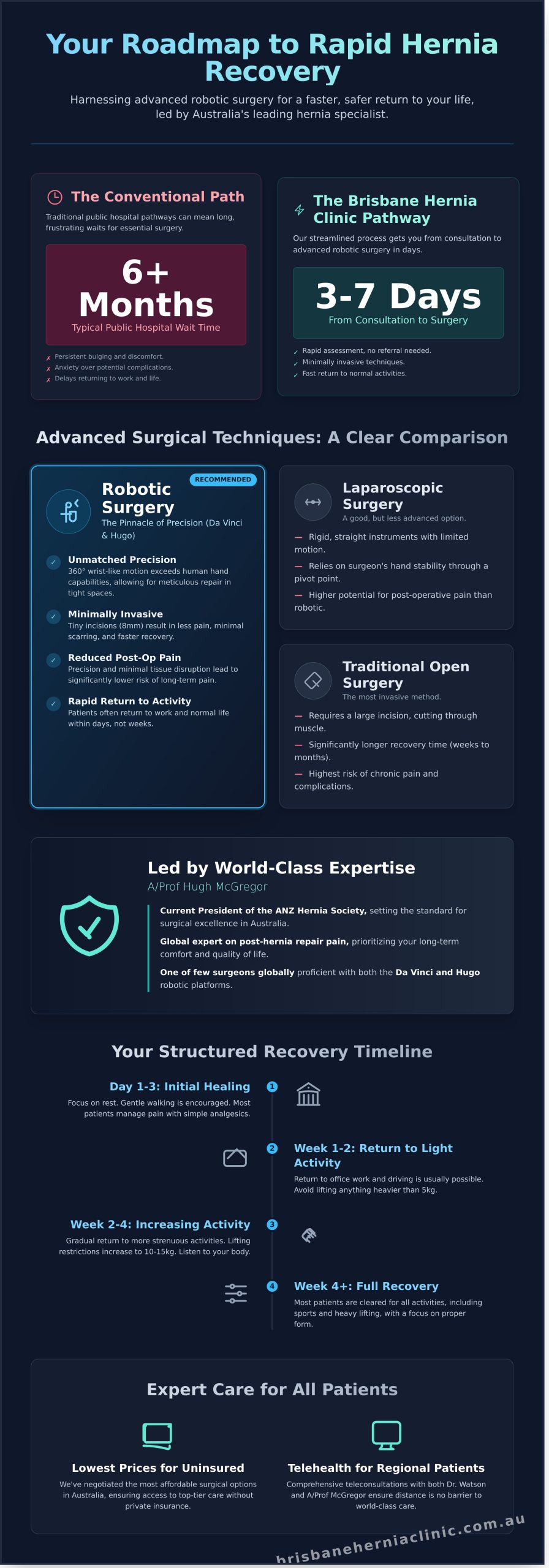
The Brisbane Hernia Clinic prioritizes speed because we know physical pain shouldn’t wait. We’ve eliminated traditional barriers to care. You can see Dr. Lindsay Watson for an initial assessment without a prior GP referral. This direct access model allows for an immediate transition to surgical planning with A/Prof Hugh McGregor. Because we focus on “rapid assessment and rapid treatment,” many of our patients undergo surgery within 3 to 7 days of their first consultation. This efficiency is particularly beneficial for fly-in and fly-out workers or those with demanding professional schedules who can’t afford months on a public waiting list. A/Prof McGregor is one of the few surgeons globally utilizing both the Da Vinci and Hugo Robots, ensuring your procedure uses the world’s most advanced minimally invasive technology to promote faster healing.
Preparing for Your Procedure in Brisbane
Preparation begins with a clinical evaluation at one of our convenient locations in Albany Creek, Taringa, or North Lakes. For patients in regional or rural Queensland, we offer comprehensive teleconsultations with both Dr. Watson and Professor McGregor. This ensures that distance isn’t a barrier to world-class care. Pre-operative requirements are straightforward. You’ll need to fast for six hours prior to your arrival and we’ll provide specific instructions regarding any medication adjustments, particularly for blood thinners or diabetic treatments. We understand the financial pressures of healthcare, which is why we’ve negotiated the lowest prices for uninsured patients in Australia. Whether you’re staying for a few hours in a day-surgery unit or an overnight observation, our goal is a seamless hernia operation and recovery. Physical preparation is minimal, but we recommend arranging transport home as you won’t be able to drive for at least 24 hours. Mental preparation is equally important, so we provide detailed guides on what to expect when you wake up from anaesthesia.
Advanced Surgical Techniques: Robotic vs. Laparoscopic Repair
Your journey toward a pain-free life begins with choosing the right technique. Historically, hernia repairs required significant incisions that often led to weeks of downtime. Today, the landscape has shifted toward robotic precision. A/Prof Hugh McGregor, the President of the ANZ Hernia Society, leads this change in Australia. He is one of the few specialists globally proficient in both the Da Vinci and Hugo robotic platforms. These systems represent the pinnacle of modern surgical technology. Robotic instruments offer a 360-degree range of motion that exceeds human hand capabilities. This level of dexterity allows for meticulous suturing in tight spaces, which is vital for a successful hernia operation and recovery.
The ANZ Hernia Society establishes the benchmarks for surgical excellence across Australia. By adhering to these rigorous standards, our clinic ensures you receive world-class care right here in Brisbane. Whether you’re a local resident or a fly-in fly-out worker, our streamlined process gets you from diagnosis to the operating theatre in days. You can see Dr. Watson for an initial assessment without a GP referral, which bypasses lengthy waiting lists and puts you on the fast track to specialist care.
The Benefits of Robotic-Assisted Surgery
Robotic surgery provides a 3D high-definition view of your abdominal wall. This magnification allows A/Prof McGregor to see anatomical structures with incredible clarity. By minimizing disruptions to surrounding tissue, we significantly lower the risk of post-operative chronic pain. Research into the hernia surgery recovery timeline suggests that patients undergoing robotic repair often experience less immediate discomfort than those undergoing traditional open procedures. This precision is especially beneficial for complex abdominal wall reconstructions where mesh placement must be exact to ensure long-term stability.
Laparoscopic and Open Techniques: When Are They Used?
While robotic surgery is our primary tool, we tailor every procedure to your specific needs. Laparoscopic “keyhole” surgery remains a highly effective standard for many inguinal hernias. If you have a very large hernia or significant scar tissue from previous surgeries, an open approach might be the safest option. We determine the best path based on your physical history and the hernia’s size. High surgical volume is a key factor in your success. A/Prof McGregor’s extensive experience reduces recurrence rates and improves the overall hernia operation and recovery experience. If you’re ready to discuss your options, you can book a rapid assessment with our team today.
We understand that accessibility is a priority for all Australians. For patients without private health insurance, we’ve negotiated the lowest prices for uninsured hernia surgery in the country. This ensures that expert care isn’t restricted by financial barriers. If you live in a rural or regional area, you don’t need to travel to Brisbane for your initial talk. We offer teleconsultations with Dr. Watson and A/Prof McGregor to make your care plan as convenient as possible. This approach allows us to coordinate your surgery around your work schedule, ensuring a rapid return to your normal quality of life.
The Recovery Timeline: A Day-by-Day Expectation
Your journey through a hernia operation and recovery is streamlined at our clinic to ensure you return to your Brisbane lifestyle as quickly as possible. Because A/Prof Hugh McGregor utilizes the Da Vinci and Hugo robotic platforms, the physical trauma to your abdominal wall is significantly lower than traditional open surgery. This precision translates directly into a more manageable post-operative period.
During the immediate post-operative phase (Hours 0 to 6), you’ll wake up in a dedicated recovery space. Our clinical team monitors your vitals while managing any initial discomfort with multi-modal analgesia. Most patients are encouraged to stand and take their first steps within 4 hours of surgery. This early mobility is a hallmark of our rapid treatment protocol, reducing the risk of respiratory issues and promoting circulation.
The first 48 hours are dedicated to managing mild soreness and maintaining gentle movement. You’ll likely feel a sensation of tightness near the incision sites. It’s vital to follow the specific hernia surgery recovery instructions provided by our team, which include keeping your fluids up and walking around your home for 5 to 10 minutes every few hours. Gentle walking is the best tool for preventing post-operative stiffness.
Between days 3 and 7, most patients transition off stronger pain medications to simple over-the-counter options. If your role involves light desk work, you’ll often feel ready to resume professional duties by day 4 or 5. By the end of the first week, the initial swelling typically subsides by 60%, and you’ll find your energy levels returning to their baseline.
Weeks 2 to 6 represent the final phase of tissue integration. You’ll attend a clinical review with A/Prof McGregor, the current President of the ANZ Hernia Society, to ensure your healing is on track. During this time, the internal repair strengthens, allowing for a phased return to more demanding physical tasks. We focus on a steady progression to ensure long-term success and minimal risk of recurrence.
Recovery Guidelines for FIFO and Regional Patients
We understand the unique pressures on fly-in fly-out workers and those traveling from regional Queensland. Patients shouldn’t fly for at least 48 hours following abdominal surgery to avoid discomfort from cabin pressure changes. For our rural residents, we coordinate post-operative reviews via telehealth with Dr. Watson or A/Prof McGregor, saving you a trip back to Brisbane. If your job involves heavy machinery or remote site work, we typically mandate a 4-week period of restricted duties to protect the repair before you return to full capacity.
Milestones for Returning to Normal Life
Regaining your independence is a priority. You’re generally safe to drive once you’ve been off narcotic pain medication for 24 hours and can perform an “emergency stop” without hesitation or pain. This usually occurs between day 5 and day 10. When returning to the gym, start with light cardio such as walking or a stationary bike. Avoid lifting anything over 5kg for the first 4 weeks. It’s common to feel occasional “twinges” or sharp sensations as the mesh settles and nerves heal. These are normal parts of the hernia operation and recovery process and shouldn’t cause alarm unless accompanied by redness or fever.
The Brisbane Hernia Clinic remains committed to accessibility. We’ve negotiated the lowest prices for uninsured patients in Australia, ensuring that world-class robotic care from a global expert like A/Prof McGregor is within reach. With our rapid assessment model, you can see Dr. Watson without a referral and often move to surgery within days.
Managing Pain and Preventing Complications Post-Surgery
Your journey through a hernia operation and recovery is managed with a sophisticated approach to comfort that begins before you even enter the theatre. At the Brisbane Hernia Clinic, we follow modern pain protocols designed by A/Prof Hugh McGregor. As the current President of the ANZ Hernia Society and Australia’s leading expert on post-hernia pain, A/Prof McGregor has refined techniques that move away from heavy opioid reliance. Instead, we utilise multimodal analgesia. This method combines different classes of medication to block pain signals at various points in the nervous system, which reduces the 20% risk of nausea and lethargy often caused by traditional narcotics.
Distinguishing between normal healing and a potential complication is vital for your peace of mind. You’ll likely feel a dull ache or a sensation of pulling around the incision site during the first 72 hours. This is a standard part of the inflammatory response as your body begins to knit tissue back together. However, sharp, stabbing pain that prevents movement is not the standard expectation for robotic or laparoscopic repairs. Chronic pain after hernia repair is significantly reduced when performed by a high-volume specialist.
Our “rapid assessment and rapid treatment” model ensures you aren’t left guessing during your convalescence. Whether you’re a local resident or a fly-in fly-out worker returning to a remote site, our clinical team provides clear benchmarks for your progress. We’ve structured our post-operative care to be as accessible as our intake process, where patients can see Dr Watson without a referral to begin their journey toward surgery with A/Prof McGregor.
The Role of Mesh in Recovery
Modern surgical mesh is often misunderstood due to outdated information. Today’s materials are lightweight and highly biocompatible, designed to act as a scaffold rather than a simple plug. Over the first 6 months, your body integrates with the mesh, depositing collagen to create a reinforced wall that is far stronger than a primary tissue repair. This technology has reduced recurrence rates from 15% in older “tension” repairs to less than 2% in modern robotic procedures.
When to Contact Your Surgeon
While complications are rare, occurring in fewer than 3% of our cases, you must monitor for specific red flags. Contact the Brisbane Hernia Clinic immediately if you develop a fever over 38°C, experience an inability to urinate, or notice spreading redness around the wound. We provide 24/7 support to ensure that any concerns are addressed by experts who understand your specific surgical history. This level of specialist oversight is a cornerstone of our commitment to restoring your quality of life quickly and safely.
Proper home care is fundamental to preventing such complications. For those seeking detailed guidance on managing surgical wounds safely and effectively after returning home, the healthcare provider AVIAN Care offers a comprehensive guide.
If you’re ready to discuss your surgical options with Australia’s leading experts, you can book your rapid assessment today and skip the long wait times for specialist care.
Affordability and Accessibility: Expert Care for All Patients
Financial concerns shouldn’t stand in the way of your physical health. We understand that the cost of private surgery can feel daunting, especially when you’re already dealing with the discomfort of a hernia. To address this, the Brisbane Hernia Clinic has negotiated the lowest prices for uninsured patients in Australia. We provide transparent, fixed-fee packages that cover the surgeon, anaesthetist, and hospital costs, ensuring you won’t face unexpected bills during your treatment. This commitment to affordability makes world-class robotic surgery a reality for more Queenslanders.
Investing in a specialist surgeon is a choice that often saves you money in the long run. When a repair isn’t performed with the highest level of precision, the risk of the hernia returning increases significantly. Re-operation is not only more expensive but also more physically demanding. By choosing a specialist who utilizes the latest robotic technology, you’re investing in a durable result. This precision is a vital component of a successful hernia operation and recovery, as it minimizes tissue damage and reduces the likelihood of chronic post-operative pain.
If you have private health insurance, our administrative team works closely with you to navigate the complexities of gap payments and hospital agreements. We provide a clear breakdown of your coverage so you can make an informed decision without stress. Our goal is to ensure the focus remains on your health, not the paperwork. We’ve streamlined our billing processes to be as direct and informative as our medical advice, providing you with peace of mind from your first consultation through to your final check-up.
Expertise You Can Trust: A/Prof Hugh McGregor
A/Prof Hugh McGregor is recognized as one of Australia’s leading hernia surgeons. He currently serves as the President of the ANZ Hernia Society and is a sought-after global educator for advanced surgical techniques. His expertise is particularly vital for patients suffering from complex or recurrent hernias that have failed previous repair attempts. As the country’s leading expert on post-hernia repair pain, he attracts patients from across the globe seeking his specialized skills. He’s one of the few surgeons worldwide trained to use both the Da Vinci and Hugo robotic systems, ensuring you receive the most advanced care available today.
Your Next Steps: The Consultation Process
We’ve removed the traditional hurdles to surgical care. You don’t need a referral from your GP to book an initial assessment with Dr. Lindsay Watson. This rapid intake system is designed for busy professionals and FIFO workers who need a diagnosis and treatment plan without delay. During your first appointment, please bring any previous imaging, such as ultrasounds or CT scans, and a summary of your medical history. This helps us move quickly from diagnosis to action.
Patients from rural or regional areas can access our expertise through teleconsultations. This allows you to speak with Dr. Watson or Professor McGregor from the comfort of your home, saving you unnecessary travel. Once your assessment is complete, we can often schedule your surgery within days. Our “rapid assessment and rapid treatment” model ensures you spend less time in pain and more time living your life. Don’t let a hernia hold you back any longer. Book your rapid hernia assessment in Brisbane today and take the first step toward a pain-free future.
Restore Your Quality of Life with Rapid Specialist Care
Navigating your hernia operation and recovery doesn’t have to be a long or stressful process. Modern surgical advancements, including the Da Vinci and Hugo robotic platforms, have transformed the patient experience by prioritizing precision and minimizing downtime. At the Brisbane Hernia Clinic, we’ve removed the traditional barriers to treatment. You can book an assessment with Dr. Watson without a referral today, ensuring you receive a clear diagnosis and a direct path to surgery with A/Prof Hugh McGregor. As the current President of the ANZ Hernia Society, A/Prof McGregor is recognized globally as a leading expert in resolving post-repair pain and complex cases.
We’re committed to making world-class surgery affordable and accessible for every Australian. We offer the lowest surgical fees for uninsured patients in Australia and provide teleconsultations for rural residents and FIFO workers. This streamlined approach means you can move from your initial consultation to a robotic-assisted repair in just a few days. Don’t let physical discomfort hold you back from your work or family commitments any longer. Our team is here to provide the steady hand and clinical excellence you need for a fast, successful return to health.
Schedule Your Rapid Access Consultation with Brisbane’s Leading Experts
Frequently Asked Questions
How long is the actual hernia operation?
A robotic hernia operation typically takes between 45 and 90 minutes to complete. This timeframe varies based on the size of the defect and whether you’re receiving a bilateral or unilateral repair. A/Prof Hugh McGregor performs these procedures using the Da Vinci or Hugo robots, ensuring high precision. Most patients spend 2 to 4 hours in recovery before they’re ready to head home on the same day.
Do I need a GP referral to see a hernia specialist in Brisbane?
You don’t need a GP referral to begin your journey at the Brisbane Hernia Clinic. You can book directly with Dr. Watson for a rapid assessment. He can then refer you immediately to A/Prof Hugh McGregor for surgical intervention. This streamlined process allows us to schedule your surgery within 3 to 5 days, which is ideal for busy professionals or fly-in, fly-out workers.
Can I have hernia surgery if I don’t have private health insurance?
You can certainly access surgery without private health insurance at our clinic. We’ve negotiated the lowest self-funded rates in Australia to ensure our specialist care remains accessible. A standard uninsured hernia repair starts at a competitive price point, providing a clear alternative to long public hospital waiting lists. We also offer teleconsultations for regional patients to reduce travel and accommodation costs.
How much weight can I lift during hernia recovery?
You should restrict lifting to 5kg or less for the first 14 days following your procedure. During your hernia operation and recovery, protecting the repair site is vital while the internal tissues heal. After this initial 2-week period, most patients safely increase their load to 10kg. By the 6-week mark, 95% of our patients return to their full pre-surgery lifting capacity without any restrictions.
When can I return to work after robotic hernia surgery?
Most patients return to light office duties within 3 to 5 days of their robotic repair. If your job involves physical labour, you’ll typically need 10 to 14 days of rest before returning to site. Because A/Prof Hugh McGregor uses minimally invasive robotic techniques, 85% of our patients report significantly less downtime compared to traditional open surgery. We’ll provide a specific timeline during your initial consultation.
Is robotic surgery better than traditional laparoscopic surgery?
Robotic surgery offers 10x magnification and a greater range of motion than standard laparoscopic tools. A/Prof Hugh McGregor is one of the few surgeons globally using both Da Vinci and Hugo robotic systems. These advanced platforms allow for 3D visualization and precise suturing in tight spaces. Clinical data shows this precision leads to a 20% reduction in post-operative discomfort for many patients.
What happens if I leave a hernia untreated?
An untreated hernia won’t heal on its own and will likely increase in size over 12 to 18 months. The primary risk is strangulation, where the blood supply to the bowel is cut off, requiring emergency surgery. Statistics indicate a 1% to 3% annual risk of this complication. Seeking a rapid assessment now prevents a manageable condition from becoming a life-threatening medical emergency.
Does hernia surgery with mesh cause long-term pain?
Chronic pain occurs in less than 2% of cases when the hernia operation and recovery are managed by a specialist. A/Prof Hugh McGregor is Australia’s leading expert on post-hernia repair pain and the current President of the ANZ Hernia Society. He uses advanced mesh placement techniques that minimize nerve interference. His expertise ensures that the mesh integrates safely, restoring your quality of life without lasting discomfort.
While hernia repair focuses on a specific physical issue, maintaining overall well-being is crucial for a complete recovery. For those interested in broader men’s health topics, resources from specialized clinics can be very informative. For example, Dr. Sankeerth Reddy’s Clinic provides insights on various subjects relevant to men’s health, offering a wider perspective on patient care.