Did you know that by 2026, more than 80% of patients seeking hernia surgery brisbane have access to advanced minimally invasive platforms that can significantly reduce surgical downtime? You likely recognise the nagging discomfort of a physical bulge or a sharp ache during exercise, and the prospect of a long public waitlist only adds to your frustration. It’s common to feel anxious about the differences between robotic and laparoscopic techniques or to worry about the long term safety of modern surgical mesh.
We’ve created this guide to provide you with expert clinical insights into the most effective repair options available across the region. You will gain a clear understanding of how modern surgical precision can eliminate your pain and facilitate a return to your normal routine in fewer than 10 days. We’ll explore the latest data on robotic assisted repairs, clarify current mesh safety protocols, and outline exactly what you can expect during your recovery journey with a specialist surgeon dedicated to your long term health.
Empowering yourself with knowledge is the first step in managing any health concern, from understanding surgical options to recognizing the signs of other urgent issues. For example, patient guides from health providers like Star Dental Care are invaluable for learning about conditions such as dental abscesses, ensuring you can seek timely care when needed.
Key Takeaways
- Learn why adult hernias require surgical intervention and how to identify the clinical symptoms that signal it is time for professional medical care.
- Compare the benefits of robotic, laparoscopic, and open techniques to determine the most effective approach for your hernia surgery brisbane.
- Gain clarity on the safety of modern surgical mesh and how these innovative scaffolds support your body’s natural tissue growth for long-term stability.
- Navigate the logistics of private and public healthcare costs in Queensland, including how A$ fees are managed through Medicare and Private Health Insurance.
- Discover how the Rapid Access Pathway provides immediate specialist expertise, streamlining your journey toward a fast and safe recovery.
Understanding Hernia Surgery in Brisbane: Signs, Symptoms, and Necessity
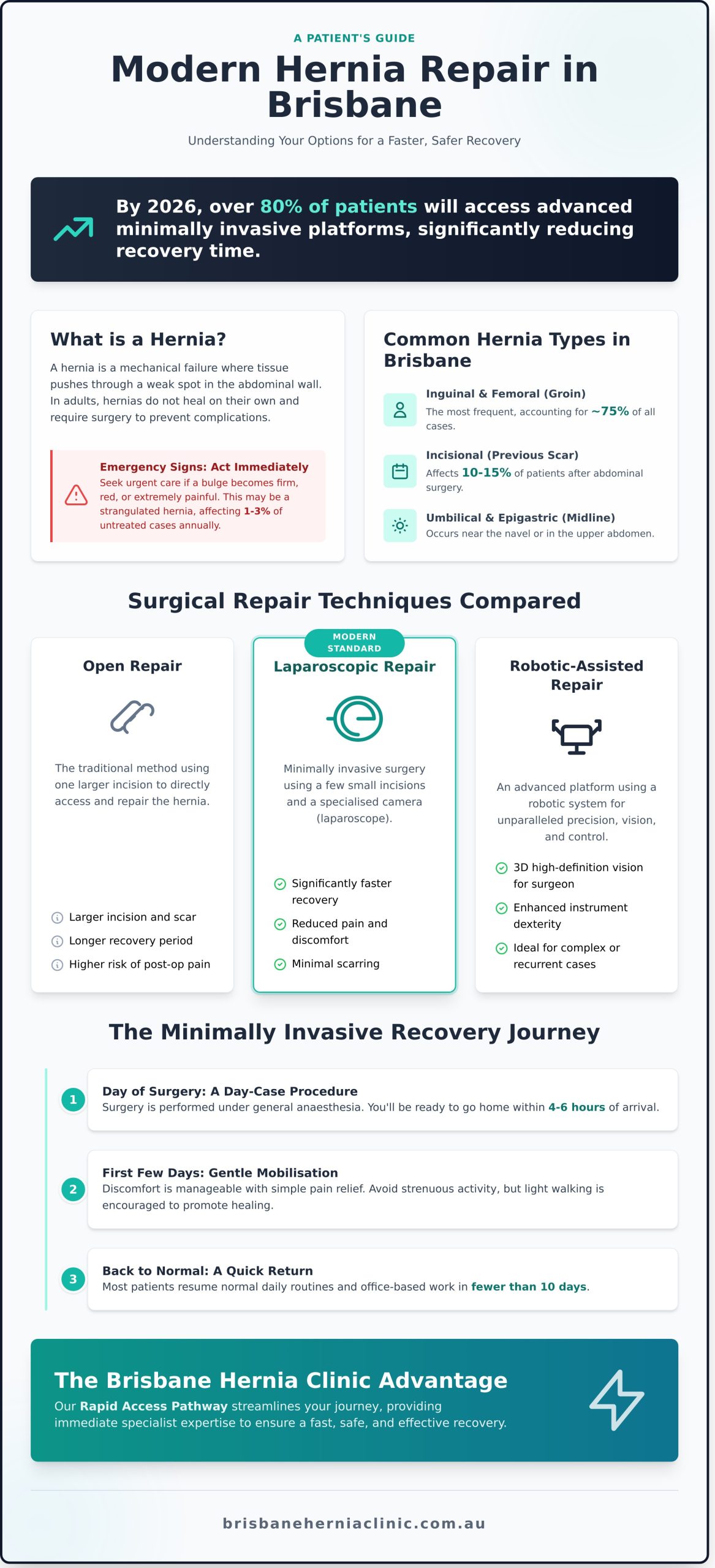
A hernia occurs when an internal organ or fatty tissue pushes through a localized weakness in your surrounding muscle or connective tissue. This structural defect creates a visible or palpable bulge, often accompanied by physical discomfort. You should understand that in adult patients, hernias are mechanical failures of the abdominal wall. They don’t heal spontaneously with rest, exercise, or medication. Because the defect tends to enlarge over time due to intra-abdominal pressure, seeking hernia surgery brisbane is the standard medical recommendation to prevent future complications.
Brisbane residents often notice symptoms during specific local conditions. Our humid summer months, where temperatures frequently exceed 30°C, often involve increased physical activity or outdoor sports that place sudden strain on the abdomen. You might feel a dull ache or a heavy sensation while gardening in the heat or during a weekend run along the Brisbane River. This discomfort usually intensifies during heavy lifting, coughing, or prolonged standing, as these actions increase the pressure against the weakened muscle wall. For a deeper look at the various surgical methods used to correct these issues, you can consult this comprehensive guide to hernia repair which details the evolution of these procedures.
Most patients undergo elective surgery to restore their quality of life and prevent the condition from worsening. However, you must recognize the signs of a medical emergency. If a bulge becomes firm, red, or extremely painful and cannot be pushed back into the abdomen, it may be “strangulated.” This means the blood supply to the trapped tissue is cut off. Clinical data suggests that approximately 1% to 3% of untreated inguinal hernias progress to this state annually, requiring immediate surgical intervention to prevent tissue necrosis.
Common Hernia Types Treated in Brisbane Clinics
Inguinal and femoral hernias are the most frequent reasons for specialist consultations in our region, accounting for approximately 75% of all abdominal wall defects. These occur in the groin area and are significantly more common in men. Umbilical and epigastric hernias involve weaknesses near the navel or the upper midline of the abdomen; these often become more prominent after weight fluctuations or pregnancy. We also frequently treat incisional hernias. These develop at the site of a previous surgical scar, affecting roughly 10% to 15% of patients who have undergone prior abdominal operations.
When to Seek a Specialist Consultation
You should book a consultation if you notice a persistent “dragging” sensation in the abdomen or groin that worsens by the end of the day. While some hernias cause acute, sharp pain, many present as a vague heaviness that limits your ability to exercise or work. In a professional clinical setting, we utilize physical examinations and high-resolution ultrasound, which has a sensitivity of roughly 90% for detecting hernias that aren’t easily visible. Early intervention is vital. Addressing the issue while the defect is small allows for simpler surgical techniques, lower recurrence rates, and a faster return to your daily Brisbane lifestyle.
Comparing Surgical Techniques: Open, Laparoscopic, and Robotic Repair
Surgical techniques for hernia repair have evolved significantly over the last 30 years. What was once a procedure requiring a large incision and a week of hospital stay has become a streamlined, precision-focused experience. When you prepare for hernia surgery brisbane, you’ll likely find that most procedures are performed in modern day-surgery units. These facilities are designed for efficiency and patient comfort. You’ll receive general anaesthesia, ensuring you remain completely asleep and pain-free during the operation. Most patients are ready to be driven home within 4 to 6 hours of their arrival, thanks to advanced recovery protocols.
The choice between open, laparoscopic, and robotic techniques isn’t a one-size-fits-all decision. Surgeons evaluate the hernia’s size, its location, and your previous surgical history to determine the safest path. For example, a primary inguinal hernia in a fit individual is often handled differently than a recurrent hernia in a patient with significant scar tissue. The goal is always a “tension-free” repair, which reduces the risk of the hernia returning. This usually involves the use of a medical-grade mesh. For those curious about the materials used, reviewing hernia mesh safety information can provide clarity on how these devices support the abdominal wall during healing.
The Rise of Robotic-Assisted Hernia Surgery
Robotic-assisted surgery represents the current pinnacle of abdominal wall repair. Using the Da Vinci robotic system, surgeons operate with a 3D high-definition view that provides 10x magnification. This level of detail allows for incredible precision when navigating delicate nerves and blood vessels. By 2026, robotic repair has become the gold standard for complex abdominal wall reconstructions in Australia. Because the robotic instruments have a greater range of motion than the human hand, there’s often less trauma to surrounding tissues. This precision typically results in a 25% reduction in post-operative opioid requirements for many patients.
This level of precision is made possible by advancements in automation technology, a field that also powers Australia’s advanced manufacturing sector. For readers interested in the industrial side of these technologies, suppliers such as InstroDirect are key providers of the necessary equipment.
Laparoscopic (Keyhole) vs. Open Surgery
Laparoscopic surgery, often called keyhole surgery, uses three small incisions usually between 5 and 12 millimetres. It offers several distinct advantages:
- Minimal scarring and improved cosmetic results.
- A 40% faster return to light office work compared to open procedures.
- Lower rates of wound infection due to the smaller incision sites.
Open surgery is still a highly effective and necessary tool in a specialist’s repertoire. It involves a single incision directly over the hernia. This approach is often the safest choice for very large hernias or for patients who cannot tolerate the carbon dioxide gas used to inflate the abdomen during keyhole surgery. While the external incision is larger, the internal repair is just as robust. If you’re concerned about which approach is right for your physical requirements, speaking with an experienced surgeon can help you weigh the benefits of each method.
Recovery milestones differ across these techniques. Patients undergoing laparoscopic or robotic hernia surgery brisbane often resume driving within 3 to 5 days. In contrast, open surgery patients may need 10 to 14 days before they feel comfortable behind the wheel. Regardless of the method, the focus remains on restoring your quality of life and getting you back to your routine with a strong, permanent repair.
The Role of Mesh in Modern Hernia Repair: Safety and Innovation
You’ve likely heard discussions regarding surgical mesh safety. It’s a common point of concern for patients preparing for hernia surgery brisbane. We view mesh not as a foreign object, but as a sophisticated scaffold. This structure supports your body’s natural healing process, allowing your own collagen and tissue to weave through the material to create a reinforced abdominal wall. By 2026, the surgical community in Brisbane has shifted almost exclusively to lightweight, macroporous, and biocompatible materials. These innovations allow the mesh to remain flexible and move with your body while providing necessary structural integrity.
Historically, hernia repairs relied solely on stitches to pull the edges of a hole together. This created significant tension, and recurrence rates often reached as high as 15%. When researching Modern Hernia Repair Options, you’ll find that the evolution of these materials has transformed patient outcomes. With the advent of modern mesh techniques, recurrence figures have plummeted to less than 2% for most primary repairs. This reduction in the need for repeat surgeries is a direct result of better material science and improved surgical precision.
Addressing Mesh Misconceptions
It’s vital to distinguish between the historical complications associated with transvaginal mesh and the abdominal mesh used in hernia repair. These are entirely different clinical applications with different risk profiles. Specialists in Brisbane minimize complications like chronic pain through precise anatomical placement and the use of absorbable fixation devices or even medical glues instead of traditional tacks. When meeting your specialist, you should ask these specific questions:
- Is the mesh being used a lightweight, macroporous variety?
- Will you be using a “tension-free” technique to secure it?
- How does this specific material integrate with my tissue type?
The goal is a repair that feels natural. By using the latest fixation techniques, surgeons ensure the mesh stays exactly where it’s needed without irritating surrounding nerves. This careful approach is why the vast majority of patients return to their daily routines without ever feeling the presence of the mesh.
Tailored Management and Mesh-Free Alternatives
While mesh is the gold standard for most cases, it isn’t the only path available. The Shouldice technique, developed in the 1940s, remains a viable mesh-free alternative for specific, small inguinal hernias. This approach involves a multi-layered repair using only sutures. We often discuss this option with high-performance athletes or patients with confirmed sensitivities to synthetic materials. Every plan for hernia surgery brisbane must be evidence-based and tailored to the individual.
We don’t believe in a one-size-fits-all solution. Instead, we match the repair method to your specific physiology, the size of the defect, and your lifestyle requirements. For a patient who lifts heavy weights professionally, a mesh repair often provides the most reliable long-term security. For a younger patient with a very small defect, a non-mesh repair might be appropriate. Your surgeon’s role is to weigh these factors and provide a recommendation that prioritizes your safety and a rapid return to your quality of life.
Navigating the Logistics: Costs, Locations, and Recovery
Choosing the right path for your medical care involves weighing the differences between the public and private systems in South East Queensland. Public surgery through Queensland Health is available at no direct cost to eligible patients, but wait times for non-emergency hernia repairs often exceed 365 days. If you opt for private hernia surgery brisbane, you gain the ability to choose your specialist and schedule your procedure within a timeframe that suits your professional and personal life, often as quickly as 14 to 21 days after your initial consultation.
Understanding the financial landscape is a priority for our team. We provide every patient with a detailed written quote to ensure Informed Financial Consent. This document breaks down the estimated “gap” payment, which is the difference between the specialist’s fee and what insurance covers. Medicare generally contributes 75% of the Medicare Benefits Schedule (MBS) fee for private procedures. Your Private Health Insurance (PHI) covers the remaining 25% of that schedule fee, along with hospital costs such as theatre fees and accommodation. You’ll only be responsible for your agreed policy excess and any professional gap fees disclosed upfront.
Specialist Care Across Brisbane and North Lakes
We provide expert consultations in North Lakes, Albany Creek, and Redcliffe to ensure your care remains close to home. By offering local appointments, we reduce the travel burden on you and your support network during the diagnostic and follow-up phases. Our specialists operate at leading facilities including North Lakes Day Hospital and Peninsula Private Hospital. These locations provide high-tech surgical environments and specialized nursing teams focused on rapid recovery and patient safety.
Recovery Milestones and Returning to Activity
Your recovery begins the moment you wake up from anaesthesia. During the first 48 hours, you’ll focus on managing localized tenderness with prescribed analgesia and performing short, frequent walks around your home to encourage circulation. Most patients who undergo laparoscopic (keyhole) hernia surgery brisbane find they can return to office-based work or light administrative duties within 3 to 7 days. This quick turnaround is a primary benefit of minimally invasive techniques that minimize muscle trauma.
- Days 1-2: Rest at home, gentle mobilization, and adherence to the prescribed pain management plan.
- Days 3-7: Graduation to light daily activities; most patients stop taking strong pain relief during this window.
- Week 2: Return to driving is usually permitted once you can perform an emergency stop without hesitation or pain.
- Week 6: This is the critical milestone for structural healing. You must avoid lifting objects heavier than 5 kilograms until this point to protect the repair.
Long-term success depends on your post-operative follow-up appointment, typically scheduled 2 to 4 weeks after your procedure. This visit allows your surgeon to monitor the healing of your incisions and provide a personalized timeline for returning to the gym, running, or heavy manual labor. We prioritize a structured return to your normal routine to ensure the durability of the repair and your overall quality of life.
Ready to discuss your treatment options and receive a clear breakdown of costs? Book a consultation with our Brisbane specialists today.
The Brisbane Hernia Clinic Advantage: Rapid Access and Specialist Expertise
Choosing where to undergo hernia surgery brisbane is a decision that directly impacts your long-term physical comfort and mobility. At the Brisbane Hernia Clinic, we’ve restructured the patient journey to eliminate the frustrations of long waiting lists and fragmented care. Our Rapid Access Pathway allows you to engage with our specialist team immediately. You don’t need a prior GP referral to start the process with our GP specialist, which removes a common barrier to timely treatment. This direct access ensures that your symptoms are evaluated by experts who focus exclusively on abdominal wall health.
Our clinical model relies on the close synergy between Dr. Hugh McGregor, a specialist general surgeon, and Dr. Lindsay Watson, our GP specialist. They work in tandem to ensure your diagnosis is precise and your surgical plan is tailored to your specific anatomy. Dr. Watson provides the initial comprehensive assessment, while Dr. McGregor applies his two decades of surgical experience to the repair itself. This collaborative approach means you receive a continuity of care that is often missing in larger, more generalized hospital settings.
Streamlined Pathways for Faster Relief
Waiting times in the traditional healthcare system can be a significant source of anxiety. A standard referral process often involves a 4 to 6 week wait just to secure an initial consultation with a specialist. Our Rapid Access Pathway reduces this timeframe significantly, with most patients seen in less than 1 week. We provide a one-stop assessment for routine hernias at our Albany Creek and Taringa clinics, allowing for a quick diagnostic review and a clear path forward.
By centralizing our diagnostic tools and specialist knowledge, we provide a structured environment where you can get answers quickly. If you’re experiencing a persistent ache or a visible bulge, you shouldn’t have to wait months for a resolution. Our clinics are designed to facilitate rapid movement from your first phone call to your final postoperative checkup. This efficiency is especially beneficial for patients who need to plan their surgery around work commitments or family responsibilities.
Expertise You Can Trust
Experience is the most critical factor in surgical success. Dr. Hugh McGregor has performed thousands of procedures over 20 years, focusing on advanced laparoscopic and robotic techniques. High-volume centers like ours typically see lower complication rates because the entire team maintains a sharp focus on a specific set of procedures. Medical data indicates that surgeons performing more than 50 hernia repairs annually achieve better patient outcomes and lower recurrence rates than those who perform them less frequently. We prioritize minimally invasive methods to ensure you experience less postoperative pain and a faster return to your daily routine.
Our commitment to robotic-assisted surgery represents the latest advancement in hernia surgery brisbane. This technology allows for greater precision in tight anatomical spaces, which is particularly useful for complex or recurrent hernias. Our goal is always the restoration of your quality of life through the most effective and least traumatic means possible. You can regain your strength and return to the activities you love without the constant distraction of physical discomfort.
To book your first appointment, you can contact our reception team or use our online booking portal. When you arrive at our Albany Creek or Taringa locations, please bring the following items:
- Any previous imaging results, such as ultrasounds or CT scans
- A current list of all medications and dosages
- Your Medicare card and private health insurance details
- A referral from your GP, if you already have one
We’re here to provide the steady hand and expert mind you need for a successful recovery. Take the first step toward a life free from hernia pain by contacting us today.
Restoring Your Quality of Life with Advanced Hernia Care
Living with the persistent ache or visible bulge of a hernia doesn’t have to be your permanent reality in 2026. Modern medicine has shifted toward minimally invasive robotic and laparoscopic repairs that prioritize shorter recovery times and reduced post-operative discomfort. Choosing the right path for hernia surgery brisbane means accessing technology that reinforces your abdominal wall with precision while minimizing the impact on your daily routine.
At the Brisbane Hernia Clinic, you’re supported by the expertise of Dr. Hugh McGregor, a specialist surgeon who’s been performing these complex procedures since 2002. You don’t need to wait for months or navigate complex red tape; our Rapid Access Pathway allows you to consult a specialist even without a prior GP referral. Whether you require a standard inguinal repair or a complex robotic reconstruction, our team focuses on getting you back to your active lifestyle safely and efficiently.
Book your specialist hernia assessment in Brisbane today to discuss your treatment options and receive a clear, fixed-cost estimate in A$. You deserve the confidence that comes with expert surgical care and a steady hand on your journey to recovery.
Frequently Asked Questions
Do I need a GP referral for hernia surgery at the Brisbane Hernia Clinic?
Yes, you need a current GP referral to claim Medicare rebates for your specialist consultation and subsequent surgery. A referral ensures your GP has assessed your symptoms and provided us with your relevant medical history. This document is typically valid for 12 months and allows you to access a rebate of approximately A$78.05 for your initial assessment with our surgical team.
How much does private hernia surgery cost in Brisbane?
The cost for private hernia surgery depends on your level of health fund coverage, but out-of-pocket surgeon fees usually range from A$500 to A$1,500. Total costs include the surgeon, anesthetist, and hospital stay fees. We provide a detailed Informed Financial Consent quote after your first appointment so you understand every expense before you commit to the procedure.
How long is the recovery time after a laparoscopic hernia repair?
Most patients return to light office work within 3 to 5 days following a laparoscopic procedure. While you’ll feel some aching for the first 48 hours, our minimally invasive techniques allow for a faster return to daily life. You should avoid heavy lifting over 5 kilograms for 4 to 6 weeks to ensure the mesh integrates securely with your tissue.
What is the difference between robotic and laparoscopic hernia surgery?
Robotic surgery uses specialized 3D imaging and wristed instruments that provide greater precision than the straight tools used in traditional laparoscopic surgery. Both are excellent options for hernia surgery brisbane patients. The robotic platform offers a 10x magnified view, which helps your surgeon navigate complex anatomy. This often leads to a 15% reduction in postoperative discomfort for complex abdominal wall repairs.
Can I drive myself home after a hernia operation?
You cannot drive yourself home because the general anesthetic impairs your coordination and reflexes for at least 24 hours. You must arrange for a responsible adult to collect you from the hospital and stay with you overnight. Most patients resume driving within 5 to 7 days, provided they can perform an emergency stop without pain and aren’t taking sedative pain medications.
What happens if I leave my hernia untreated?
Leaving a hernia untreated increases the risk of incarceration or strangulation, where the protruding tissue becomes trapped and loses its blood supply. Hernias don’t heal on their own and 25% of men with an inguinal hernia will eventually require surgery due to increasing pain. If strangulation occurs, it becomes a medical emergency requiring intervention within 6 hours to prevent tissue death.
Is hernia surgery covered by Medicare in Australia?
Yes, Medicare covers a portion of the fees for hernia surgery brisbane when the procedure is medically necessary. Medicare pays 75% of the Medicare Benefits Schedule (MBS) fee for in-hospital procedures, while your private health insurer covers the remaining 25%. You’ll still be responsible for any gap fee charged by the specialist. We’ll explain these specific MBS item numbers during your consultation.
How do I know if my hernia is an emergency?
A hernia is an emergency if the bulge becomes hard, red, or purple and is accompanied by severe pain, nausea, or vomiting. If you can’t push the bulge back into your abdomen or if you stop passing gas, seek medical attention at an emergency department immediately. These symptoms indicate a 90% likelihood of bowel obstruction or strangulation, which requires urgent surgical repair.