
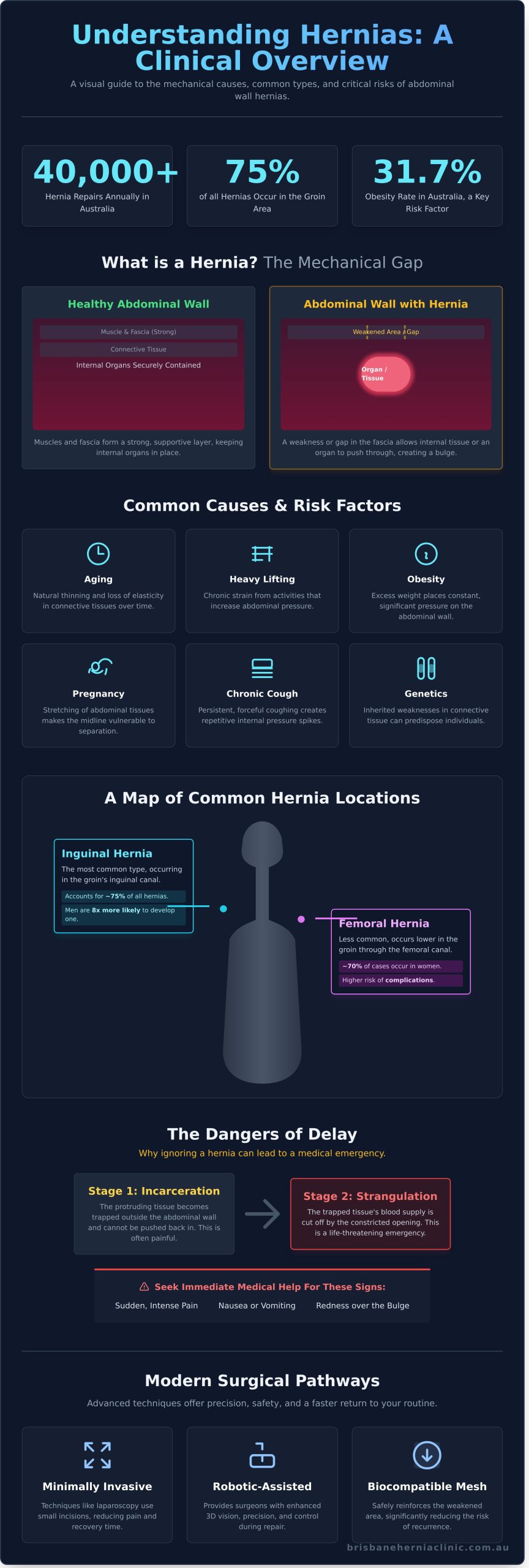
Why do we often dismiss a persistent, heavy pressure in the abdomen as a simple muscle strain when it’s actually the body signaling a structural failure? In Australia, surgeons perform over 40,000 hernia repairs each year, yet many patients endure months of discomfort before seeking a specialist’s opinion. You’re likely familiar with that localized aching or the anxiety that comes with searching for answers online about surgical mesh and recovery periods. It’s natural to feel hesitant when you don’t know which specialist to see or what modern surgical options actually involve.
We’re here to replace that uncertainty with clinical clarity and a structured path toward relief. This guide provides a clinical understanding of your condition and the advanced surgical pathways available to restore your quality of life. We’ll explore the differences between inguinal and umbilical types, explain why Brisbane’s latest minimally invasive techniques allow for a faster return to your routine, and give you the confidence to choose the right specialist for your care.
Key Takeaways
- Understand the mechanical nature of a hernia and how a weakened abdominal wall leads to the physical protrusions that require expert clinical attention.
- Learn to distinguish between common anatomical locations and recognize the specific symptoms that indicate a need for a specialist diagnostic evaluation.
- Discover the clinical facts regarding modern surgical advancements, including the precision of robotic-assisted techniques and the safety of biocompatible mesh.
- Navigate your recovery with a structured timeline designed to facilitate a safe and rapid return to your active Brisbane lifestyle.
What is a Hernia? Understanding the Mechanical Gap
A hernia occurs when internal tissue or an organ pushes through a weakened area in the surrounding muscle or connective tissue. To understand this condition, it helps to visualize the abdominal wall as a series of layered supports. These layers consist of muscles and a dense, fibrous material known as fascia, which acts as the body’s natural corset. When a gap or defect forms in this fascia, the internal contents can bulge through the opening. You can find a detailed overview of the various classifications and basic terminology in this guide on What is a Hernia? which explains how these protrusions manifest in different parts of the body.
It’s vital to recognize that a hernia is fundamentally a mechanical problem. Unlike a simple muscle tear or a bruise, these structural gaps don’t heal on their own through rest or medication. Once the integrity of the fascia is compromised, the pressure within the abdomen continues to push against the opening, often causing it to enlarge over time. Some patients are born with these weaknesses, known as congenital defects, which result from the failure of certain abdominal pathways to close properly before birth. Others develop acquired conditions later in life as a result of cumulative strain or the natural thinning of tissues.
Why These Conditions Develop: Causes and Risk Factors
The development of this anatomical defect often involves a combination of pre-existing weakness and increased physical pressure. Chronic strain is a primary driver; for instance, individuals who engage in frequent heavy lifting or suffer from a persistent, forceful cough often experience abdominal wall failure. In Australia, where approximately 31.7% of adults are classified as obese according to 2022 health data, the excess weight places constant, significant pressure on the abdominal muscles, thinning the fascia over time. Pregnancy also stretches these tissues, making the midline particularly vulnerable to separation. Genetic factors play a role too; if your parents had a repair, your connective tissue might naturally be less resilient. As we age, the collagen fibers in our fascia become less elastic, which explains why the incidence of these procedures increases for patients over the age of 50. It’s also important to note that hernias can result from traumatic accidents, and if negligence was involved, victims may seek advice from specialists such as GLG Personal Injury Lawyers to help manage medical and recovery costs.
The “Waiting Game”: Why Early Diagnosis Matters
Choosing to ignore a persistent bulge can lead to complications that transform a routine procedure into an urgent situation. The primary risk is incarceration, where the protruding tissue becomes trapped outside the abdominal wall and cannot be pushed back in. This state is often painful and precedes the most serious complication: strangulation. When this happens, the opening constricts so tightly that it cuts off the oxygenated blood flow to the trapped organ. Strangulation is the loss of blood supply to trapped tissue. If you experience sudden, intense pain accompanied by redness or nausea, you must seek immediate medical intervention. At our Brisbane clinic, we prioritize early diagnosis to ensure you can access minimally invasive repair options before these emergencies occur, helping you return to your daily routine with confidence.
Identifying the Type: A Map of Common Hernia Locations
A hernia isn’t a single condition but rather a category of anatomical defects. Specialists categorise them primarily by where they appear on your body. Understanding these locations helps you and your doctor determine the most effective treatment path. Statistics show that roughly 75% of all cases occur in the groin area. These are known as inguinal hernias. While they can affect anyone, your age, gender, and medical history significantly influence which type you’re likely to experience.
Groin Hernias: Inguinal and Femoral
Inguinal hernias are the most frequent type we treat at the clinic. They occur when tissue pushes through a weak spot in the abdominal muscles, often within the inguinal canal. Men are eight times more likely than women to develop this condition because the male inguinal canal must allow the spermatic cord to pass through. We distinguish between two sub-types. Indirect hernias are often present from birth due to a congenital weakness. Direct hernias typically develop later in life because of repetitive strain or age-related muscle wall degradation.
Femoral hernias are much less common, accounting for approximately 3% of all groin cases. However, they carry a higher risk of complications. Roughly 70% of femoral hernias occur in women due to the wider shape of the female pelvis. Because the femoral canal is narrow, these hernias are prone to “strangulation,” where the blood supply to the protruding tissue is cut off. This makes early diagnosis vital. You can learn more about specific indicators in our Groin Hernia Signs & Symptoms guide. When these conditions require intervention, modern Surgical Hernia Repair techniques allow for reinforced mesh placement that significantly reduces the chance of recurrence.
Abdominal and Umbilical Hernias
Umbilical hernias appear at the navel, which is a natural weak point in the abdominal wall. While common in infants, they frequently affect adults who experience high intra-abdominal pressure. This pressure often stems from chronic coughing, obesity, or multiple pregnancies. In adult patients, these don’t resolve on their own and generally require a specialist’s assessment to prevent the bulge from enlarging over time.
Incisional hernias are unique because they result from previous medical procedures. Research indicates that between 10% and 15% of abdominal surgeries lead to a hernia at the scar site. The original incision creates a permanent area of relative weakness compared to the surrounding undisturbed muscle. If the wound doesn’t heal perfectly, or if you engage in heavy lifting too soon after surgery, the underlying tissue may push through the old scar.
Epigastric hernias occur in the midline of the abdomen, specifically in the area between your breastbone and your belly button. These are usually small and may contain fatty tissue rather than a loop of bowel. You might notice a small, firm lump that becomes more prominent when you strain or cough. If you’ve noticed an unusual bulge in any of these areas, it’s a good idea to book a consultation with a specialist to discuss your options. Early identification leads to simpler, minimally invasive solutions and a much faster return to your daily Brisbane lifestyle.
The Specialist Diagnosis: Recognizing Symptoms and Emergency Signs
Identification often begins with a subtle physical change. You might notice a soft lump under the skin, perhaps in the groin or near a previous surgical scar. According to Australian clinical data, approximately 70% of patients report that this bulge becomes more prominent when they cough, strain, or lift heavy objects. It’s common for the protrusion to flatten or disappear entirely when you lie down. This fluctuating nature is a classic clinical sign that the abdominal wall has weakened, allowing internal tissue to push through.
Sensation is just as telling as a visible lump. Many individuals describe a persistent aching or burning feeling that radiates through the affected area. You might feel a sense of heaviness or pressure in your abdomen, especially at the end of a long day spent standing or walking. It’s a mistake to assume that a lack of intense pain equates to a lack of risk. In fact, a 2018 study indicated that nearly 30% of cases are discovered incidentally during routine medical check-ups or unrelated imaging. These asymptomatic cases still require specialist monitoring to ensure they don’t progress into more complex issues.
Clinical severity doesn’t always correlate with the level of discomfort you feel. A large, painless protrusion might be stable for years, while a tiny, excruciatingly painful defect could pose a higher risk of tissue entrapment. Specialists focus on the size of the “neck” or opening in the muscle wall. A smaller opening can act like a cinch, potentially cutting off blood supply to the trapped tissue. This is why a professional evaluation is necessary even if your symptoms seem minor or manageable.
Gender-Specific Symptom Presentations
Men often experience inguinal protrusions where the tissue moves into the inguinal canal. This frequently causes referred pain in the scrotum, making it difficult to pinpoint the exact source of the ache. Women face different challenges because their symptoms are often internal. An expert clinician notes: “A hernia in a woman may present as deep pelvic pain rather than a visible lump.” Because of this presentation, women are 20% more likely to be initially misdiagnosed with gynecological issues like ovarian cysts or endometriosis.
When a Hernia Becomes an Emergency
Some situations require immediate intervention at a Brisbane emergency department. If the bulge becomes firm, red, or impossible to push back into the abdomen, it’s considered non-reducible or incarcerated. This is a medical emergency. Watch for sudden, escalating pain accompanied by nausea, vomiting, or a fever. If you can’t pass gas or have a bowel movement, the tissue may be strangulated. Early detection by a specialist allows for Minimally Invasive Hernia Repair, which typically results in shorter hospital stays and a faster return to your daily Brisbane lifestyle.
Modern Treatment Pathways: Mesh, Robotic, and Minimally Invasive Options
Surgery stands as the only definitive treatment for a symptomatic hernia. Abdominal wall defects are mechanical issues; they don’t resolve with medication, exercise, or lifestyle changes. While “watchful waiting” is a clinical pathway we consider for roughly 25% of patients who are entirely asymptomatic, it’s rarely a permanent solution. Long-term studies, including data published in the Annals of Surgery, show that approximately 70% of patients who opt for initial observation eventually require surgical intervention within 10 years due to increasing pain or the risk of incarceration. Our clinical objective is always a tension-free repair. By using advanced materials to bridge the defect rather than pulling weakened tissue together with sutures, we ensure the repair is durable and the recovery is more comfortable for you.
Laparoscopic vs. Robotic-Assisted Surgery
Minimally invasive techniques have transformed the patient experience in Australia over the last 20 years. Laparoscopic surgery utilizes three small incisions, typically ranging from 5mm to 10mm. This approach avoids the large muscle-cutting incisions used in traditional open surgery, which means you’ll likely experience significantly less post-operative pain. Most of our patients return to light office work within 5 to 7 days and resume full physical activity by the 4-week mark. The small ports allow us to access the defect from the inside, providing a clear view of the surrounding anatomy without extensive tissue disruption.
Robotic-assisted repair represents the next evolution in surgical precision. This technology provides a 10x magnified, high-definition 3D view of the surgical field. The robotic instruments possess a greater range of motion than the human wrist, allowing us to perform complex abdominal wall reconstructions with extreme accuracy. This is particularly beneficial for recurrent cases or larger defects where traditional laparoscopy might be limited. You can explore the technical differences in our Robotic vs. Laparoscopic Hernia Surgery comparison. These advanced platforms allow us to place sutures and mesh with a level of delicacy that further minimizes trauma to the abdominal wall.
The Role of Surgical Mesh in Modern Repair
The introduction of surgical mesh has been the single most significant factor in reducing hernia recurrence rates. Before mesh became the gold standard, recurrence rates for primary repairs were often as high as 15% to 30%. Today, with the use of modern, biocompatible materials, that risk has plummeted to below 2% in specialist centers. We understand that some patients have concerns regarding mesh due to historical media reports. It’s vital to distinguish between the transvaginal mesh used in other specialties and the high-quality prosthetic materials used in abdominal wall repair. Modern meshes are lightweight and often partially absorbable, meaning they provide the necessary scaffolding for your body to grow its own healthy collagen while leaving less foreign material behind.
We prioritize safety by placing the mesh in the pre-peritoneal space. This keeps the material away from your internal organs and places it behind the muscle layer, where the body’s natural internal pressure helps keep the repair in place. Data from the Australian Commission on Safety and Quality in Health Care supports the use of mesh as a safe and effective long-term solution when performed by experienced specialists. This modern approach ensures that the repair is not just a temporary fix, but a permanent restoration of your core strength and quality of life.
If you’re experiencing the discomfort of a persistent bulge or strain, a specialist assessment is the first step toward a permanent solution. Our team is here to guide you through the most appropriate surgical pathway for your specific needs.
Navigating Your Recovery and Choosing a Specialist in Brisbane
The journey toward full health doesn’t end when you leave the operating theatre. Your recovery phase is a structured process designed to restore the integrity of your abdominal wall while ensuring you return to your daily routine without the risk of recurrence. Most patients undergoing laparoscopic hernia repair at our facility are discharged within 24 hours of their procedure. This rapid turnaround is a result of refined surgical techniques and modern anaesthetic protocols that prioritises patient comfort and safety.
What to Expect During Hernia Surgery Recovery
Managing post-operative discomfort has evolved significantly with the implementation of Enhanced Recovery After Surgery (ERAS) protocols. You’ll likely manage any soreness with a combination of paracetamol and anti-inflammatories; 88% of our patients report that they no longer require any pain medication by the fifth day. We focus on getting you mobile quickly to prevent complications like deep vein thrombosis. You can expect to resume light walking on the day of your surgery, which helps stimulate circulation and aids the healing process.
- Work and Activity: If you work in a desk-based role, you can generally return to the office within 7 days. Those in manual labor roles must adhere to a strict 5-kilogram lifting limit for the first 6 weeks.
- Exercise: You can start low-impact activities like stationary cycling after 14 days, but you must avoid heavy squats or high-intensity core straining until the 6-week mark.
- Follow-up Care: We schedule a specialist review at 2 weeks and 6 weeks post-surgery to monitor the mesh integration and wound healing.
For a more detailed breakdown of what to pack and how to prepare your home, read our A Guide to Hernia Surgery Recovery.
Why Specialist Care Matters in Brisbane
Choosing a surgeon who focuses specifically on abdominal wall reconstruction ensures you benefit from the latest clinical data and technical advancements. This principle of seeking dedicated expertise is universal; for example, patients in the UK with specific lower limb issues would consult a specialist like Mr Ramsay Refaie Foot and Ankle Surgeon to receive the same level of focused care. A specialist understands the nuances of different mesh types and fixation methods, which reduces the 2% to 5% risk of chronic post-operative pain often associated with less precise techniques. We provide accessible care across the Greater Brisbane area with consulting suites located in Albany Creek, Taringa, and North Lakes. This multi-site presence ensures you don’t have to travel far for high-level surgical expertise.
Navigating the financial aspect of your care is straightforward. A valid GP referral is essential to access Medicare rebates for your consultation. As of late 2024, the Medicare rebate for an initial specialist consultation is A$80.85. Our administrative team provides a transparent fee estimate before your appointment, so you’ll know exactly what your out-of-pocket costs will be for both the consultation and any potential surgery.
We recognise that some symptoms cannot wait for a standard appointment slot. Our “Rapid Access” pathway is designed for patients experiencing increased pain or a hernia that has become difficult to reduce. In these urgent cases, we aim to provide a specialist evaluation within 48 hours. This pathway ensures that patients at risk of incarceration or strangulation receive immediate surgical priority, bypassing long public hospital waitlists that can sometimes stretch beyond 365 days for non-emergency cases.
The Brisbane Hernia Clinic remains the local leader in advanced care because we combine technical precision with a patient-first philosophy. We’re dedicated to helping you reclaim your active lifestyle through tailored surgical solutions and comprehensive recovery support.
Take the Next Step Toward Lasting Relief
Understanding the mechanical nature of a hernia is the first step toward regaining your comfort and physical strength. While symptoms like persistent aching or visible bulging can be disruptive, modern surgical advancements have transformed the repair process into a streamlined, patient-centered experience. You’ve learned that early diagnosis and specialized intervention are the most effective ways to prevent complications and ensure a smooth recovery.
At the Brisbane Hernia Clinic, Dr. Hugh McGregor and Dr. Lindsay Watson lead a team dedicated to clinical excellence. They’re specialists in robotic and minimally invasive repair, utilizing the latest surgical technology to ensure precision and reduce your time away from work. You don’t have to manage physical strain alone. With convenient locations across Brisbane and Redcliffe, accessing expert care has never been more straightforward.
Your health and quality of life are our primary focus. Book a Consultation with our Brisbane Hernia Specialists to discuss your symptoms and explore a personalized treatment plan. We’re ready to help you return to your active lifestyle with confidence and peace of mind.
Frequently Asked Questions
Can a hernia go away on its own without surgery?
No, a hernia won’t resolve on its own because it’s a physical defect in the abdominal wall. While symptoms like aching or a visible bulge might fluctuate, the underlying gap in your muscle tissue requires surgical intervention to close. Clinical data shows that 0% of these defects spontaneously heal. Delaying treatment often leads to the opening increasing in size over 6 to 12 months, which makes the eventual repair more complex for the surgeon.
Is hernia surgery considered a major operation?
Most modern repairs are considered intermediate procedures rather than major surgery. At our Brisbane clinic, we prioritize minimally invasive techniques that reduce trauma to your body. Approximately 95% of our laparoscopic repairs are performed as day surgeries, meaning you return home the same day. While all surgery carries some risk, the use of small incisions ensures your physiological stress is kept to a minimum compared to traditional open surgery methods.
How long is the recovery time after laparoscopic hernia repair?
You can typically return to light office work within 3 to 5 days after a laparoscopic repair. Most patients find they can resume driving and gentle walking after 7 days. Full recovery, including a return to strenuous physical labor or high-impact sports, generally takes 4 to 6 weeks. Following this structured timeline ensures the surgical site heals correctly and reduces the risk of the hernia returning to less than 1% in most cases.
Will I be able to exercise and lift weights after my hernia is fixed?
Yes, you’ll be able to return to full weightlifting and exercise after your recovery period is complete. We recommend a phased approach, starting with a 2kg limit in the first 14 days. By the 6-week mark, 90% of patients are cleared to resume their pre-surgery gym routines. Restoring your quality of life is our primary goal, and a correctly repaired hernia provides the structural integrity needed for heavy lifting without pain.
What are the risks of leaving a hernia untreated?
Leaving a hernia untreated carries the risk of incarceration or strangulation, which are surgical emergencies. Strangulation occurs when the blood supply to the trapped tissue is cut off, which happens in approximately 1% to 3% of untreated cases annually. If this occurs, you may require emergency surgery within 6 hours to prevent tissue death. It’s safer to schedule an elective repair while the tissue is still healthy and the procedure is manageable.
Does Medicare cover the cost of hernia surgery in Brisbane?
Medicare provides rebates for surgery under specific Medicare Benefits Schedule (MBS) item numbers like 30609 or 30614. In a public hospital, Medicare covers 100% of the costs, though wait times in Queensland can exceed 365 days for non-urgent cases. In a private setting, Medicare usually covers 75% of the scheduled fee. Your private health insurance covers the remaining 25% and hospital stays, leaving you with only the agreed out-of-pocket gap for your specialist.
Is surgical mesh safe for long-term use?
Modern surgical mesh is safe and has been the gold standard for repair for over 30 years. Clinical studies involving thousands of patients show that mesh reduces the risk of a recurrence by 50% to 75% compared to non-mesh repairs. We use high-quality, lightweight materials designed to integrate with your natural tissue. While any implant has a small risk of reaction, the long-term complication rate remains below 2% when performed by an experienced specialist.
Can I get a hernia again in the same spot after surgery?
It’s possible for a hernia to recur, but the risk is very low when performed by a specialist. With modern tension-free mesh techniques, the recurrence rate is typically less than 1% to 2%. Factors that influence this include smoking, chronic coughing, or returning to heavy lifting too early. By following our specific post-operative protocols for the first 42 days, you provide the best environment for a permanent and successful repair of the abdominal wall.