What if the most intimidating part of your hernia repair wasn’t the surgery itself, but the outdated belief that a major procedure requires a large, painful incision? You’re likely feeling a mix of apprehension about general anaesthesia and confusion over whether "keyhole" or "robotic" surgery is actually the safer choice for your body. It’s natural to worry about how long you’ll be away from your family or your job in Brisbane while you recover from physical discomfort like bulging or aching.
This specialist guide demystifies the process of laparoscopy, showing you how modern techniques reduce post-operative pain and lower complication rates by 40% compared to traditional open methods. You’ll gain the confidence to choose a minimally invasive path that prioritizes your safety and long-term comfort. We’ll walk through the surgical steps, explain why these advancements offer a faster return to daily activity, and outline a clear 14 day timeline for your journey back to full health and exercise.
Key Takeaways
-
Understand the "keyhole" philosophy and how major internal repairs are achieved through incisions as small as 0.5cm.
-
Learn why laparoscopy is often the preferred minimally invasive choice, offering a sophisticated balance of precision and faster recovery compared to traditional open surgery.
-
Gain insight into the surgical journey, from the specialized placement of trocars to the advanced visualization techniques used by your specialist.
-
Discover why most patients can return home the same day and what to expect during the critical first few hours of your recovery in Brisbane.
-
Find out how to bypass long waiting lists through the Rapid Access Pathway for expert surgical assessment without a prior referral.
Table of Contents
-
The Procedure: What Happens During Laparoscopic Hernia Surgery?
-
Laparoscopy vs. Open vs. Robotic Surgery: Choosing the Right Path
What is Laparoscopy? Understanding the "Keyhole" Philosophy
When you’re diagnosed with a hernia, the prospect of surgery can feel daunting. However, modern surgical techniques have transformed this experience, moving away from the large, invasive incisions of the past. What is Laparoscopy? At its core, it’s a minimally invasive approach that allows a specialist to perform complex internal repairs through tiny ports rather than one wide opening. This technique uses a specialized camera and slender instruments to navigate the abdominal cavity with extreme precision.
The "keyhole" metaphor describes the ability to achieve major internal corrections through incisions measuring between 0.5cm and 1cm. This isn’t just about minimizing scars. By using these small entry points, we access the hernia defect without the significant muscle and tissue disruption required in traditional open surgery. It’s a philosophy of maximum internal repair with minimum external impact. You’ll find that this approach respects the integrity of your abdominal wall, which is essential for a smooth recovery.
This technique represents a major leap in medical history. Laparoscopy began as a diagnostic tool in the early 1900s, but it wasn’t until the late 1980s that it became a primary surgical method. The first laparoscopic gallbladder removal in 1987 changed everything, proving that surgeons could perform intricate work without "opening up" the patient. Since then, the technology has advanced to include 4K high-definition imaging and articulating instruments that mimic the human wrist.
In the Australian healthcare system, laparoscopy has become the gold standard for most elective hernia repairs. Data from the Australian Institute of Health and Welfare reflects a consistent preference for minimally invasive methods due to their efficiency and safety. At the Brisbane Hernia Clinic, we prioritize this method because it offers a tension-free repair, often using a lightweight mesh to reinforce the weakened area from the inside. This internal reinforcement is structurally superior for many patients, particularly those with recurrent or bilateral hernias.
The Core Components: Camera, Light, and Gas
The laparoscope is the central piece of technology in this procedure. It’s a long, thin tube equipped with a high-intensity light and a high-definition camera that acts as the surgeon’s eye. This provides a magnified, crystal-clear view of the hernia and surrounding structures on a monitor in the operating theatre. To create enough room to work safely, we use carbon dioxide gas. Insufflation is the process of gently inflating the abdominal cavity with carbon dioxide to allow clear visibility. This temporary "air dome" ensures that your internal organs are safely distanced from the surgical instruments during the repair.
Why Surgeons Prefer Minimally Invasive Access
We prefer laparoscopy because it significantly reduces trauma to your body. Large incisions require cutting through skin, fat, and muscle, which leads to more pain and a longer healing time. With keyhole surgery, the abdominal wall remains mostly intact. This precision leads to several clinical advantages:
-
Enhanced Visualization: High-definition magnification allows us to identify and protect delicate nerves and blood vessels that might be harder to see with the naked eye.
-
Lower Infection Risk: Smaller wounds are less exposed to the environment. Clinical studies show that laparoscopic wound infection rates are often below 2%, significantly lower than traditional open surgery.
-
Reduced Incisional Hernias: Because the incisions are so small, the risk of developing a new hernia at the site of the surgery is greatly diminished.
By choosing this advanced method, you’re opting for a procedure designed to get you back to your Brisbane lifestyle as quickly as possible. The focus is always on precision, safety, and a rapid return to your normal daily activities.
The Procedure: What Happens During Laparoscopic Hernia Surgery?
Your journey begins in the anaesthetic bay, where you meet the specialist team dedicated to your care. After the initial checks, the team transfers you to the operating theatre. Once the anaesthetic takes effect, the surgeon creates three small incisions, typically ranging from 5mm to 12mm in size. These tiny openings serve as entry points for "trocars," which are hollow tubes that act as ports for the surgical instruments. Through one port, we insert a high-definition laparoscope. This camera transmits a magnified, crystal-clear image of your internal anatomy onto a monitor, providing a level of detail that traditional open surgery cannot match.
The surgeon then uses specialized, long-handled instruments to perform the repair. We first identify the hernia sac, which is the small pouch of peritoneum poking through the abdominal wall. We gently "reduce" the hernia by pulling the protruding tissue back into its correct position inside the abdomen. This process is handled with extreme precision to avoid any trauma to the surrounding nerves or blood vessels. This methodical approach is a hallmark of The Laparoscopy Procedure, ensuring the internal structures are clearly visualised before any repair begins.
Anaesthesia and Patient Safety
Laparoscopic hernia repairs are almost always performed under general anaesthesia. This is a deliberate choice for your comfort and safety. It ensures your abdominal muscles are fully relaxed, which is essential for the surgeon to create the necessary space to work. Throughout the entire operation, a consultant anaesthetist monitors your vital signs, including heart rate and oxygen saturation, every single minute. Modern anaesthetic techniques are incredibly sophisticated. The risk of "accidental awareness" is exceptionally low, occurring in approximately 1 in 19,000 cases according to the 5th National Audit Project. You will remain in a deep, pain-free sleep until the procedure is finished.
Precision Repair with Surgical Mesh
To prevent the hernia from returning, we use a lightweight, flexible surgical mesh to reinforce the weakened area. The surgeon rolls the mesh into a tight cylinder, passes it through a 10mm port, and then unfurls it inside the abdomen. We position this mesh behind the defect, using the body’s internal pressure to help hold it in place. To ensure it stays secure, we use fixation methods such as absorbable tacks, medical-grade glue, or self-gripping mesh technology. These materials are highly biocompatible and designed to stay in the body permanently. Over 6 to 12 months, your natural tissue grows into the mesh, creating a strong, permanent reinforcement. This technique has reduced recurrence rates to less than 2% for primary repairs in specialist centres.
If you have been experiencing a persistent ache or a visible bulge in the groin, it is a good idea to discuss your symptoms with a specialist to see if this minimally invasive approach is right for you. Our goal is always to restore your quality of life with the highest level of surgical precision and care.
Laparoscopy vs. Open vs. Robotic Surgery: Choosing the Right Path
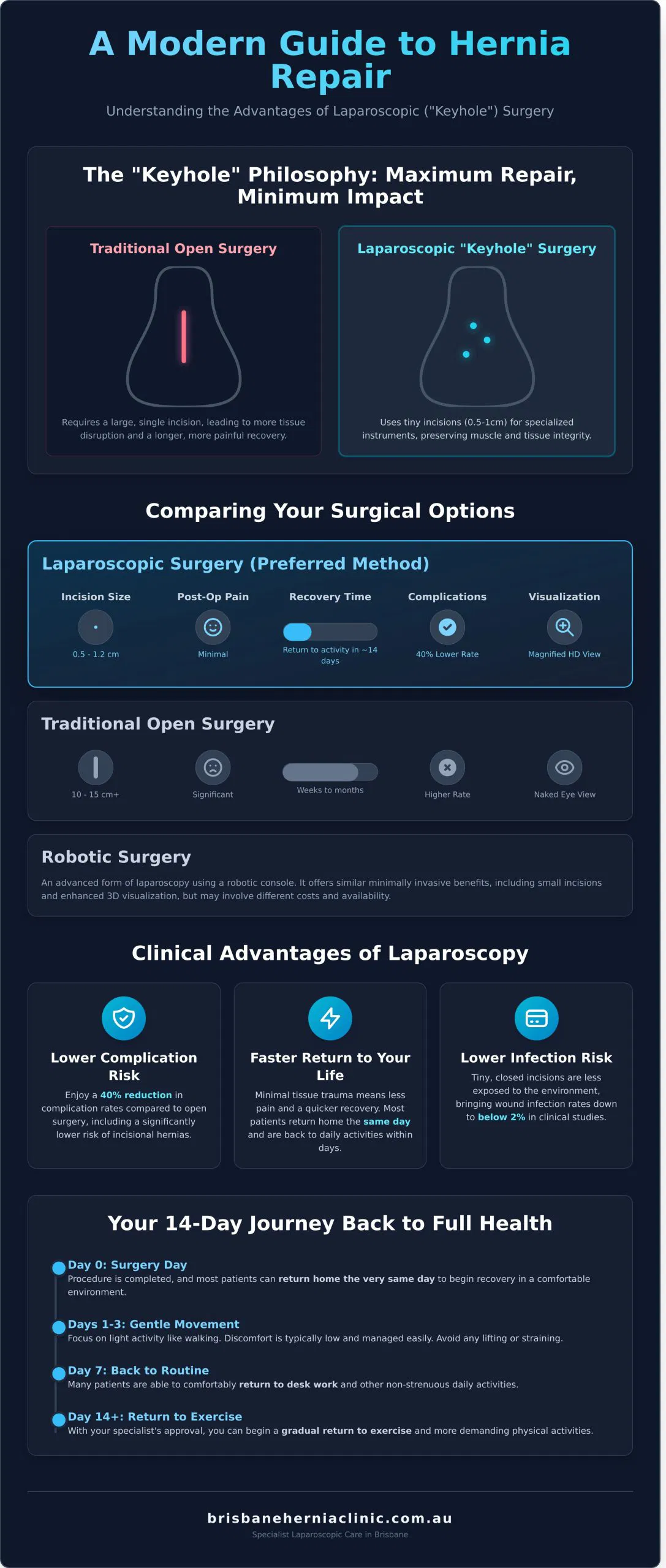
Choosing the right surgical approach is a decision we make together based on your specific anatomy, medical history, and lifestyle goals. You’ll find three primary paths available: open, laparoscopic, and robotic-assisted. Each method has its place in a modern Brisbane clinic, but the goal remains the same: a durable repair with minimal disruption to your life. Deciding between these methods depends on your history. If you’ve had previous abdominal surgeries, laparoscopy might be the safer route to avoid existing scar tissue and reduce the risk of wound complications.
You might worry that open surgery is "stronger" because the surgeon can see the hernia with their own eyes. This is a common concern, but it’s largely a misconception. While open surgery is a reliable and time-tested standard, modern Laparoscopic Surgery provides 10x to 15x magnification on a high-definition monitor. This allows us to see nerves and blood vessels with far greater clarity than the naked eye. The strength of the repair comes from the precise placement of the mesh and the body’s natural healing process, not the size of the incision.
When is Laparoscopy Superior to Open Surgery?
Laparoscopy is often the gold standard for patients with bilateral hernias (bulges on both sides) or recurrent hernias that were previously repaired using an open technique. By entering the abdomen through small, 5mm to 10mm incisions, we avoid the scar tissue from your previous operation. Data from clinical trials suggests that this approach offers significant advantages:
-
Reduced Chronic Pain: Patients report a 20% lower incidence of long-term groin pain and numbness compared to open surgery.
-
Faster Recovery: Most patients return to light office work within 3 to 5 days.
-
Athletic Return: You can typically resume heavy lifting or high-impact sports by week 4, whereas open surgery often requires 6 to 8 weeks of restricted activity.
The Robotic Advantage: When Precision Matters Most
The robotic system represents the next evolution of laparoscopy. While standard laparoscopic tools are "straight-stick" instruments with limited movement, the robot provides wristed instrumentation. These tools mimic the human hand but with a 360-degree range of motion and zero tremor. This level of control is vital for complex abdominal wall reconstructions where we must suture internal layers with extreme accuracy. It bridges the gap between the visibility of keyhole surgery and the tactile flexibility of open surgery. To understand if this advanced technology fits your specific case, you can explore our detailed guide on Advanced Robotic Hernia Repair.
Ultimately, the "best" technique isn’t universal. A small, simple primary hernia in a patient who isn’t concerned about a 5cm scar might be perfectly suited for an open repair under local anaesthetic. However, for the majority of active Australians looking to minimize downtime and chronic discomfort, minimally invasive options provide a clear clinical edge. We tailor the approach to ensure your repair is as robust as possible while protecting your quality of life.
Recovery and Aftercare: Life After Keyhole Surgery
Following your laparoscopy, you’ll spend the first 2 to 4 hours in a dedicated recovery ward. Clinical staff monitor your vital signs, including heart rate and oxygen levels, as the anaesthesia wears off. Most patients at Brisbane Hernia Clinic benefit from the "day surgery" model, which allows for discharge on the same day as the procedure. This modern approach is possible because minimally invasive techniques cause significantly less tissue trauma and blood loss than traditional open surgery. You’ll be ready to head home once you can tolerate oral fluids, walk short distances, and pass urine comfortably.
The first 48 hours involve managing mild to moderate discomfort at the incision sites. You might also experience "referred pain" in your shoulder tips. This sensation occurs because residual carbon dioxide gas used to inflate the abdomen during the procedure can irritate the phrenic nerve. It’s a common side effect that typically resolves within 48 hours as your body naturally absorbs the gas. Moving around your home frequently helps dissipate this gas and eases the sensation faster than remaining stationary.
The First Week: Activity and Wound Care
Your recovery at home begins with simple wound management. You can generally shower 24 hours after surgery, though it’s vital to pat the waterproof dressings dry rather than rubbing them. These dressings should remain in place until your scheduled follow-up or until they begin to peel at the edges. Monitoring the three small incision sites for unusual redness, heat, or discharge is a standard part of your post-operative routine.
Walking is your most effective tool for a smooth transition during this first week. We recommend 5 to 10 minutes of gentle pacing around the house every few hours to promote healthy blood flow and prevent respiratory issues. You should avoid heavy lifting and strenuous "light duties" like vacuuming or hanging laundry during these first 7 days. For a detailed roadmap of your progress, you can review our guide on Week-by-Week Recovery After Hernia Surgery.
Returning to Normal: Work, Driving, and Sport
Most patients can return to non-strenuous office work within 7 days of a laparoscopic hernia repair. If your role involves physical labour, you may require 2 to 3 weeks of modified duties to protect the repair site. Driving is typically permitted within 3 to 5 days, provided you’re no longer taking strong analgesics and can perform an emergency stop without any hesitation or sharp pain. Every patient’s physiological response is unique, so these timelines serve as a general specialist framework.
Resuming high-impact sports or gym routines requires more patience. While walking is encouraged, you must avoid lifting objects heavier than 10 kilograms for at least 4 to 6 weeks. This period allows the internal mesh and your body’s natural tissues to integrate and reach maximum structural strength. Your recovery concludes with a formal follow-up consultation with Dr. McGregor or Dr. Watson. During this appointment, we’ll assess your healing and provide the final clearance for a full return to all physical activities.
If you’re ready to discuss your surgical recovery plan with a specialist, book a consultation at the Brisbane Hernia Clinic today.
Accessing Specialist Laparoscopic Care in Brisbane
Choosing the right surgeon for your laparoscopy is the most critical decision in your recovery journey. Clinical data suggests that surgeons who perform more than 100 hernia repairs annually achieve significantly lower recurrence rates and fewer post-operative complications. At the Brisbane Hernia Clinic, our specialists focus almost exclusively on these procedures. This high-volume experience ensures that every movement is precise, every mesh placement is secure, and every patient receives the benefit of refined surgical intuition. We don’t just perform surgery; we specialise in the restoration of abdominal wall integrity.
We understand that living with a hernia is more than just a physical inconvenience. The constant aching or the visible bulge can limit your ability to work, exercise, and enjoy life with your family. Our approach combines this technical expertise with a commitment to getting you back to your normal routine as quickly as possible. By utilising advanced minimally invasive techniques, we focus on reducing trauma to the body, which leads to less post-operative pain and a faster return to the activities you love.
The Rapid Access Service: Timely Diagnosis
Waiting months for a specialist appointment while in physical discomfort is frustrating. We’ve redesigned the patient journey to eliminate these delays. Our Rapid Access Service allows you to bypass the traditional GP-to-specialist waiting cycle, which often stretches beyond 40 days in the Brisbane metropolitan area. You don’t need a formal referral to start the assessment process with our team, though we’ll coordinate closely with your regular doctor once your treatment plan is established.
Your journey begins with our dedicated nurse coordinators. These experienced professionals conduct an initial clinical assessment to understand the severity of your symptoms and the nature of your hernia. They act as your primary point of contact, ensuring that any necessary diagnostic imaging is ready before you even see the surgeon. This streamlined process means you get answers faster and can schedule your surgery without unnecessary administrative hurdles. Book your Rapid Access Assessment today to take the first step toward relief.
Our Brisbane Locations
Accessibility is a cornerstone of our patient-centered care. We’ve established a network of consultation suites to ensure you don’t have to travel across the city for expert advice. You can find our specialists at several convenient hubs:
-
Albany Creek: Serving the northern suburbs with convenient local access and ample parking.
-
North Lakes: Providing modern facilities for the growing Moreton Bay region
-
When the time comes for the procedure itself, we operate at leading private hospitals across Brisbane. These facilities are equipped with the latest surgical towers and high-definition imaging systems required for advanced laparoscopy. Most of our patients return home within 24 hours of their surgery, often reporting a 65% reduction in discomfort within the first week compared to traditional open surgery methods. This efficiency is a result of our meticulous focus on keyhole techniques.
Our goal is simple: to restore your quality of life through precision and care. By choosing a specialist clinic that prioritises minimally invasive techniques, you’re choosing a faster recovery, smaller scars, and a durable repair. We’re here to guide you through every stage, from that first diagnostic call to your final post-operative check-up. Your health shouldn’t have to wait for a long list; we provide the path to a pain-free future today.
Take the Next Step Toward Lasting Relief
Choosing the right surgical approach is a vital step in resolving the persistent ache of a hernia. Modern laparoscopy transforms hernia repair into a streamlined process. It prioritizes smaller incisions and reduced pain, helping you return to work or sport much faster than traditional methods. While the "keyhole" philosophy is often the preferred choice, the most effective outcome depends on matching the technique to your specific clinical needs. Every patient’s body is different, so your surgical path should be just as unique.
At the Brisbane Hernia Clinic, we’ve provided specialized care to the Queensland community since 2002. Led by Dr. Hugh McGregor, our team maintains expertise in robotic, laparoscopic, and open techniques to ensure you receive the most appropriate treatment. We know that waiting for surgery can be a source of anxiety. That’s why our Rapid Access Pathway is designed to accelerate your treatment timeline, moving you quickly from diagnosis to recovery. You don’t have to live with the daily strain of a hernia. Consult with our Brisbane specialists to see if laparoscopy is right for you. We’re here to help you move forward with confidence and comfort.
Frequently Asked Questions
Is laparoscopy considered major surgery?
Yes, laparoscopy is considered major surgery because it requires general anaesthesia and the entry into a body cavity. While the incisions are small, typically 5mm to 10mm, the internal repair is significant. We maintain the highest clinical standards to ensure your safety throughout the procedure. This approach allows us to address the hernia effectively while minimising the impact on your body’s overall systems.
How long does a laparoscopic hernia repair take?
A standard laparoscopic hernia repair usually takes between 45 and 60 minutes to perform. If you have a bilateral hernia, which means a hernia on both sides, the procedure may take up to 90 minutes. You’ll then spend approximately 2 to 3 hours in the recovery area. Most of our patients return home the same day to begin their recovery in comfort.
Will I have scars after keyhole surgery?
You’ll have three or four small scars following your keyhole procedure. These incisions are very small, usually between 5mm and 12mm long, which is much smaller than the 10cm incision used in traditional surgery. These marks generally fade over 12 months until they’re barely visible. We use dissolvable sutures and waterproof dressings to help your skin heal as cleanly as possible.
Can a laparoscopy be converted to an open surgery?
Surgeons can convert a laparoscopy to open surgery if they encounter unexpected anatomical challenges or dense scar tissue. This transition happens in fewer than 1% of cases in our Brisbane practice. It isn’t a failure of the procedure, but a professional decision made to ensure your safety. If this occurs, the surgeon will complete the repair using a traditional larger incision.
How soon can I drive after a laparoscopy?
You can usually return to driving within 5 to 7 days after your surgery. You must be able to perform an emergency brake maneuver without feeling sharp pain or hesitation. It’s also vital that you’ve stopped taking any strong opioid pain relief for at least 24 hours. Always check your specific car insurance policy, as some Australian insurers have strict post-operative exclusion periods.
Is laparoscopy safe for older patients or those with other health conditions?
Laparoscopy is frequently the safest option for older patients because it results in less physiological stress than open surgery. Research suggests that minimally invasive techniques lead to a 20% faster return to walking for patients over age 70. We carefully review your heart and lung health before surgery. This ensures that the carbon dioxide used during the procedure is managed safely for your specific condition.
What are the most common risks associated with laparoscopic surgery?
The most frequent risks include minor bruising, a 2% chance of wound infection, or a temporary collection of fluid called a seroma. More serious risks, such as nerve injury or recurrence, affect fewer than 1% of patients at our clinic. We provide you with a detailed recovery plan to monitor these risks. Our team is always available to address any concerns during your healing phase.
Do I need a GP referral to see a specialist at Brisbane Hernia Clinic?
You’ll need a current GP referral to see our specialists and claim your Medicare rebate. A standard referral from your doctor lasts for 12 months, while a specialist-to-specialist referral only lasts for 3 months. This document provides us with your essential medical background and current medications. Without it, Medicare won’t subsidise your A$250 to A$350 consultation fee, increasing your out-of-pocket expenses significantly.