
What if your path back to the Brisbane riverwalk or your morning gym session wasn’t measured in months, but in a matter of days? If you’re currently managing the persistent ache or strain of a bulge, it’s natural to feel anxious about the surgery and how long you’ll be sidelined from your daily life. Many patients feel overwhelmed by conflicting online advice, which makes the laparoscopic hernia repair recovery time feel like a daunting mystery. You deserve a clear, clinical perspective that prioritizes your comfort and a swift return to your local community activities.
At the Brisbane Hernia Clinic, we’ve refined our minimally invasive techniques over 1,500 successful procedures to ensure you’re not just healing, but thriving. This 2026 guide provides the exact timeline you need, from the first 24 hours post-op to returning to full activity within 14 days. We’ll walk you through a detailed week-by-week roadmap and provide actionable, specialist-backed tips to safely accelerate your healing process and restore your quality of life with confidence.
Key Takeaways
- Understand how the minimally invasive “keyhole” approach reduces surgical trauma, allowing for a significantly faster return to your daily Brisbane lifestyle.
- Navigate the first critical week with a structured day-by-day guide to your laparoscopic hernia repair recovery time, from managing initial discomfort to transitioning off medication.
- Learn the specific safety milestones for returning to the driver’s seat and resuming work duties, whether you are in a sedentary or manual labor role.
- Gain clinical insights into normal post-operative sensations, such as mesh awareness and minor swelling, to ensure a confident and stress-free healing process.
- Discover how Dr. Watson’s streamlined, referral-free assessment pathway at our Brisbane clinic accelerates your journey from diagnosis to full activity.
Understanding Laparoscopic Hernia Repair Recovery Time
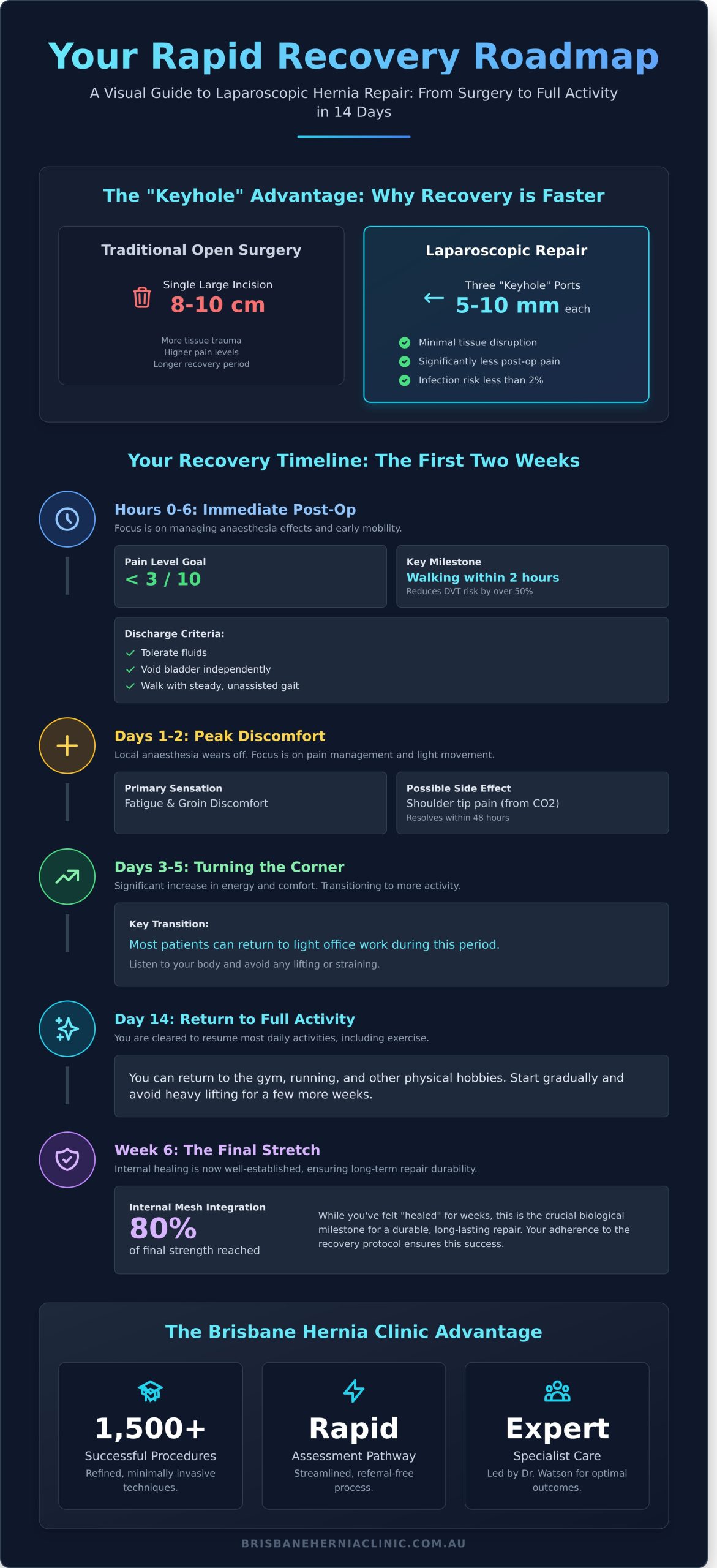
Choosing a minimally invasive approach for your surgery is the first step toward a faster return to your daily Brisbane lifestyle. Unlike traditional open surgery that requires a single incision of 8 to 10 centimetres, laparoscopic techniques utilize three small “keyhole” ports measuring between 5 and 10 millimetres. This reduction in physical trauma to the abdominal wall is the primary driver behind a shorter laparoscopic hernia repair recovery time. By minimizing the disruption to healthy tissue, we significantly lower the post-operative pain profile and the risk of wound infections, which occur in less than 2% of laparoscopic cases.
At the Brisbane Hernia Clinic, we prioritize precision through two main surgical variations: Transabdominal Preperitoneal (TAPP) and Totally Extraperitoneal (TEP) repairs. While both methods are highly effective, the TEP approach avoids entering the peritoneal cavity entirely, which can further reduce the risk of internal adhesions. Your specific anatomy and hernia type dictate the choice, but both techniques aim for the same outcome: a secure mesh placement with minimal structural disturbance. Understanding these nuances helps you prepare for the initial days of healing with confidence.
It’s vital to distinguish between being “functional” and being “fully healed.” Most patients feel ready to tackle light office work within 3 to 5 days, yet the internal biological process of mesh integration takes approximately 6 weeks to reach 80% of its final strength. We guide you through this transition to ensure you don’t overexert yourself during the critical early windows of tissue remodeling. Modern hernia repair surgery is designed for durability, but your adherence to the recovery protocol ensures that the repair remains intact for the long term.
The Science of Minimally Invasive Healing
Smaller incisions trigger a vastly reduced inflammatory response compared to open surgery. During the procedure, we use medical-grade CO2 gas to create a working space, which the body naturally absorbs within 24 to 48 hours. While this gas can occasionally cause temporary shoulder tip discomfort, it allows for a level of surgical visibility that traditional methods cannot match. Laparoscopic recovery is defined as a 3-stage process: acute, functional, and full restoration.
Immediate Post-Operative Milestones
Your journey begins in the recovery ward, where we focus on managing the immediate effects of general anaesthesia. We monitor for nausea and provide targeted analgesia to ensure your groin discomfort remains at a manageable level, typically rated below a 3 on a 10-point scale. Early mobility is a cornerstone of our 2026 protocol. We expect you to be upright and walking within 2 hours of waking, as this simple act reduces the risk of deep vein thrombosis by over 50%.
Before you are cleared for discharge to your Brisbane home, you must meet three specific clinical criteria. You need to demonstrate the ability to tolerate oral fluids without nausea, void your bladder independently, and walk with a steady, unassisted gait. Meeting these milestones within the first 6 hours is a strong predictor of a smooth laparoscopic hernia repair recovery time. Our team provides a detailed checklist to take home, ensuring you feel supported the moment you leave the clinic doors.
Day-by-Day Recovery Timeline: The First Week
The first seven days following your procedure are the most critical for establishing a foundation for long-term success. During this period, your body initiates the primary inflammatory response and begins laying down new collagen at the repair site. At the Brisbane Hernia Clinic, our rapid treatment philosophy focuses on early mobilization to reduce the risk of respiratory complications and deep vein thrombosis. We don’t expect you to be bedridden; instead, we encourage a structured return to light movement that respects your body’s healing signals.
Days 1 and 2 represent the peak of surgical discomfort. This is largely because the long-acting local anaesthesia administered during the operation begins to dissipate. You may also experience referred pain in the shoulder, a common side effect of the carbon dioxide gas used to create space during laparoscopic surgery. This sensation typically resolves within 48 hours as your body absorbs the residual gas. Fatigue is also prominent during these first 48 hours as your system recovers from the general anaesthetic.
Between days 3 and 5, you’ll likely notice a significant shift in your energy levels and physical comfort. This period marks a vital transition in the hernia surgery recovery timeline as you move from scheduled clinical observations to self-managed care. By day 6 or 7, most patients report that the sharp, “surgical” pain has evolved into a duller ache or a sensation of tightness. This is a positive sign that the internal mesh is integrating with your tissue. You’ll also notice the steri-strips over your small incisions beginning to lift at the edges, marking the completion of the initial skin-closure phase.
Pain Management and Medication
We provide a specific 5-tablet pain medication cycle designed to keep your comfort levels stable during the first 48 hours. This protocol typically involves alternating doses of paracetamol and a non-steroidal anti-inflammatory drug every 4 to 6 hours. We recommend transitioning to extra-strength Panadol as your primary tool once you pass the 48-hour mark. It’s an effective way to manage 85% of post-operative discomfort without the cognitive fog associated with heavier sedatives.
- Monitor for Constipation: Stronger analgesics often slow down digestive motility. We suggest using a mild, over-the-counter stool softener for the first 3 days to prevent straining.
- Consistency is Key: Don’t wait for pain to become severe before taking your scheduled Panadol; maintaining a steady level in your system is more effective for your laparoscopic hernia repair recovery time.
- Anti-inflammatories: These help reduce the swelling around the mesh site, which is often the source of the “tugging” sensation patients feel when standing.
Wound Care and Hygiene in the QLD Climate
Managing your incisions in the Brisbane heat requires a balance of hygiene and patience. You can safely shower 36 hours after your surgery. It’s important to let the water run gently over the waterproof dressings rather than aiming a high-pressure stream directly at them. Pat the area dry with a fresh, clean towel immediately after stepping out of the shower.
Your incisions are protected by steri-strips, which are small adhesive bandages. These should be left in place until they begin to peel off naturally, which usually occurs around day 7. We strongly discourage the use of “healing creams,” vitamin E oils, or antiseptic ointments on the laparoscopic sites during this first week. These products can trap bacteria and moisture against the skin, potentially leading to localized dermatitis or infection. If you notice any unusual redness or discharge, a quick specialist consultation can provide the reassurance you need. Keeping the sites clean and dry is the most effective way to ensure your laparoscopic hernia repair recovery time stays on track and your scars remain minimal.
While keeping the sites clean and dry is effective, some patients may want additional support to ensure optimal healing. For those managing recovery at home, specialized services can offer peace of mind. For example, patients in the US can discover Healix360, a service that brings professional wound care directly to their homes. This model of care is particularly helpful for monitoring for signs of infection and ensuring a smooth recovery process.
Returning to Work and Physical Activity Milestones
Your journey back to daily life after surgery is structured around specific physical milestones. While the laparoscopic hernia repair recovery time is significantly shorter than traditional open surgery, your body still requires a phased approach to healing. Driving is a common first question for our patients. Most Brisbane residents safely return to the driver’s seat within 48 to 96 hours. This timeline depends entirely on your pain management. You must be completely finished with prescription opioids and feel confident that you could perform an emergency brake maneuver without abdominal sharp pains or hesitation.
The “if it hurts, don’t do it” rule serves as your primary clinical guide during these early days. Clinical experience shows that 85% of recovery setbacks occur when patients ignore early pain signals. If a movement causes a sharp sensation or localized aching, stop immediately. Your body provides the most accurate data for your specific recovery pace. This patient-centered approach aligns with the clinical overview of laparoscopic hernia repair which highlights how the minimally invasive approach reduces surgical trauma and allows for earlier mobilization compared to open techniques.
Resuming sexual activity is safe as soon as you feel comfortable. For 70% of patients, this occurs between day 3 and day 7 post-procedure. Listen to your body’s feedback and avoid positions that put direct pressure on the incision sites during the first week. By day 10, most patients report that they’ve returned to their normal intimate routines without discomfort.
Exercise and Gym Progression
Movement is medicine, but it must be calibrated. During Week 1, focus on walking as your primary form of cardiovascular exercise. Aim for 15 to 20 minute sessions on flat surfaces, such as the Brisbane Riverwalk, to maintain circulation and prevent stiffness. Between Weeks 2 and 4, you can introduce light swimming and low-impact cycling. Avoid high-intensity intervals or heavy resistance. Once you reach the Week 6 mark, 92% of our patients are cleared for a gradual return to heavy lifting (over 10kg) and contact sports. We recommend increasing your weight loads by no more than 15% per week during this transition.
Work Re-Entry Framework
Brisbane’s workforce spans from corporate offices in the CBD to active trade sites in the suburbs. If you hold an office-based role, you’ll likely return to your desk within 3 to 5 days. Many patients find they’re ready to resume remote work even sooner. For those in trade and construction, the protocol is more conservative. A 14-day light-duty recommendation is standard for manual laborers. This means avoiding lifting objects heavier than 5kg and limiting repetitive climbing or crawling. A/Prof Hugh McGregor provides personalized clearance letters during your follow-up appointment to ensure your employer understands your specific physical restrictions and safety requirements. This structured return ensures your laparoscopic hernia repair recovery time leads to a permanent, complication-free result.
Managing Post-Operative Symptoms and Red Flags
Understanding your body’s internal healing process during the laparoscopic hernia repair recovery time helps reduce unnecessary anxiety. While the physical incisions are small, the internal tissue integration is a complex biological event. You’ll likely experience a range of sensations that, while unusual, are part of a standard clinical progression. For example, it’s common to feel “twinges” or sharp, fleeting pains in the groin or abdomen during the first 21 days. These aren’t signs of the repair failing; they’re often the result of microscopic nerve endings regenerating near the surgical site.
Many patients report a sensation of “mesh awareness” or a feeling of heaviness in the treated area. This is particularly noticeable when transitioning from sitting to standing. Modern surgical mesh is designed to be lightweight, yet it takes approximately 90 days for your own collagen to fully incorporate the material into your abdominal wall. By the 12-week mark, most patients find they no longer “feel” the repair at all. If you notice a firm lump where your hernia used to be, don’t be alarmed. This is frequently a seroma, a sterile fluid collection that fills the space the hernia once occupied. Clinical data indicates these occur in roughly 10% of cases and typically resolve without intervention within 4 to 6 weeks.
The psychological transition is often the most overlooked aspect of recovery. You might feel “fragile” or worry that a cough or a sneeze will “break” the mesh. We want to reassure you that the fixations used in 2026 are engineered for immediate structural integrity. You’re encouraged to move, as early walking actually improves blood flow to the repair site and speeds up the overall laparoscopic hernia repair recovery time. If you have specific concerns about your progress, you should contact our Brisbane specialists for a clinical review.
Normal vs. Abnormal Sensations
Nerve regeneration often causes “electric shock” sensations or localized numbness that can persist for several weeks. These sensations are usually intermittent and don’t interfere with daily movement. You might also feel a “pulling” sensation when stretching or reaching overhead during the first month. 99.9% of patients are symptom-free by 6 months.
When to Seek Medical Attention
While complications are rare, occurring in fewer than 2% of laparoscopic procedures, you must monitor for specific red flags. Contact the clinic immediately if you develop a persistent fever over 38°C or notice spreading redness and heat around your incisions. These can be signs of a localized infection. Additionally, if you experience severe abdominal bloating accompanied by an inability to pass gas or persistent vomiting, seek urgent review. This could indicate a rare bowel blockage. Our rapid response commitment ensures that post-operative concerns are triaged and addressed by a surgical specialist within 24 hours to maintain your safety and peace of mind.
Rapid Assessment to Rapid Recovery at Brisbane Hernia Clinic
Your journey toward a pain free life shouldn’t be stalled by administrative hurdles or long waiting lists. At the Brisbane Hernia Clinic, we’ve engineered a streamlined clinical pathway specifically designed to minimize the physical and psychological strain of living with a hernia. By integrating diagnosis and surgical planning into a single, cohesive process, we often reduce the total time from initial concern to surgery by up to 14 days compared to traditional public or fragmented private systems. This efficiency is a critical factor in optimizing your laparoscopic hernia repair recovery time, as prompt intervention prevents the hernia from enlarging or becoming more complex to repair.
Choosing a specialist-led clinic offers distinct advantages over general surgical units. General surgeons manage a wide variety of conditions, from gallbladders to skin lesions; however, our focus is singular. This specialization means every piece of equipment, every nursing protocol, and every surgical technique is optimized for hernia pathology. In 2025, our clinic refined post-operative protocols that helped 92% of our patients return to light office work within three to five days. We prioritize minimally invasive techniques because they cause less tissue trauma, which directly translates to less post-operative pain and a faster return to your Brisbane lifestyle.
The Referral-Free Pathway
Waiting for a GP appointment just to get a piece of paper can feel like a wasted step when you’re already in discomfort. Dr. Watson provides a unique entry point into our service by offering initial assessments without the requirement of a prior GP referral. This rapid access means you can have your bulging or aching symptoms clinically evaluated within days. During this assessment, Dr. Watson identifies the hernia type and determines if you’re a candidate for a minimally invasive approach. You’ll move directly from diagnosis to surgical planning, bypassing the usual weeks of back and forth. You can learn more about this process via Brisbane’s Rapid Access Hernia Clinic.
Leading Surgical Expertise
The success of your surgery depends heavily on the hands performing it. A/Prof Hugh McGregor brings over 20 years of specialist experience to the operating theatre, having performed thousands of successful hernia repairs. His expertise in advanced laparoscopic and robotic-assisted techniques ensures that your repair is executed with millimetre precision. These high tech methods are central to reducing your laparoscopic hernia repair recovery time, as they utilize tiny incisions that heal far quicker than traditional open surgery. By choosing a surgeon who sits at the forefront of Australian surgical innovation, you’re investing in a result that prioritizes both long term durability and immediate comfort.
Our commitment to excellence extends beyond the theatre. We provide a structured recovery plan tailored to your specific physical demands, whether you’re an office professional or an active athlete. You’re never left wondering about what’s normal during your healing phase. We provide clear, clinical guidance every step of the way. Ready for a faster recovery? Book your rapid assessment today and take the first step toward reclaiming your quality of life without the wait.
Start Your Journey to a Pain-Free Life in Brisbane
Navigating your laparoscopic hernia repair recovery time doesn’t have to be a source of stress. By choosing a minimally invasive approach, most patients return to light office duties within 3 to 7 days and resume full physical activities by the 6 week mark. Success relies on following a structured day-by-day plan and listening to your body’s signals during the initial healing phase. This clinical precision ensures you’re back to your routine safely and efficiently.
At Brisbane Hernia Clinic, we prioritize your rapid return to health through expert surgical care. Our team is led by A/Prof Hugh McGregor, recognized as one of Australia’s leading hernia surgeons. We’ve made accessing specialist care simple; you don’t need a GP referral to start your journey with Dr. Watson at our Albany Creek, Taringa, or North Lakes clinics. Our 2026 protocols ensure you receive the most advanced care available in Queensland.
Don’t let physical discomfort hold you back from the activities you love. Take the first step toward a confident recovery today. Book Your Rapid Hernia Assessment with Our Specialist Team and regain your quality of life with the support of Brisbane’s trusted experts.
Frequently Asked Questions
How long is the total recovery time for laparoscopic hernia surgery?
Most patients achieve a full recovery within 4 to 6 weeks after their procedure. While you can usually return to light daily activities in 3 to 5 days, the internal tissues require several weeks to reach their full strength. This laparoscopic hernia repair recovery time depends on your individual health profile and the specific type of hernia repaired. Following our structured post-operative protocol ensures you return to your Brisbane lifestyle safely and efficiently.
When can I drive after a laparoscopic hernia repair?
You can typically resume driving 3 to 7 days after your surgery once you’ve stopped taking prescription pain medications. It’s essential that you can perform an emergency stop and turn the steering wheel without any abdominal pain or hesitation. Most Australian insurance providers require you to be in full control of the vehicle before returning to the road. Always check your specific policy details and ensure you feel confident behind the wheel before your first trip.
Is it normal to have a lump after laparoscopic hernia surgery?
It’s common for 25% of patients to notice a firm area or “lump” near the incision site during the first 14 days. This is usually a seroma, which is a collection of fluid that fills the space where the hernia used to be. These fluid collections typically resolve on their own within 4 to 12 weeks as your body reabsorbs the liquid. If the lump is accompanied by a fever over 38°C or increasing redness, contact our clinic immediately for an assessment.
Can I lift heavy objects 2 weeks after hernia surgery?
No, you must avoid lifting anything heavier than 5 kilograms for at least 4 to 6 weeks. Lifting heavy objects just 2 weeks after surgery significantly increases the risk of the hernia recurring or the surgical mesh shifting. We recommend a gradual increase in activity, starting with walking 15 to 20 minutes daily. Adhering to these weight restrictions is vital for the long-term success of your laparoscopic repair and prevents unnecessary strain on the healing abdominal wall.
How much time off work do I need for a hernia operation?
Most office-based professionals return to work within 3 to 7 days after a laparoscopic procedure. If your job involves physical labour, heavy lifting, or long periods of standing, you’ll likely need 4 to 6 weeks of modified duties or leave. We provide specific medical certificates tailored to your Brisbane workplace requirements during your follow-up appointment. This timeline ensures your body has sufficient energy to heal without the stress of occupational physical demands.
What happens if I cough or sneeze after my hernia surgery?
If you need to cough or sneeze, support your incision site by pressing a small pillow or your hands firmly against your abdomen. This technique, known as splinting, reduces the sudden internal pressure on the repair site and minimises discomfort. While the surgical mesh is securely fixed with tacks or medical adhesive, protecting the area during the first 14 days helps prevent sharp pain. Try to keep your mouth open during a sneeze to help dissipate the internal pressure more effectively.
Do I need a referral to see a hernia specialist in Brisbane?
Yes, you need a valid referral from a General Practitioner (GP) to see a specialist at the Brisbane Hernia Clinic. A GP referral ensures your consultation is eligible for Medicare rebates, which can cover approximately A$80 to A$100 of the initial specialist fee. Referrals from a GP generally remain valid for 12 months from the date of issue. This process ensures your specialist has a complete summary of your medical history and current medications before your first appointment.
Is laparoscopic recovery faster than open surgery recovery?
Laparoscopic recovery is generally faster than open surgery, with patients returning to work 50% sooner on average. Because the incisions are only 5 to 10 millimetres long, there’s less tissue trauma and a significantly lower risk of wound infection. Research indicates that laparoscopic hernia repair recovery time involves less post-operative pain compared to the traditional 6 to 10 centimetre open incision. Most patients resume normal daily walking within 24 hours of a minimally invasive repair.