Last Monday, a 45-year-old Brisbane local sat in our clinic, worried that the persistent ache near his navel meant his weekend training at the local park was over for good. You likely feel that same hesitation every time a simple lift or a deep breath triggers physical discomfort. It’s natural to feel anxious about mesh safety or confused by the technical debate between robotic and laparoscopic benefits. At the Brisbane Hernia Clinic, we believe that clinical clarity is the first step toward your physical recovery.
This 2026 guide clarifies your umbilical hernia repair options by breaking down the latest surgical advancements and safety protocols. You’ll discover how modern, minimally invasive techniques now allow for a 98% success rate in permanent repairs with significantly less scarring than traditional methods. We provide a clear, evidence-based timeline so you know exactly when it’s safe to return to the gym or the office. From comparing robotic precision to outlining a structured four-week recovery plan, this overview ensures you can choose your specialist with absolute confidence.
Key Takeaways
-
Compare traditional open surgery with modern laparoscopic and robotic techniques to identify the most suitable umbilical hernia repair options for your lifestyle and physical needs.
-
Understand the critical role of advanced mesh in reducing recurrence rates from 30% to less than 5% while addressing common concerns regarding modern material safety.
-
Gain clarity on your post-operative journey with a structured recovery timeline, from managing initial discomfort to resuming light activity within the first two weeks.
-
Discover the clinical advantages of high-volume specialist care and how the Brisbane Hernia Clinic Rapid Access Pathway streamlines your transition from diagnosis to recovery.
Table of Contents
-
Understanding Umbilical Hernias: Why Repair is Often Necessary
-
Comparing Umbilical Hernia Repair Options: Open, Laparoscopic, and Robotic
-
Recovery Timeline: Returning to Activity After Hernia Surgery
Understanding Umbilical Hernias: Why Repair is Often Necessary
An umbilical hernia is a physical defect where abdominal contents, such as fatty tissue or a loop of intestine, protrude through a weakened section of the abdominal wall at the navel. It’s a common condition, but for adults, it’s one that rarely resolves without intervention. In the Brisbane clinical environment, we see a diverse range of patients presenting with these defects, often seeking clarity on when a simple bulge becomes a surgical necessity. While some hernias remain stable for years, others progress rapidly, necessitating a clear understanding of your umbilical hernia repair options to ensure long term health.
By 2026, the prevalence of these hernias is expected to rise alongside national obesity rates. Current Australian health data indicates that 67% of adults are classified as overweight or obese, which places constant, high level pressure on the umbilical ring. Chronic respiratory conditions that cause persistent coughing and the physical demands of heavy lifting also contribute to the gradual widening of the fascial gap. These factors don’t just cause the hernia; they prevent it from healing naturally.
The concept of watchful waiting is a frequent topic in our consultations. If your hernia is smaller than 1.5 centimetres and painless, your surgeon might suggest monitoring it periodically. However, this isn’t a permanent solution for everyone. Clinical studies show that 25% of patients originally managed with observation eventually require surgery due to increasing pain or the risk of incarceration. Incarceration occurs when the protruding tissue becomes trapped outside the abdominal wall. If this tissue loses its blood supply, it becomes strangulated. This is a life threatening emergency that requires immediate surgery to prevent tissue death within a 6 to 12 hour window.
Symptoms That Signal It Is Time for Surgery
Visible bulging is the most obvious sign of a defect. You might notice the lump increases in size when you strain, cough, or lift a heavy object. If the site feels tender or if you experience sharp, localised pain, the hernia is likely progressing. You should be aware of these specific warning signs:
-
Persistent aching: A dull, heavy sensation that worsens by the end of the day.
-
Changes in skin colour: Red, purple, or dark discolouration over the bulge.
-
Irreducibility: An inability to gently push the hernia back into the abdomen while lying down.
-
Digestive distress: Nausea or vomiting paired with a painful, firm umbilical lump.
The Anatomy of the Navel Defect
Think of your abdominal wall as a multi layered corset made of muscle and a tough fibrous layer called fascia. The navel is a natural weak point where the umbilical cord once connected. In adults, the fascial gap lacks the regenerative capacity seen in infants, meaning the hole won’t seal on its own. Pregnancy is a major catalyst for this defect in the Australian clinical landscape. During pregnancy, the abdominal wall can stretch significantly to accommodate a growing baby, often thinning the tissue at the navel. Once this structural integrity is lost, the pressure of daily life ensures the hole stays open. Exploring your umbilical hernia repair options early helps you avoid the complications associated with a weakened abdominal core.
While managing the physical strains of pregnancy that can lead to issues like hernias, many expectant parents also focus on monitoring their baby’s development. For those exploring specialized ultrasound services, you can check out Scan Baby Ltd to see what modern clinics provide.
Comparing Umbilical Hernia Repair Options: Open, Laparoscopic, and Robotic
Selecting the most effective surgical path requires a careful evaluation of your physical health, your lifestyle, and the specific characteristics of the hernia itself. At the Brisbane Hernia Clinic, we prioritize precision to ensure you return to your daily routine with minimal delay. There are three primary umbilical hernia repair options available to patients today, each offering distinct advantages depending on the size of the abdominal wall defect and your personal medical history.
Your surgeon will consider several critical factors before recommending a specific technique. These include your Body Mass Index (BMI), the width of the hernia defect measured in centimeters, and whether you’ve had previous abdominal surgeries that might have left internal scar tissue. For instance, a defect larger than 2cm often necessitates a different strategy than a minor bulge discovered during a routine physical. Our goal is to match the procedure to your body to minimize the risk of recurrence.
The Traditional Open Approach
Open repair remains a reliable and time-tested method for addressing small, simple hernias. During this procedure, a single incision is made directly over or just below the belly button to allow the surgeon direct access to the weakened tissue. It’s often the preferred route for defects under 2cm in patients who don’t lead highly strenuous lifestyles. One significant benefit of this method is the ability to perform a detailed "inny" belly button reconstruction, which restores the natural appearance of the navel. While this approach is effective, it involves a direct incision that requires careful management during the initial healing phase.
Minimally Invasive: Laparoscopic vs. Robotic
Laparoscopic surgery utilizes three to four small incisions, usually less than 1cm each, to insert a camera and specialized tools. This technique is renowned for reducing post-operative pain and allowing a faster return to work, often within 7 to 10 days. By avoiding a large central incision, we reduce the risk of wound infections and help you regain your mobility sooner. It’s an excellent option for active individuals in the Brisbane area who want to resume their exercise routines quickly.
Robotic-assisted repair represents the 2026 gold standard for managing complex or large defects. This technology provides the surgeon with a high-definition 3D view of the surgical site and superior instrument wrist-articulation. These tools allow for meticulous suturing that traditional laparoscopic instruments cannot always achieve. We frequently recommend robotic surgery for recurrent hernias or gaps exceeding 3cm, as the precision of the robotic arms ensures a more durable repair in challenging environments. This advanced technology is a cornerstone of our commitment to specialist care. If you’re concerned about a persistent bulge or discomfort, you can book a consultation with our specialists to discuss which modern technique fits your needs.
The choice between these umbilical hernia repair options ultimately rests on achieving the best long-term outcome for your specific case. Whether we utilize the tactile feedback of an open repair or the high-tech precision of a robotic system, our focus remains on a safe, permanent fix that restores your quality of life. We ensure every patient receives a tailored plan designed for maximum safety and a rapid recovery.
The Mesh Debate: Safety, Recurrence, and Modern Materials
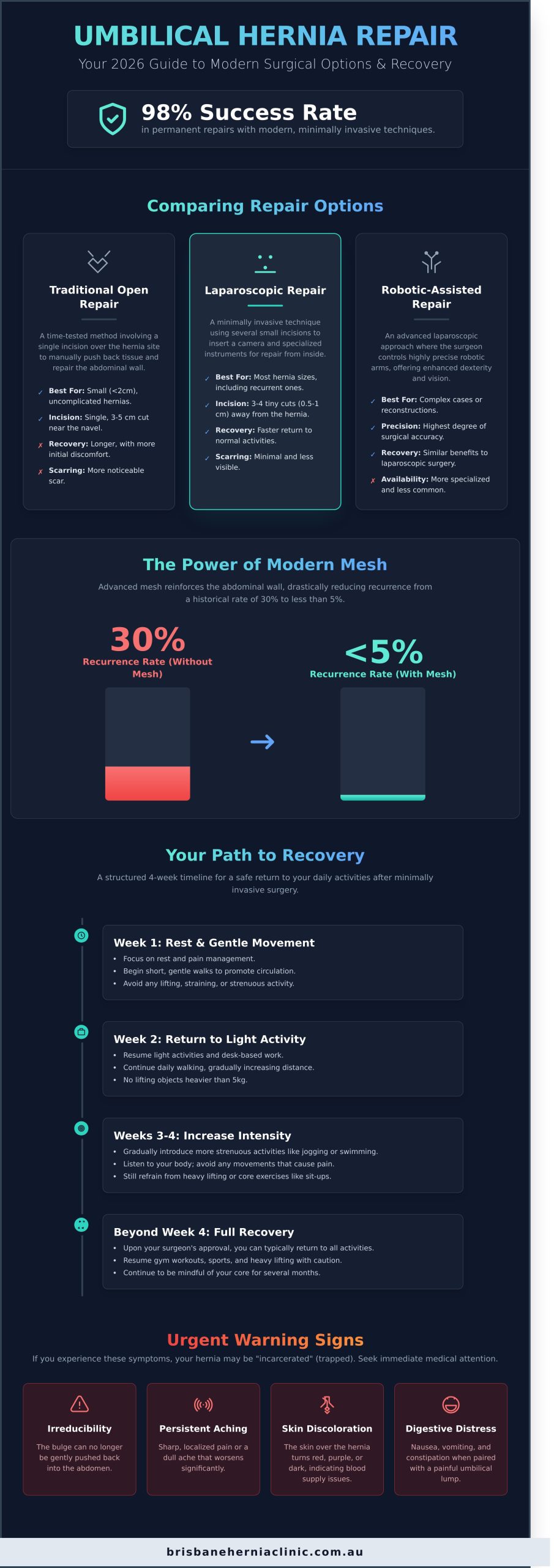
Choosing between different umbilical hernia repair options often leads to a discussion about surgical mesh. For many patients, the decision centers on balancing the risk of the hernia returning against the presence of a foreign material in the body. Clinical data provides a clear picture of why mesh is frequently recommended. Without mesh, recurrence rates for umbilical hernias can reach 30%, particularly in defects larger than 1.5 cm. When we incorporate modern mesh, that recurrence rate drops significantly to under 5%. This 25% difference in success rates is the primary reason mesh has become the clinical standard for most adult patients.
You might’ve heard concerning stories about mesh in the news, which often leads to "mesh anxiety." It’s vital to distinguish between the older products used in different surgical fields and the advanced hernia repair surgical mesh we use today. Modern materials are biologically inert and designed to integrate with your tissues. We only consider suture-only (non-mesh) repairs for very small defects, usually under 1 cm, or in specific pediatric cases where the body’s natural healing capacity is higher. Permanent mesh remains the gold standard for long term durability, though absorbable meshes are sometimes used in contaminated fields where an active infection is present.
How Modern Mesh Works with Your Body
At the Brisbane Hernia Clinic, we select TGA-approved materials that act as a "scaffolding" for your body. Instead of just "plugging" a hole, the mesh facilitates natural tissue growth. Within weeks, your own collagen fibers weave through the mesh pores, creating a reinforced wall that’s stronger than the original tissue. We prefer lightweight, macroporous meshes. These designs use significantly less material than older "heavyweight" versions. This reduction in material minimizes the stiff "foreign body" sensation and allows for better flexibility as you move and exercise. This approach ensures a rapid return to your daily Brisbane lifestyle without the discomfort of a restrictive abdominal wall.
Risks and Complications: A Transparent View
Transparency is vital. We believe in providing a clear, data-driven view of potential risks so you can make an informed choice. While complications are rare, they can include:
-
Infection: This occurs in approximately 1% to 2% of elective cases.
-
Seroma: This is a temporary fluid collection that affects about 5% of patients but usually resolves without further intervention.
-
Chronic Pain: Post-operative discomfort lasting more than three months is rare, occurring in less than 1% of our patients.
Surgical technique plays a massive role in these statistics. Robotic-assisted umbilical hernia repair options allow for extremely precise mesh placement behind the muscle layer. This protects the mesh from the skin and internal organs. We use advanced fixation methods, including absorbable tacks or medical-grade glues, to prevent mesh migration. This precision reduces the trauma to surrounding nerves. It’s the most effective way to prevent long term pain and ensure your recovery is as smooth as possible. By placing the mesh in the "sublay" position, we use the body’s own internal pressure to help keep the repair in place.
Recovery Timeline: Returning to Activity After Hernia Surgery
Your journey back to full health depends heavily on which umbilical hernia repair options you and your surgeon selected. While minimally invasive techniques often allow for a faster return to daily life, your body requires a structured timeline to ensure the repair remains secure. Following a surgical plan isn’t just about comfort; it’s about protecting the integrity of the mesh or sutures during the critical early healing phases.
-
Days 1-3: You’ll focus on initial mobility. We expect you to walk around your home for 5 minutes every hour to stimulate circulation. Expect some localized swelling and a dull ache at the incision site.
-
Weeks 1-2: Most patients return to sedentary office work during this window. You can enjoy light 15-minute walks on flat ground. You must not lift objects heavier than 2 kilograms, which is roughly the weight of a standard 2-litre milk carton.
-
Weeks 3-4: You can usually resume driving once you’ve stopped all prescription pain medications and can perform an emergency brake maneuver without abdominal pain. You’ll feel your energy levels returning to 90% of your baseline.
-
Week 6+: This is the major milestone. Your internal tissue has successfully integrated with the repair site. You can typically return to the gym, swimming, and heavy lifting, provided you start at 50% of your previous intensity.
Pain Management and Wound Care
Our clinic utilizes modern multimodal analgesic protocols. This strategy combines different non-opioid medications to target pain pathways effectively, reducing the need for strong narcotics by approximately 65%. You can typically shower 48 hours after your procedure. Keep your waterproof dressings in place until your post-operative check, usually 10 days after surgery. It’s normal to see slight bruising, but contact us if you develop a fever over 38°C or see redness spreading more than 2cm from the wound.
Exercise and Lifestyle Adjustments
Protecting your core is vital during the first month. Avoid any "valsalva" maneuvers, which involve holding your breath while straining. This action can increase intra-abdominal pressure by 100%, potentially compromising the surgical site. Pushing yourself "too much too soon" remains the leading cause of repair failure and hernia recurrence. To support your recovery, aim for 25 to 30 grams of fibre daily. This prevents constipation and the unnecessary abdominal strain that occurs during difficult bowel movements.
If you’re unsure which umbilical hernia repair options are right for your lifestyle, our specialists can provide a tailored assessment of your surgical needs.
**Ready to regain your quality of life?**
[Book a consultation with our Brisbane specialists today](https://brisbaneherniaclinic.com.au) to discuss your surgical recovery plan.
Choosing Your Specialist Hernia Surgeon in Brisbane
Selecting the right surgeon is the final, most critical step in your journey toward recovery. While many general surgeons perform hernia operations, seeking a high-volume specialist significantly impacts your long-term success. Clinical data indicates that surgeons who perform over 100 hernia procedures annually achieve a 50% reduction in recurrence rates compared to those with lower volumes. At the Brisbane Hernia Clinic, our focus is exclusively on abdominal wall pathology. This specialization ensures you receive the most advanced umbilical hernia repair options available in Australia today.
We developed the Brisbane Hernia Clinic Rapid Access Pathway to eliminate the frustration of long wait times. Most patients receive an initial specialist assessment within 14 days of their inquiry. This streamlined approach allows for faster diagnosis and a quicker return to physical activity. We believe in results. During your consultation, we’ll perform a thorough physical examination and review any existing ultrasound or CT scans. We use a collaborative approach; we’ll explain the mechanics of your hernia and why a specific surgical technique suits your unique anatomy.
For roughly 12% of patients with recurrent hernias or large defects exceeding 4cm, we utilize a multidisciplinary framework for complex abdominal wall reconstruction. This involves coordinated care that may include advanced imaging and specific pre-habilitation protocols to ensure the abdominal wall’s structural integrity is fully restored. Our goal is to provide a permanent solution that withstands the pressures of your daily life.
Specialist Expertise: A/Prof McGregor & Dr. Watson
A/Prof. McGregor and Dr. Watson bring over 18 years of surgical experience to the clinic. They’ve pioneered the use of robotic-assisted techniques in Queensland, focusing on precision and reduced post-operative pain. You can access their expertise at several convenient locations, including North Lakes and Albany Creek. Their commitment to safety is backed by a clinical audit process that tracks patient outcomes for 12 months post-surgery to ensure the highest standards of care.
Preparing for Your Consultation
To begin, you’ll need a referral from your GP, though you can contact our Rapid Access service directly via Dr Watson for guidance on the process. When you arrive, it’s helpful to have a list of questions ready. You might ask about the benefits of robotic-assisted surgery or the specific type of mesh we recommend for your case. We provide detailed information on all umbilical hernia repair options to ensure you feel confident in your treatment plan. Book your specialist hernia assessment today to take the first step toward a pain-free life.
Take the Next Step Toward Lasting Relief
Choosing between different umbilical hernia repair options doesn’t have to be overwhelming. Modern surgical standards in 2026 emphasize precision through laparoscopic and robotic-assisted techniques, which significantly reduce post-operative pain and recovery times compared to traditional methods. Since 2009, A/Prof Hugh McGregor has led our team in delivering specialist care, focusing on durable repairs that utilize the latest medical-grade mesh materials to prevent recurrence. We understand that a visible bulge or persistent aching can impact your quality of life, so we’ve streamlined our clinical processes for your convenience.
Our Brisbane clinic prioritizes your long-term health by combining high-level medical authority with an empathetic, patient-centered approach. Through our Rapid Access Pathway, you’ll receive a timely assessment that cuts through standard waiting lists and puts you on a clear, structured path to recovery. Whether you’re managing a physically demanding job or simply want to exercise without strain, our goal is to get you back to your peak condition with minimal disruption. You don’t have to manage this discomfort alone; expert help is available right here in your local community.
Book Your Specialist Consultation at Brisbane Hernia Clinic
We’re ready to help you reclaim your comfort and restore your core strength with confidence.
Frequently Asked Questions
Do I really need mesh for a small umbilical hernia repair?
While very small defects under 1cm might be closed with sutures alone, clinical data from the Australian Hernia Registry suggests that using mesh reduces recurrence rates from 10% down to less than 2% for most patients. Mesh provides a tension-free bridge that supports your abdominal wall as it heals. At Brisbane Hernia Clinic, we evaluate each case individually to determine if mesh is necessary for your long-term stability.
How long is the hospital stay for umbilical hernia surgery?
Most umbilical hernia repairs are performed as day-stay procedures, meaning you’ll spend approximately 4 to 6 hours in the hospital before returning home. If your case is complex or involves a larger abdominal wall reconstruction, you might stay overnight for observation. Our focus on minimally invasive techniques ensures that 95% of our patients are recovering in their own beds on the same day as their surgery.
Can an umbilical hernia come back after it has been repaired?
Yes, a recurrence is possible, though modern umbilical hernia repair options like mesh reinforcement have significantly lowered this risk. Statistics show that without mesh, recurrence rates can be as high as 15%, but specialized techniques reduce this to approximately 1% to 3%. Factors such as smoking, chronic coughing, or heavy lifting during the first 6 weeks of recovery can increase the chance of the hernia returning.
When can I return to lifting weights at the gym after surgery?
You can typically resume light walking immediately, but you must avoid lifting weights over 5kg for the first 4 weeks. Most patients return to full gym activity, including compound lifts, after 6 to 8 weeks once the internal scar tissue has reached 80% of its final strength. We provide a structured recovery timeline to ensure you don’t compromise your repair while regaining your fitness and strength safely.
Is umbilical hernia surgery covered by private health insurance in Australia?
Yes, umbilical hernia repair is generally covered by private health insurance in Australia under Medicare Benefits Schedule item numbers 30621. Depending on your level of cover, your insurer may pay for the hospital stay and a portion of the specialist fees. You’ll need to check your specific policy for Silver or Gold tier inclusions to confirm your out-of-pocket costs, which is usually $500.
What happens if I leave my umbilical hernia untreated?
An untreated hernia won’t heal on its own and will likely increase in size over time. The primary risk is strangulation, where a loop of bowel becomes trapped and loses blood supply, which occurs in roughly 3% of cases annually. This is a medical emergency requiring immediate surgery. By choosing proactive umbilical hernia repair options, you avoid the complications associated with emergency procedures and ensure a smoother, planned recovery.
Will my belly button look different after the operation?
Your surgeon’s goal is to restore the natural appearance of your navel, though some subtle changes in shape are common. During the repair, we often remove the bulging sac and tuck the skin back into its original position. In 90% of cases, patients report an improved aesthetic appearance as the protruding "outie" is transformed back into an "innie" or a flat profile that matches their natural anatomy.
How much time do I need off work for a laparoscopic repair?
If you work in an office or have a sedentary role, you can usually return to work within 3 to 5 days. For those in physically demanding jobs in Brisbane, such as construction or nursing, we recommend taking 2 to 3 weeks off to avoid straining the repair. Our team provides specific medical certificates tailored to your occupation to ensure you have adequate time for a safe and complete recovery.