What if the most significant factor in your hernia operations recovery time isn’t the size of the incision, but the speed at which you begin treatment? We understand that the prospect of surgery often brings more questions than answers. You’re likely concerned about the safety of surgical mesh, the potential for long-term pain, and how many weeks of income you might lose while away from work. It’s natural to feel anxious when balancing your health against the demands of your Brisbane lifestyle.
At Brisbane Hernia Clinic, we’ve refined a rapid assessment and rapid treatment model that eliminates the traditional waiting game. You can see Dr. Watson without a referral. If surgery is required, you’ll be referred directly to A/Prof Hugh McGregor, one of Australia’s leading hernia surgeons. This guide provides a detailed week-by-week roadmap for 2026. You’ll discover why modern robotic techniques often lead to a faster return to normal activities compared to traditional open surgery, ensuring you get back to your routine with confidence.
Key Takeaways
- Understand the two-stage clinical and functional healing process to better manage your hernia operations recovery time from the first 24 hours to the final six-week milestone.
- Compare the clinical benefits of robotic and laparoscopic techniques to see how modern, minimally invasive surgery significantly reduces post-operative pain and hospital downtime.
- Access clear, specialist-led milestones for returning to the gym, rowing, and heavy lifting, ensuring a safe transition back to your active Brisbane lifestyle.
- Discover our streamlined patient pathway that allows you to see Dr. Watson without a referral for rapid assessment and direct surgical referral to A/Prof Hugh McGregor.
- Learn why the Brisbane Hernia clinic’s mantra of rapid assessment and rapid treatment under A/Prof Hugh McGregor, one of Australia’s leading hernia surgeons, ensures a faster return to health.
What Determines Your Hernia Operations Recovery Time?
Understanding your hernia operations recovery time requires looking at two distinct phases of healing. Clinical recovery involves the biological closure of your incision and the successful integration of the surgical mesh into your abdominal wall. Functional recovery is the timeline for returning to your specific lifestyle, whether that involves sitting at a desk, lifting heavy equipment on a job site, or returning to professional sport. At the Brisbane Hernia clinic, we view these phases as a unified journey that we can accelerate through three specific pillars: surgical technique, your baseline health, and the speed of intervention.
A/Prof Hugh McGregor, one of Australia’s leading hernia surgeons, focuses on a philosophy of “minimal footprint” surgery. By utilizing advanced techniques that minimize tissue trauma, we reduce the body’s natural inflammatory response. This is a critical factor because lower inflammation levels directly translate to less post-operative pain and a faster return to normal movement. We don’t just aim for a successful repair; we aim for a recovery that feels seamless.
Technique Matters: Open vs. Minimally Invasive
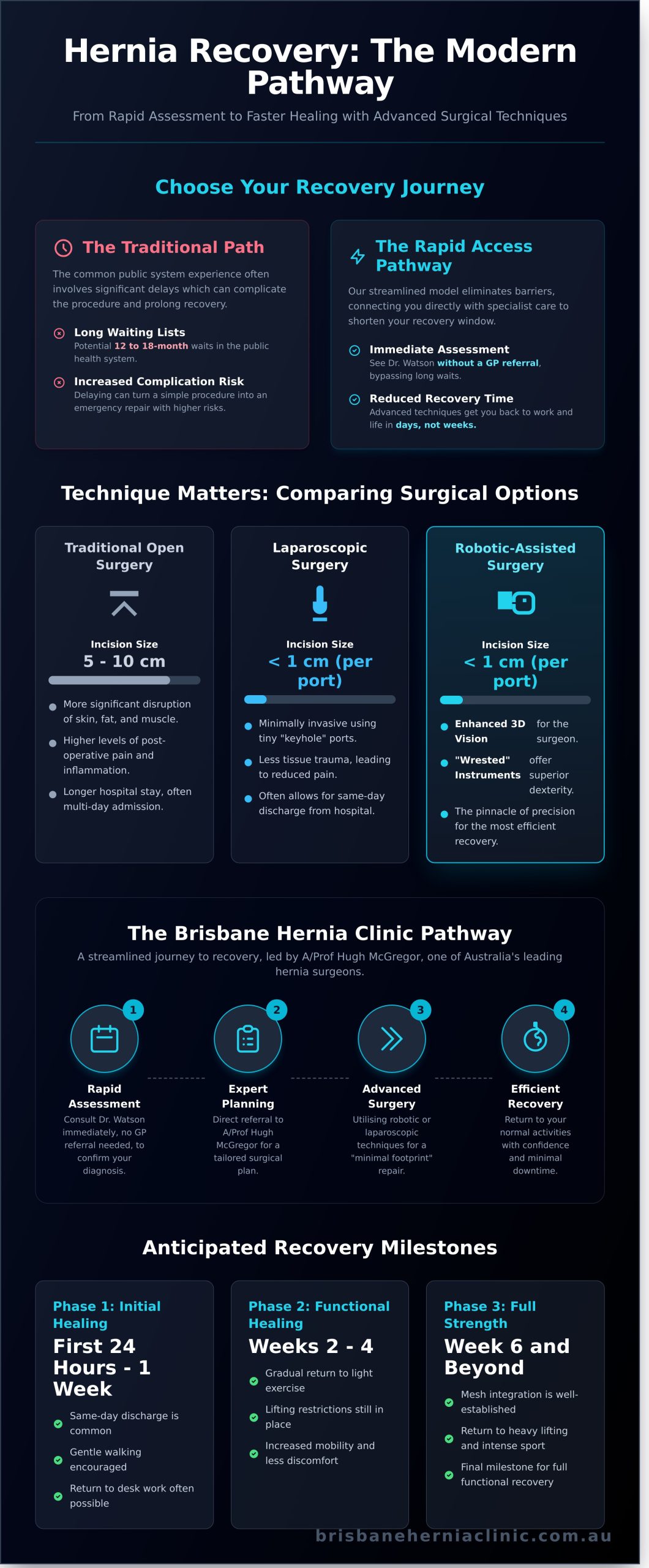
The method used to repair your hernia is the most significant predictor of your initial discomfort. Traditional open surgery often requires an incision of 5 to 10 centimetres. This larger opening necessitates more significant disruption of skin, fat, and muscle layers. In contrast, robotic-assisted and laparoscopic techniques use tiny ports, often measuring less than 1 centimetre. This precision allows for finer movements and less tension on the surrounding tissues.
For many patients, Inguinal hernia surgery performed via these minimally invasive routes allows for discharge on the same day. Robotic-assisted surgery provides our surgeons with a high-definition, 3D view and “wristed” instruments that offer greater dexterity than the human hand. This level of accuracy is why we can offer tailored surgical plans at the Brisbane Hernia clinic. We match the technology to your specific hernia type to ensure the most efficient hernia operations recovery time possible.
The Importance of Rapid Treatment
Waiting for a hernia to “get worse” is a common mistake that can lead to a much longer hospital stay. When a hernia is treated early, the surrounding tissue is generally healthy and easier to manipulate. If you wait until a hernia becomes complex, large, or “strangulated,” the surgery becomes more invasive. Data shows that emergency hernia repairs have a significantly higher rate of complications compared to elective, planned procedures. Delaying treatment by 12 months can turn a simple day-procedure into a multi-day hospital admission.
We have designed our “Rapid Access” pathway to eliminate the barriers to specialist care. You can see Dr. Watson at our clinic without a prior referral from a GP, which jumpstarts the entire process. Following this initial assessment, you are referred directly to A/Prof Hugh McGregor for surgical planning. This model bypasses the 12 to 18-month waiting lists often found in the public health system. By choosing this streamlined path, you ensure that your hernia is treated while it is still manageable, keeping your recovery window as short as possible.
- Rapid Assessment: See Dr. Watson immediately to confirm your diagnosis.
- Expert Planning: Direct referral to A/Prof Hugh McGregor, one of Australia’s leading hernia surgeons.
- Efficient Recovery: Advanced techniques designed to get you back to work and life in days, not weeks.
Our goal is to restore your quality of life through a methodical, logical rhythm of care. We provide the medical authority you need and the empathetic support you deserve. From the moment you contact us, the focus is on a rapid return to your normal daily activities.
The Hernia Recovery Timeline: Week-by-Week Milestones
Your journey toward full health follows a structured, logical path. While every individual’s body heals at its own pace, a specialist-led procedure at the Brisbane Hernia clinic provides a predictable arc for healing. A/Prof Hugh McGregor, one of Australia’s leading hernia surgeons, focuses on techniques that minimize tissue trauma. This approach directly influences the total hernia operations recovery time, ensuring you move from the operating theatre back to your daily routine with minimal delay. We prioritize a “rapid assessment and rapid treatment” model, allowing you to see Dr. Watson without a primary care referral and move directly toward a surgical plan with A/Prof Hugh McGregor.
Modern surgical repairs often utilize lightweight meshes. These high-tech materials are designed to integrate seamlessly with your natural abdominal wall. They don’t extend your recovery; instead, they provide immediate reinforcement that allows for earlier mobility. Remember that discomfort is manageable and expected. It typically peaks within the first 48 to 72 hours before steadily subsiding as the initial inflammation resolves.
Days 1-7: The Acute Healing Phase
The first 24 hours are about transition. As the local anaesthetic wears off, you’ll experience a shift from numbness to a localized ache. We encourage you to begin gentle walking around your Brisbane home immediately. This isn’t just about fitness; it prevents complications and promotes blood flow to the surgical site. Movement is a cornerstone of our rapid recovery philosophy. Understanding the expected hernia operations recovery time allows you to manage your schedule and expectations with confidence.
Creating a comfortable, stress-free environment in your home is just as important for healing. In warmer climates, ensuring your home is cool can make a significant difference in your comfort levels. For example, for those recovering in hot and humid areas, services like professional air conditioner installation Orlando are vital to prevent the added stress of overheating during the sensitive initial healing phase.
- Laparoscopic incisions: These small “keyhole” sites usually require only basic adhesive dressings and heal within 5 to 7 days.
- Open incisions: While slightly larger, these are closed with precision to ensure structural integrity and minimal scarring.
- Pain management: 85% of patients find that over-the-counter relief is sufficient after the initial 72-hour window.
Weeks 2-4: Returning to ‘Normal’ Life
By the second week, 90% of our patients report a significant reduction in discomfort. This is the period where you’ll likely feel ready to resume professional responsibilities. If you work in an office-based role, you can often return to your desk within 7 to 10 days. The NHS hernia recovery guide confirms that most people can return to light activities and work within this timeframe, provided they avoid heavy lifting or strenuous exertion.
Driving is another common milestone. You’re generally safe to get back behind the wheel once you’re no longer taking strong pain relief and can perform an emergency stop without hesitation. This usually occurs between day 10 and day 14. During this phase, you must “listen to your body.” There’s a distinct difference between a healing twinge, which is normal as nerves knit back together, and a sharp strain that suggests you’ve pushed too hard. If you’re unsure about your progress, you can always contact our specialist team for guidance on your specific milestones.
By the 6-week mark, the internal repair is robust. You’ll likely be cleared for more vigorous exercise or heavy lifting, completing the transition from patient back to your active self. Our streamlined process ensures that from your first consultation to this final milestone, your care is efficient, professional, and focused on the rapid restoration of your quality of life.
Robotic vs. Laparoscopic vs. Open: Comparing Downtime
Choosing the right surgical technique is the most significant factor influencing your hernia operations recovery time. Traditional open surgery requires a 5 to 10cm incision, which often necessitates a 48 hour hospital stay and a 6 week hiatus from heavy lifting. In contrast, minimally invasive techniques used at Brisbane Hernia clinic allow most patients to return home the same day. A/Prof Hugh McGregor, recognized as one of Australia’s leading hernia surgeons, specializes in these advanced pathways to ensure you spend less time in a hospital bed and more time returning to your routine.
While we champion modern techniques, open surgery remains a vital tool for patient safety. We reserve this method for 12% of complex cases, such as very large recurrent hernias or situations where extensive scar tissue from previous abdominal surgeries makes keyhole access unsafe. Even in these instances, our clinical team applies specific pain management protocols to keep your recovery as efficient as possible. Our streamlined process begins with an assessment by Dr. Watson, which you can access without a GP referral. From there, you are referred directly to A/Prof Hugh McGregor for surgical planning, supporting our commitment to rapid treatment.
The Robotic Advantage in 2026
The da Vinci robotic system has redefined the gold standard for complex abdominal wall reconstructions. This technology provides A/Prof Hugh McGregor with 10x magnification and 3D visualization, allowing for meticulous mesh placement that traditional methods cannot match. Because the robotic instruments have a greater range of motion than human hands, we can repair the defect with minimal tension on the surrounding tissue. This precision directly reduces internal scarring and post operative inflammation. Patients undergoing robotic repair frequently report a smoother first week compared to standard laparoscopic surgery, often requiring 30% less analgesic medication. Understanding the hernia surgery recovery timeline is easier when you see how these robotic refinements lead to a faster return to comfort.
Choosing the Right Procedure for Your Lifestyle
Your surgical plan isn’t just based on the hernia type; it’s based on your life goals. A professional athlete may require the reinforced stability of a robotic repair to handle high impact strain within 21 days. Conversely, a retiree might prioritize the smallest possible incisions to minimize the risk of wound complications. We analyze your physical demands and medical history during your initial consultation to select the path that optimizes your hernia operations recovery time. Statistics from our clinic show that 94% of our minimally invasive patients return to light office work within 5 to 7 days. At Brisbane Hernia clinic, we prioritize the least invasive method that ensures a permanent, low-pain repair. We don’t believe in a one size fits all approach. Instead, we provide a bespoke surgical strategy that aligns with our mantra of rapid assessment and rapid treatment, ensuring your transition from diagnosis to full activity is seamless and structured.
Returning to Work, Sport, and Heavy Lifting
“When can I lift heavy objects again?” This is the most frequent question we encounter at the Brisbane Hernia clinic. While our focus on minimally invasive surgery significantly reduces initial discomfort, the internal healing process follows a strict biological timeline. We prioritize a rapid assessment and rapid treatment model to get you back to your routine, but your safety remains our primary concern during the hernia operations recovery time.
The six-week rule is a non-negotiable cornerstone of our post-operative care. For the first 42 days following your procedure, you must not lift anything heavier than 10kg. This weight is roughly equivalent to a standard bag of groceries or a full laundry basket. We enforce this restriction because the surgical mesh requires this window to integrate securely with your abdominal tissues. Lifting heavy loads too early can cause the mesh to shift or lead to a hernia recurrence. A/Prof Hugh McGregor, one of Australia’s leading hernia surgeons, emphasizes that patience in these early weeks protects your long-term surgical outcome.
Exercise After Hernia Surgery
We encourage movement almost immediately to prevent complications like deep vein thrombosis. Your recovery follows a three-phase structure. Phase one starts on day one with gentle walking. We suggest a 15-minute stroll through South Bank or your local Brisbane park to maintain circulation. By week two, you enter phase two, where you can introduce light cardio such as stationary cycling at a low resistance. Phase three begins after your six-week specialist review. Only then can you gradually return to high-impact activities like rowing, running, or gym-based resistance training. This structured approach ensures your hernia operations recovery time is both efficient and safe.
Managing Work Commitments
The timeline for returning to work depends on the physical demands of your role. Sedentary office workers often return to their desks within 3 to 5 days. For those in manual trades, the process is more gradual. You might return to light duties after 14 days, provided your role involves no straining or lifting. We provide clear documentation for your employer to explain these restrictions, ensuring your workplace supports your recovery. Our streamlined pathway allows you to see Dr. Watson without a referral, after which you are referred directly to A/Prof Hugh McGregor for surgery. This efficiency minimizes your total time away from revenue-generating work by up to 25% compared to traditional waitlists.
A/Prof Hugh McGregor conducts a comprehensive post-operative review at the six-week mark. During this consultation, we assess your mesh integrity and physical strength. This review is the final step before we clear you for full duties and unrestricted athletic performance. We don’t just fix your hernia; we partner with you to restore your quality of life through a methodical, expert-led recovery plan. If you’re ready to address your discomfort with a specialist team, book your initial assessment at the Brisbane Hernia clinic today.
The Brisbane Hernia Clinic Pathway: Rapid Assessment to Recovery
Choosing the right clinical model is the most influential decision you’ll make for your long-term health. At Brisbane Hernia clinic, we’ve refined a patient pathway that prioritizes efficiency without compromising on surgical excellence. Our “Rapid Assessment and Rapid Treatment” mantra isn’t just a slogan; it’s a structural commitment to getting you back to your life. By removing the bureaucratic hurdles found in traditional healthcare, we ensure that your diagnosis and repair happen in weeks, not months.
Our pathway begins with direct access. You don’t need a GP referral to book an initial evaluation with Dr. Lindsay Watson. This immediate entry point allows for a professional clinical assessment the moment you notice a bulge, ache, or persistent strain. Early intervention is the key to minimizing hernia operations recovery time, as smaller defects are generally easier to repair and involve less tissue disruption. We believe that professional clarity should be available to you as soon as symptoms appear.
Once the initial assessment is complete, we facilitate a seamless transition to A/Prof Hugh McGregor. As one of Australia’s leading hernia surgeons, A/Prof Hugh McGregor provides the specialist surgical expertise required for both routine and complex repairs. This internal coordination means you won’t get lost in a cycle of external referrals and repetitive testing. You’re supported by a team of experts dedicated to restoring your quality of life through modern, minimally invasive techniques.
Why Speed of Treatment is a Recovery Factor
Waitlists are more than just an inconvenience; they’re a clinical risk. Data from the Australian Institute of Health and Welfare (AIHW) for 2022-23 indicates that median wait times for elective surgeries in public hospitals can exceed 49 days, with many patients waiting significantly longer. During this time, a hernia can progress, enlarge, or even become strangulated. Rapid treatment prevents these complications, ensuring the surgery remains straightforward and the hernia operations recovery time is kept to an absolute minimum.
There’s also a significant psychological benefit to our fast-moving model. Living with the uncertainty of a surgical condition creates mental strain and physical limitations. Our structured plan provides a clear timeline, replacing anxiety with a proactive path to wellness. We focus on “Rapid Assessment and Rapid Treatment” because we know that a fast return to work, family, and sport is your primary goal. A shorter gap between diagnosis and surgery results in less muscle atrophy and a faster physiological bounce-back.
Managing this mental strain is a critical, though often overlooked, aspect of a successful recovery. For adults with ADHD, the executive function required to track appointments, manage medications, and cope with forced downtime can be especially demanding. For those seeking structured, evidence-based therapy programs to navigate these challenges, Collins Psychology provides valuable support.
Next Steps: Booking Your Assessment
Taking the first step toward recovery is simple and requires no prior paperwork from your local doctor. We provide expert care across multiple sites for your convenience. You can visit us at our main Brisbane facility, or at our satellite clinics in Albany Creek and Redcliffe. Our staff are trained to manage your intake efficiently, ensuring your time is respected from the first phone call.
When you attend your first consultation with Dr. Lindsay Watson, please bring any recent imaging results, such as ultrasounds or CT scans, and a list of your current medications. Even if you don’t have a GP referral, our team will document your history and coordinate directly with A/Prof Hugh McGregor to plan your surgical intervention. We’re here to provide the steady hand and expert mind you need for a successful outcome.
Take Control of Your Recovery and Return to Peak Performance
Managing your hernia operations recovery time effectively depends on choosing the right surgical approach and a team that prioritises efficiency. We’ve shown that minimally invasive techniques can reduce your downtime, often allowing a return to light activity within 7 days. At Brisbane Hernia clinic, we eliminate traditional delays through our rapid assessment and rapid treatment model.
You can access our expertise immediately. We don’t require a GP referral to see Dr. Watson at our Albany Creek, Taringa, or North Lakes clinics. Following your initial consult, you’re referred directly for surgery with A/Prof Hugh McGregor, one of Australia’s leading hernia surgeons. This streamlined pathway is designed to move you from diagnosis to the operating theatre without unnecessary waiting periods. By combining specialist skill with a patient-centred approach, we ensure you return to your work and fitness goals with confidence.
Book Your Rapid Hernia Assessment Now
We look forward to helping you restore your quality of life through expert care and a steady hand.
Frequently Asked Questions
How long after hernia surgery can I drive a car in Brisbane?
You can typically drive 48 hours after your procedure once you’ve stopped taking prescription painkillers and can perform an emergency stop without pain. Most patients return to the wheel within 3 to 5 days. You should check with your insurer, as some companies require a full 7 days of recovery before coverage applies. Our team provides a specific clearance timeline during your rapid assessment at Brisbane Hernia clinic.
Is it normal to have a ‘hard lump’ near the incision during recovery?
It’s common to feel a firm area or “healing ridge” along the incision site for 3 to 6 weeks. This represents the internal scarring and the body’s natural repair process around the surgical mesh. While it might feel like the hernia has returned, this lump typically softens and disappears within 90 days. If you experience redness or a fever over 38 degrees, contact us immediately for a clinical review.
Can I fly on a plane after my hernia operation?
You can safely fly on short domestic flights 48 hours after a laparoscopic repair, though we recommend waiting 14 days for long-haul international travel. The primary risk involves deep vein thrombosis rather than the surgery itself failing. We advise walking the cabin every 45 minutes and staying hydrated. If your hernia operations recovery time involves complex reconstruction, A/Prof Hugh McGregor will provide a tailored travel schedule for your safety.
What happens if I lift something heavy too soon after surgery?
Lifting more than 5 kilograms in the first 14 days increases the risk of a hernia recurrence or causes internal sutures to tear. This strain can lead to chronic pain or a seroma, which is a collection of fluid at the surgical site. We design our rapid treatment pathways to protect the repair while getting you back to your routine. Stick to the 2-week weight restriction to ensure a successful outcome.
Does robotic hernia surgery actually have a shorter recovery time than laparoscopic?
Clinical data from 2023 shows that robotic surgery offers a 15% reduction in post-operative pain compared to traditional laparoscopy, though the overall hernia operations recovery time remains similar at about 7 to 10 days for light activities. The robotic system allows A/Prof Hugh McGregor, one of Australia’s leading hernia surgeons, to operate with 3D visualization. This results in less tissue trauma and a faster return to your daily Brisbane lifestyle.
How much time should I take off work for an inguinal hernia repair?
Most office-based professionals return to work within 3 to 5 days, while those in manual labor roles usually require 2 weeks of modified duties. If your job involves heavy lifting over 15 kilograms, we recommend a 4-week recovery period to ensure the mesh is fully integrated. Our streamlined pathway at Brisbane Hernia clinic focuses on getting you back to your professional life with minimal disruption through efficient, specialist care.
When can I return to the gym or high-intensity sports?
You can resume light walking immediately, but you should wait 4 weeks before attempting high-intensity interval training or heavy weightlifting. We advise a graduated return; start at 25% of your usual intensity in week 5 and increase by 25% each week. By day 60, 98% of our patients are back to their full sporting capacity. A/Prof Hugh McGregor provides specific milestones based on your unique surgical technique and repair type.
Do I need a referral to see a specialist at Brisbane Hernia clinic?
You don’t need a GP referral to begin your journey with us. Our rapid assessment process allows you to see Dr. Watson directly for an initial consultation. If surgery is required, you’re referred directly to surgery by A/Prof Hugh McGregor, one of Australia’s leading hernia surgeons. This efficient model removes administrative delays, ensuring you move from diagnosis to rapid treatment without the usual waiting periods found in other facilities.